Feralia – the Roman Festival of the Dead February 21st

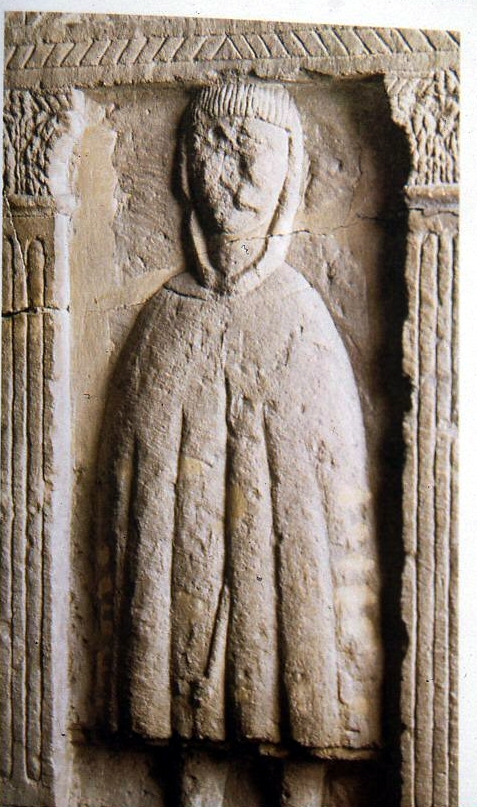
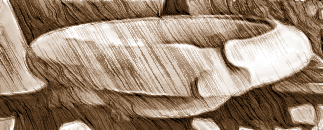
To illustrate rainwear in the Roman period and to illustrate winter showing Philu from Cirencester
Tombstone of Philus from Cirencester (Corinium Dobunnorum) showing his rain cloak

Feralia & Parentalia

Feralia is the last day of Parentalia a 9-Day Festival for the spirits of the Dead. It is described in some detail by the Roman Poet, Ovid, in his Almanac of the year called the ‘Fasti’. Here, he describes how to honour a parent:

And the grave must be honoured. Appease your father’s
Spirits, and bring little gifts to the tombs you built.
Their shades ask little, piety they prefer to costly
Offerings: no greedy deities haunt the Stygian depths.
A tile wreathed round with garlands offered is enough,
A scattering of meal, and a few grains of salt,
And bread soaked in wine, and loose violets:
Set them on a brick left in the middle of the path.
Not that I veto larger gifts, but these please the shades:
Add prayers and proper words to the fixed fires.

There is much more Ovid says about Feralia, and you can read it for free, in translation by A. S. Kline (which I used above, at www.poetryintranslation.com)

For more about Parentalia look at my earlier post about the February festivals of the Romans.

Roman Cemeteries in London

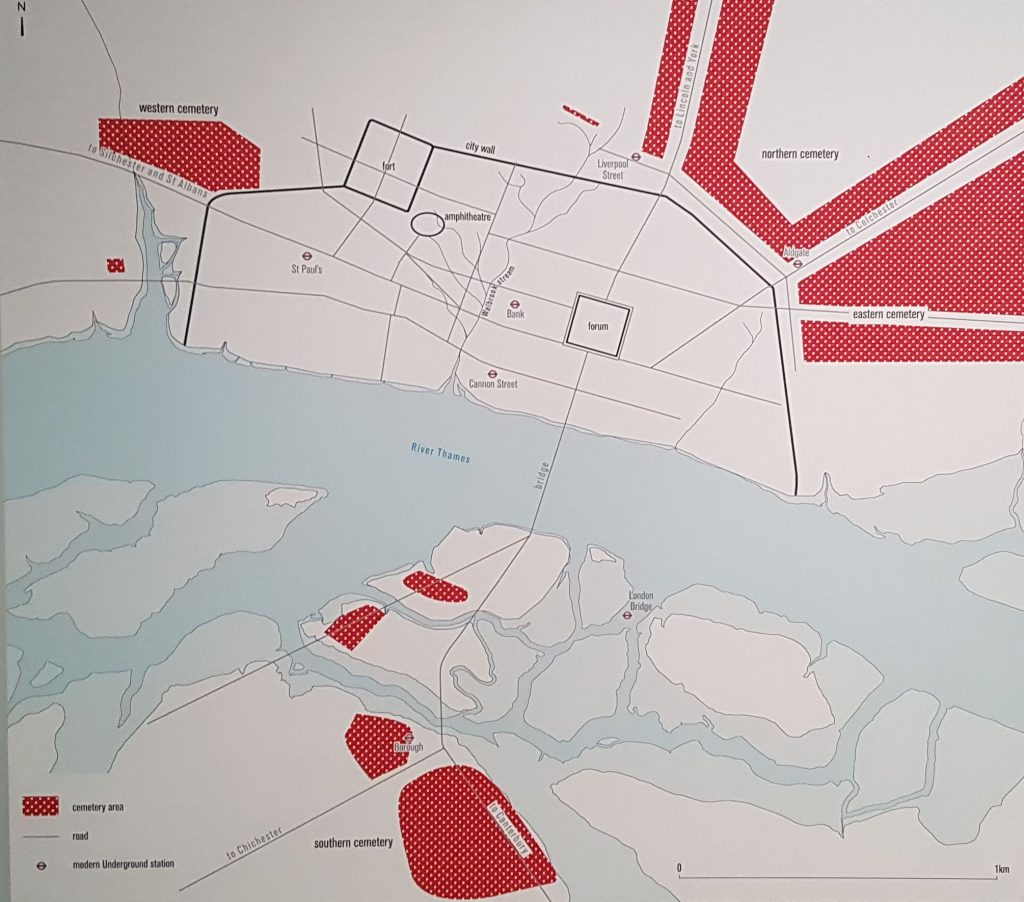
In London, archaeologists have found many Roman cemeteries around the City of London. The Romans forbade burial inside the City limits. So, the dead were buried alongside the main roads out of the City Gates. Aldgate towards Colchester, Bishopsgate to the North. Ludgate along Fleet Street to the West. Newgate to Holborn and the North West. From London Bridge to Southwark and the South. These are the places that parents would be remembered at Feralia.

Map of Roman Cemetaries from Museum of London exhibition on the Roman Dead
Map of Roman Cemeteries from the Museum of London exhibition on the Roman Dead, showing the River Thames and River Fleet. Holborn is to the left, marked ‘Western Cemetery’.

Roman Burials

Roman Mortaria

Various rites have been observed. Both inhumation and cremation were practised. I remember excavating a Roman mortaria with a hole in the bottom with the ashes of the dead in it. These large bowls were used as a mortar for grinding foodstuffs. The bottom was deliberated gritted, but they often wore through, and sometimes were reused to hold cremation ashes. I like to imagine, granny being buried in her favourite cooking vessel (or maybe a grandad who baked?).

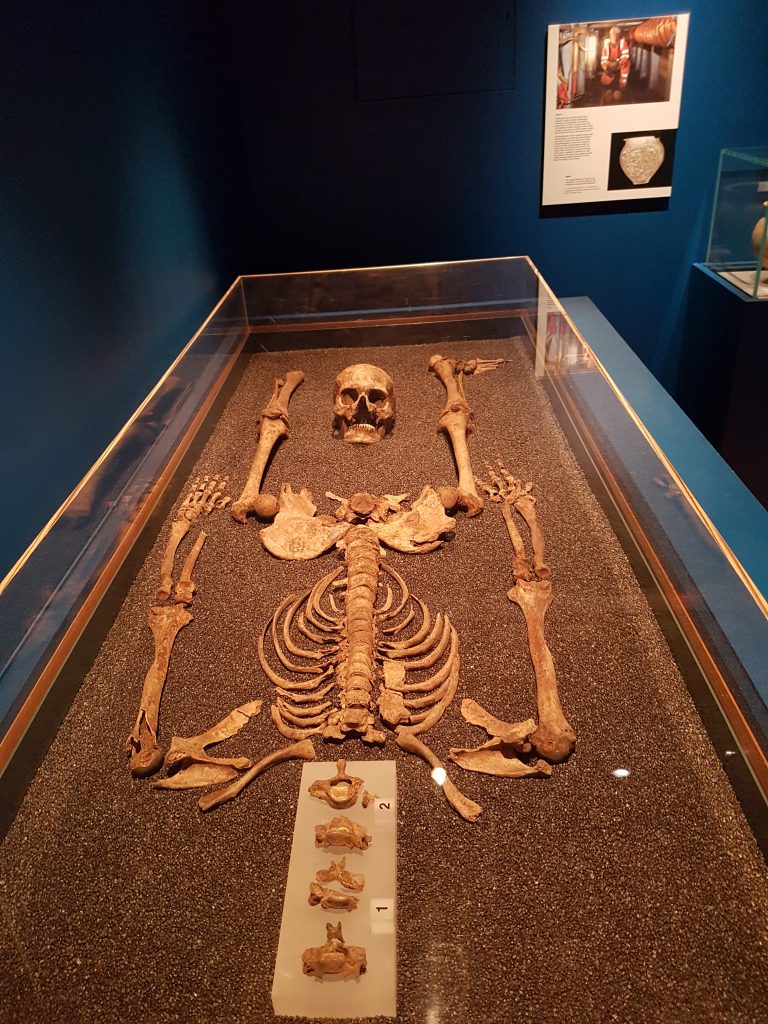
Many bodies were covered in chalk, perhaps to help preserve the body. A surprising number of bodies are found with the head by the knees. The large number of cases fuels speculation that this was a burial rite, of whom only a percentage were beheaded as a punishment. In York, near Micklegate archaeologists found a large number of beheaded graves in a cemetery thought to be of gladiators. Other graves shown signs of a funeral pyre.

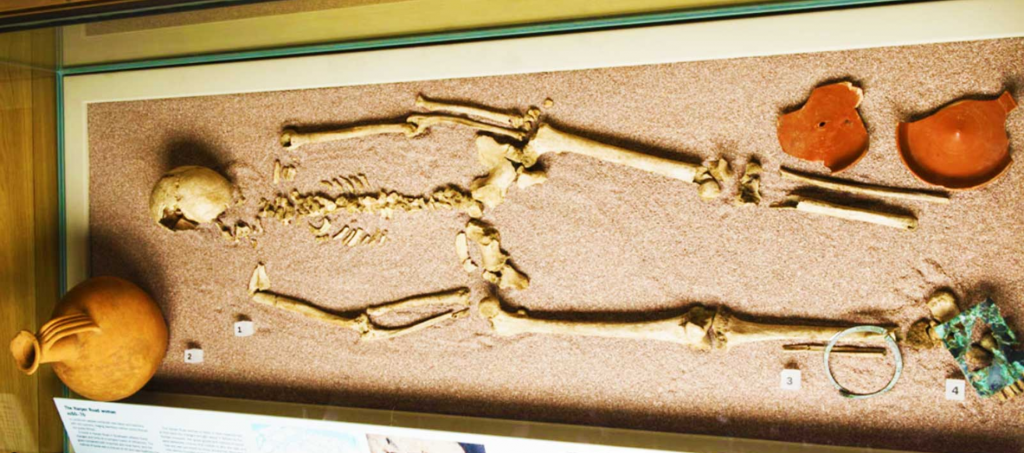
Author’s photograph of a skeleton displayed at the Roman Dead Exhibition, Museum of London, She was between 26 and 35 years old, who lived a hard life, and possibly had anaemia. Her head was severed either: before and causing death, or shortly after death, and placed between her legs as shown.

Procurator Classicianus.

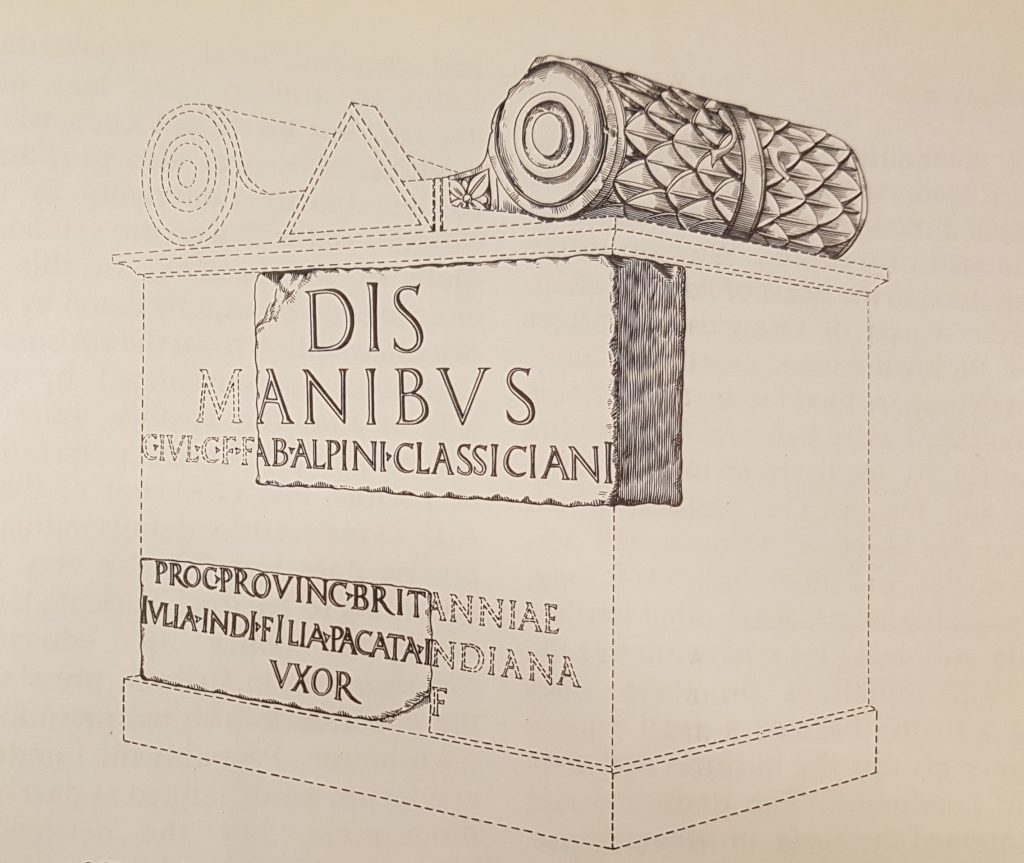
The rich and powerful were remembered with huge monuments, prominently sited along the main roads. The most famous are the burial stones found at Tower Hill of the Procurator Classicianus. What makes this special is that he is mentioned in Roman accounts of the Boudiccan Revolt of AD 60-61. He suggested to Nero that the Province would only be saved if the revenge against the British was de-escalated. Nero wisely withdrew the vengeful Roman Governor Suetonius Paulinus and replaced him with someone ready to conciliate. The Romans held the province successfully for 350 years or so more.

Reconstruction drawing of two stones found while building Tower Hill Underground Station. They read, something like, ‘To the Spirits of the Dear Departed Fabius Alpini Classicianius, Procurator of the Province of Britannia.Julia, Indi (his wife) Daughter of Pacata of the Indiana voting tribe. Had This Set up.
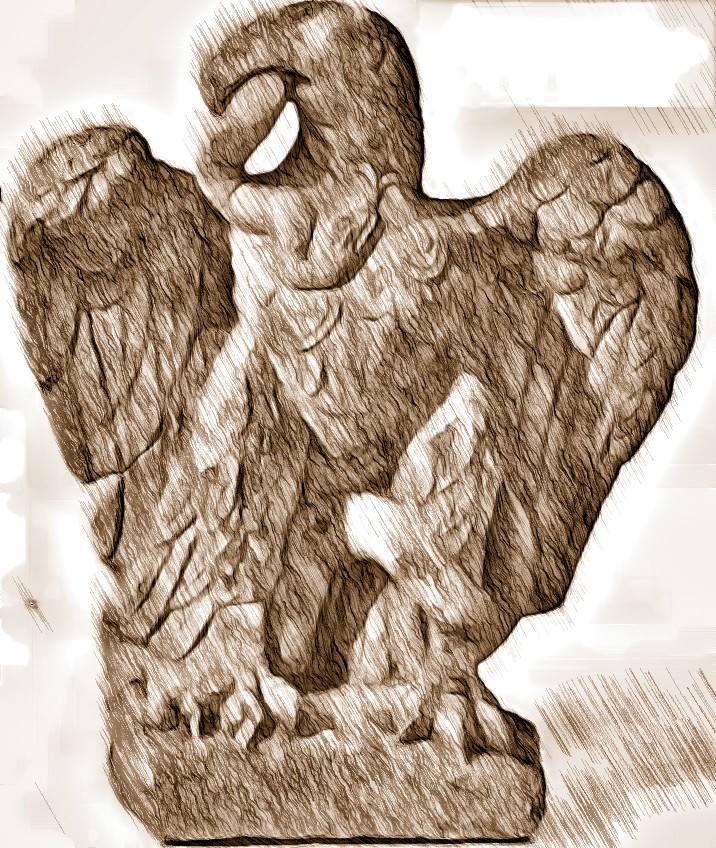
Sketch of a stone Eagle found in 2013 at an excavation at the Minories just outside the eastern side of the Roman Wall in the City of London.

A beautiful carved eagle which adorned a tombstone was found in the Cemetery in Tower Hamlets. Recently, a very grand mausoleum was excavated in Southwark. To find out more, have a look at the BBC website here:

Funerary Bed in Holborn

Finally, a couple of years ago an excavation ran by MOLA discovered a ‘funerary bed’ just outside Newgate in Holborn. It was on the banks of the River Fleet, a tributary to the River Thames. The fluvial location meant that there were extraordinary levels of preservation, which included this bed. It was dismantled and buried in the grave. It may have been a bed used as a grave good, perhaps for use in the hereafter. Or it might have been the bed upon which the deceased was carried to the funeral. (Or both?)

sketch of Roman 'Funerary' Bed found dismantled in Holborn, London
Reconstruction of a Roman ‘Funerary’ Bed found dismantled in Holborn, London (Sketch from a MOLA reconstruction drawing)

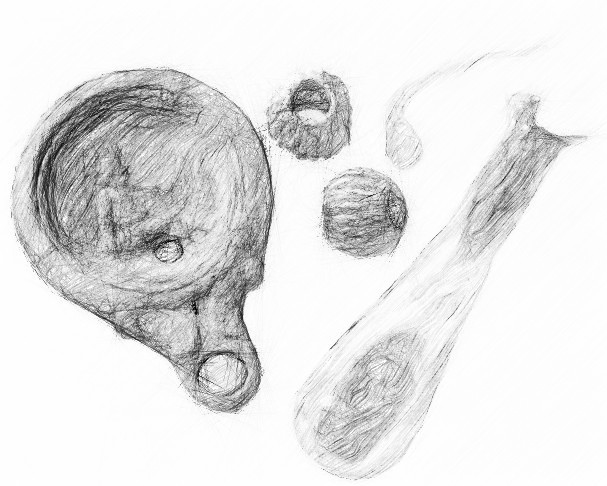
They found other grave goods. These included an olive oil lamp decorated with an image of a gladiator; jet and amber beads and a glass phial.

Sketch of Roman burial goods from Holborn 2024
Sketch of Roman burial goods from Holborn, London

For more look at www.mola.org.uk/discoveries

On This Day

1804 – Richard Trevithick‘s steam locomotive is put on wheels at the Pen-y-Darren Ironworks in Wales. and shows its capability for pulling heavy loads. Unfortunately, the Engine weighs so much it breaks the rails, so the wheels are taken off.

Toad, Frogs & Newts Migration – as the weather warms up a little, later in February is when the amphibians wake up from hibernation, and begin their annual migration to their home pond for spawning. They may walk/hop/slither up to 2 kilometres. The kind people at www,froglife.org coordinate Toad Patrols to help toads across the roads that have sprung up along their traditional migration paths.

In the Garden – prune deciduous shrubs such as Buddleia and Spiraea. Sow seeds indoors. Order lots of compost.

First Published in February 2024, revised 2025, On this Day added 2026

Ash Wednesday

Ash Wednesday Forehead Ash Cross.  Photo by Ahna Ziegler on Unsplash

Lent & Ash Wednesday

Ash Wednesday this year is early and on 18th February.  It is the First Day of Lent, the solemn time which runs up to Easter, and is symbolic of Jesus’ 40 days in the wilderness.

In Anglo Saxon the name for the season of Spring was ‘lencthen’. It is thought to derive from the idea of the lengthening days. Days do suddenly seem to have got longer. These are the official times for the evening:

Sunset: 17:21

Dusk (Civil twilight ends) : 17:55

Nightfall (Nautical twilight ends) :18:34

Full Darkness starts (Astronomical twilight ends) : 19:13

Did you know it was that complicated? But https://www.thetimeandplace.info/uk/london-city-of-london does.

Quadragesima

So strictly, Lent means Spring. The Romance languages use the term which derives from the Latin ‘Quadragesima’ which means the 40 days of Fast. Spanish (Cuaresma), French (Carême), and Italian Quaresima). For Germans, it is the fasting time: fastenzeit. In England, Lent became a specialised word for the fast period. And Spring took over as the name of the season.

A time of fasting? Time for reflection? Maybe once upon a time. When I was young, it was 40 days when you were supposed to give something up. Smoking, or drinking, or chocolate. An idea taken up by a new generation, as, for example, Dry January? A time of reflection? No, never did that.

Dust to Dust and Stardust

Ash Wednesday is named after the ashes smeared on the heads of worshippers to remind us that we are dust. I’ve never seen this done either. My footballing Vicar friend Andrew missed our Wednesday Game so that he could mark foreheads with ash crosses. The ashes were traditionally made from palms used for Palm Sunday decorations, which is indeed what Andrew did. Look here to see my post on Palm Sunday.

In the midst of life we are in death, earth to earth, ashes to ashes, dust to dust, in sure and certain hope of the Resurrection.

Thomas Cranmer

On the subject of dust, here are some spiritual lyrics by Joni Mitchell. Something profound in the true idea that we are all stardust.

We are stardust
We are golden
And we’ve got to get ourselves
Back to the garden

Woodstock by Joni Mitchell

40 Days

We all know that there are 40 days in Lent, except there are not. It’s 46 this year. This was pointed out by Tim Harford who presents a BBC radio programme called ‘More or Less’. It is a programe about statistics, or more widely about Fact Checking statistics in the news. Last year he discussed the 40 days. One answer proposed was to take away Sunday. But, my mathematics tells me this still leaves 42. The answer Tim Harford came up with is that 40 days just means a long time.

It is the length of time of Lent, but also:

The duration of the Great Flood
The time Moses was on Mt Sinai
The time the Israelites spy on Canaan
Goliath trails Saul
Elijah Walks
Jesus is tempted n the Desert
The time from Resurrection to Ascension

In other words, a long time to be doing any one thing. As Hartford says, it’s like our word ‘umpteenth’. As in ‘Kevin this is the umpteenth time I’ve told you to tidy your bedroom’. That’s what my mother said to me as she threw my clothes out of the window.

Read about Shrove Tuesday in my post here. To read about the ‘Month of Purification’ in Latin.

First published 2024, revised 2025, 2026

The Festival of Fools, Fornacalia and Fornication February 17th

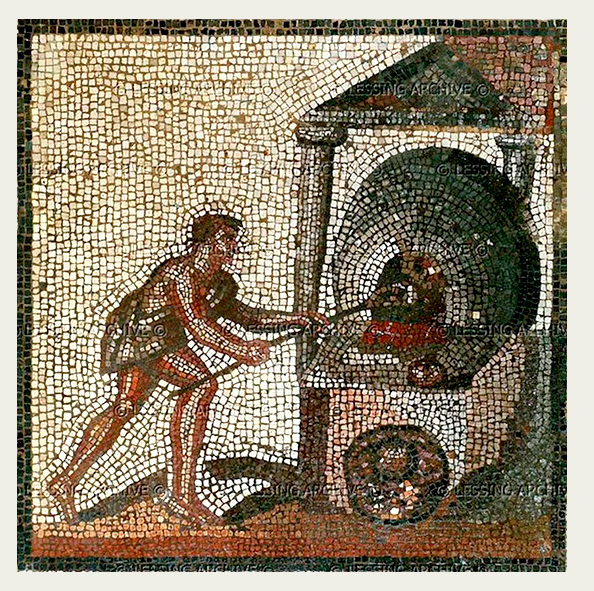
Mosaic of a man taking a loaf of bread out of a bread oven
Mosaic of Roman Bread Oven France

Fornacalia was a corn festival that took place around February 7th to the 17th. Romans were assigned individual days to celebrate (see below) but the last day, today, was reserved for those fools who did not know their proper day.

Pliny the Elder says it was King Numa Pompilius (753-673 BC), who established Fornacalia, The Feast of Ovens. Fornacalia celebrated Fornax who was the Goddess of the Oven – specifically the grain oven for drying grain. The word for oven is also Fornax, from which we probably derive our word furnace.

Organising the Fornaclia and the Curio Maximus

The Festivals in Rome were organised by the Curio Maximus who was a priest who supervised the curiae. In Rome the citizens were arranged, originally, into the 3 ancient tribes of Rome (founded in the 8th Century BC). The Tribes were supposed to represent the ancient ethnic groups. These were the Ramnes the Latin population, the Tities the Sabines, and the Luceres the Etruscans. The tribes were then divided into 10 curiae each. So there were 30 curiae.

Each Roman was supposed to be assigned to one of the curiae, which had a religious, social and voting function. The name may come from ‘co-viria – a gathering of men’. The members of the curiae were known as curiales. Each curiae had their own priest, or curio, and assistant priest ‘flamen curialis‘. And they organised the religious ceremonies of the curiae. They met in a meeting place called the curia.

So the Curio Maximus would declare when a festival was to be held, and get the curiae to organise the celebrations at the curia. I hope you are still with me! They would choose a date, for example for the Fornacalia, between about the 7th Feb and the 17th of February. And the citizens would go to their curia where there would be a ceremonial roasting of the grain, and baking into bread which would be in honour of the Goddess Fornax.

Ovid & the Feast of Fools

Ovid, who wrote his almanac poem on the Roman festivals (Fasti), reveals many of these details. This is what he says:

Learn too why this day is called the Feast of Fools.
The reason for it is trivial but fitting.
The earth of old was farmed by ignorant men:
Fierce wars weakened their powerful bodies.
There was more glory in the sword than the plough:
And the neglected farm brought its owner little return.
Yet the ancients sowed corn, corn they reaped,
Offering the first fruits of the corn harvest to Ceres.
Taught by practice they parched it in the flames,
And incurred many losses through their own mistakes.
Sometimes they’d sweep up burnt ash and not corn,
Sometimes the flames took their huts themselves:
The oven was made a goddess, Fornax: the farmers
Pleased with her, prayed she’d regulate the grain’s heat.
Now the Curio Maximus, in a set form of words, declares
The shifting date of the Fornacalia, the Feast of Ovens:
And round the Forum hang many tablets,
On which every ward displays its particular sign.
Foolish people don’t know which is their ward,
So they hold the feast on the last possible day.


Book II: February 17 From: Fasti, Book 2. Translated by A.S Kline and available here

For more information: www.vindolanda.com/blog/celebrating-the-fornacalia wikipedia.org/wiki/Fornacalia

Fornication

I am led to believe that the Roman word for the person who looked after a furnace was the fornicator. And as heat was a ’cause’ of lust, fornicators well, they fornicated.

However, others derive the word from the word Fornix, which is an arch. And arches, it was said, was where the Brothels were, hence fornicator. Not sure that I’m going with the idea that Brothels were always under arches. Below is what the online etymology dictionary’s definition which might help you make up your mind:

from Late Latin fornicationem (nominative fornicatio), noun of action from past-participle stem of fornicari “to fornicate,” from Latin fornix (genitive fornicis) “brothel” (Juvenal, Horace), originally “arch, vaulted chamber, a vaulted opening, a covered way,” probably an extension, based on appearance, from a source akin to fornus “brick oven of arched or domed shape” (from PIE root *gwher- “to heat, warm”). Strictly, “voluntary sex between an unmarried man and an unmarried woman;” extended in the Bible to adultery. The sense extension in Latin is perhaps because Roman prostitutes commonly solicited from under the arches of certain buildings.

As you can see, it’s a big old mix-up of arches, brothels, brick ovens, all quite unconvincing, so I’m sticking with my over-heated stoker theory. To find out more about Ovid and his Almanac look at my post here.

The Annona

Rome had a population of one million people, and keeping them fed was a difficult task. So the celebration of Fornacalia was an important feast designed to protect Rome’s all important grain supply. The Imperial Government took on the responsibility of providing the grain in a system called the Annona. and provided the Citizens with free bread. The Italian Annona brought much of its grain from Egypt.

Londinium & the Annona

Dominic Perring in his recent book on Roman London (Londinium in the Roman Empire) speculates that the fluctuating fortunes of London was dependent upon the routing of a northern Annona through Londinium. When the Emperor was engaged with the North Western Empire London thrived, when he wasn’t interested it declined.

On This Day

1634 – Puritan author William Prynne was sentenced in the Star Chamber for publishing “Histrio-masti”, criticising the theatre (and criticising Bishops). This was one of various trials he faced in the Star Chamber. The Star Chamber was not a normal court, with a Jury but was the instrument of repression by Charles I’s autocratic regime. Prynne had already been imprisoned in the Tower of London for a year. On the 17th February he was sentenced to: imprisonment for life; £5,000 fine; expelled from Lincoln’s Inn (i.e. deprived of the right to practice law); deprived of his Oxford degree; to have his ears cut off; to be pilloried at Westminster and Cheapside in the City of London. Oh and branded on the Cheek with S.L (Seditious Libeller).

1864 – The CSS H. L. Hunley, a Confederate vessel, is the first submarine to sink a warship, the USS Housatonic.

First published February 2023. Revised and republished 17th February 2024, 2025, On This Day added 2026

New Irish Bank Holiday for St Bridget/Imbolc! Ist Monday in February

The celtic year shown as a circle
The Celtic Year showing Imbolc, the new Irish Bank Holiday

I just came across this which I published last in 2023. I should have republished it last weekend. But here it is. The Irish created a brand new Bank Holiday for St Bridget. The first one was Monday 6th February 2023. It followed a public holiday given in 2022 for Health Workers in March. The timing of the Bank Holiday is explained by the Irish Post:

St Brigid’s Day itself falls on February 1 each year but going forward the Imbolc/St Brigid’s Day public holiday will fall on the first Monday in February, unless February 1st falls on a Friday.

This means that Ireland now has a public holiday on the 4 Celtic festivals of Samain (Halloween), Imbolc (St Bridget’s Day), Beltane (May Day) and Lughnasa (Lammas Day). These festivals are quarter-days, which mean they fall halfway between the Solstices and Equinoxes.

The Independent wrote that ‘then-Tánaiste, Leo Varadkar, said‘ ….“This will be the first Irish public holiday named after a woman.”  He also is quoted as saying:

“It marks the half-way point between the winter solstice and the equinox, the beginning of spring and the Celtic New Year.”

Extra Bank Holidays in the UK?

There are occasional calls for a new Bank Holiday in the UK. It’s often a Conservative MP calling for a National Day for the British. More often than not they suggest Trafalgar Day 21st October would be a suitable date. This commemorates the great Naval battle in 1805 in which Nelson was fatally wounded. It has several virtues in their eyes. Firstly, it is a day that confirmed Britain’s mastery of the Seas , an ideal day for celebrating patriotism. Secondly, it is the school half-term, and gives a much-needed day off between summer and Christmas. Thirdly, they can propose the day should be taken from the May Day Bank holiday. This coincides with the International Worker’s Day, which is obviously ‘a bad thing’.

Here is an example: the MP for Portsmouth MP’s supported a call for Trafalgar Day here: . The report says: ‘there are currently no bank holidays in the UK which celebrate battles or war victories’. (Portsmouth News 2016).

This, I think, leaves the rest of us thinking: ‘What planet do these people live on?’ Yes, Trafalgar Day would have been a great day for a Bank Holiday, if this were 1839. Maybe even 1939. But now Trafalgar is just not on any ordinary person’s radar. We don’t think so very much about the Napoleonic War or Nelson. Nor do we often sing ‘Heart of Oaks, are our Men’ any more. In short, it is a reminder how distant from the rest of us some MPs are. By contrast, how progressive Ireland seems.

Productivity

The Trade Union Congress proposed the need for more bank holidays. We only have the usual eight annual bank holidays for workers in England and Wales. Scotland has nine or ten; the average for the EU is ‘12.3 bank holidays a year. Finland and Romania get 15, while workers in Japan have 16 public holidays in total’.

A radio programme ‘The Bottom Line’ compared productivity in Britain and France. It revealed that Britain is now 20% less productive than France, (10% worse since Brexit). And how do we make up that productivity deficit? Yes, indeed, by working longer hours for lower wages. It appears that the French high tax, high workers’ protection regime, means they have to find ways of getting more out of their workers in their working hours. While we can just hire and fire, and are happy to make people work in a more inefficient way. Strange isn’t we are told that the French economy is a victim of socialism. Turns out Socialism is more productive.

Here is my recent post about St Bridget’s Day

First Published February 2023, Republished 2026

Festival of Imbolc, St. Bridget’s Day February 1st

Imbolc and St Bridget’s Day

Today is Imbolc, one of the four Celtic Fire Festivals. It corresponds with St Bridget’s Day, which is a Christian festival for the Irish Saint, and is the eve of Candlemas. Bridget is the patron saint of all things to do with brides, marriage, fertility, and midwifery (amongst many other things, see below). And in Ireland, 2026 was the third St Bridget’s/ Imbolc Day Bank Holiday.

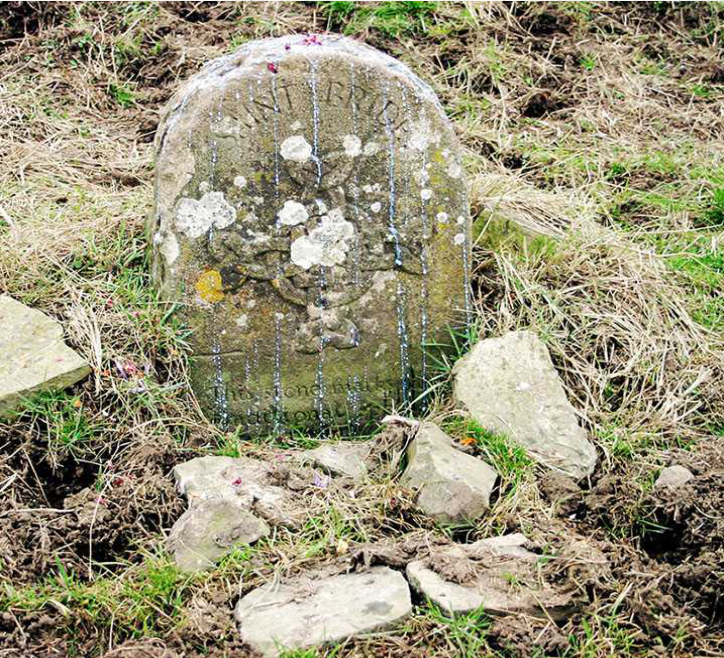
St Bride,s Statue St Bride's Church. Fleet Street
St Briget or St Bride’s Statue, St Bride’s Church. Fleet Street from K.Flude’s virtual tour on Imbolc

St Bridget, aka Briddy or Bride, converted the Irish to Christianity along with St Patrick in the 5th Century AD. Despite being a Christian, she appears to have taken on the attributes of a Celtic fertility Goddess. Her name was Brigantia, and it is difficult to disentangle the real person from the myth.

Brigantia

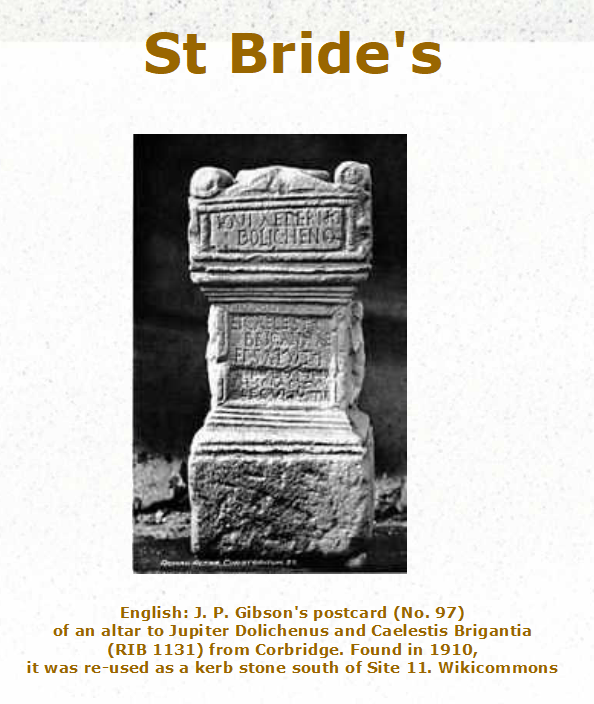
Archaeologists have found various Roman altars dedicated to Brigantia. The Brigantes tribe in the North are named after the Goddess (probably). They were on the front line against the invading Romans in the 1st Century AD, and led by Queen Cartimandua.  The Queen tried to keep her tribe’s independence by cooperating with the Romans. A few years later, Boudica took the opposite strategy. But both women had executive power as leaders of their tribes. This suggests a very different attitude to woman to the misogyny of the Romans.

altar to Brigantia
Altar to Brigantia from K Flude’s virtual tour on Imbolc

Wells dedicated to St Bridget

St Bridget's Well Glastonbury
St Bridget’s Well, Glastonbury

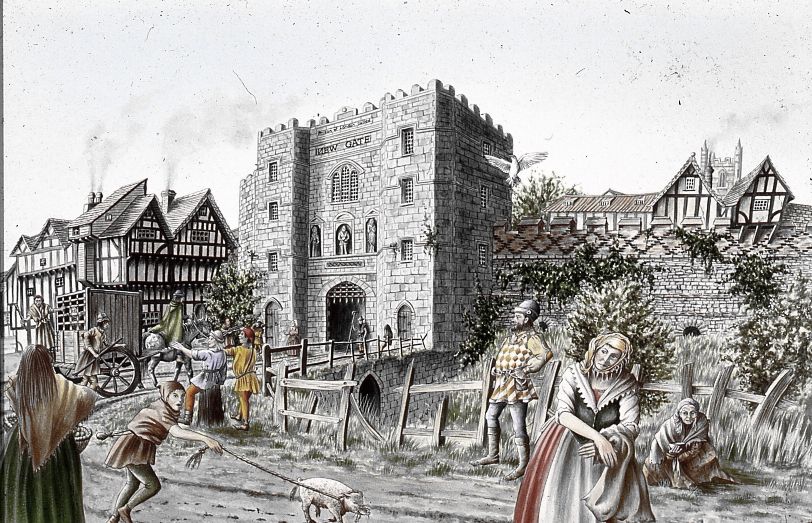
St Bride is honoured by many wells dedicated to her. Often they are associated with rituals and dances concerned with fertility and healthy babies. And perhaps, the most famous, was near Fleet Street. This was Bridewell, which became the name of Henry VIII’s Palace, and later converted into an infamous prison. St Bride’s Church, built near to the Well, has long been a candidate as an early Christian Church. Sadly, the post World War Two excavations found nothing to suggest an early Church. But, they did find an early well near the site of the later altar of the Church, and remains of a Roman building, possibly a mausoleum. Perhaps the Church may have been built on the site of an ancient, arguably holy, well. However, this is only a guess.

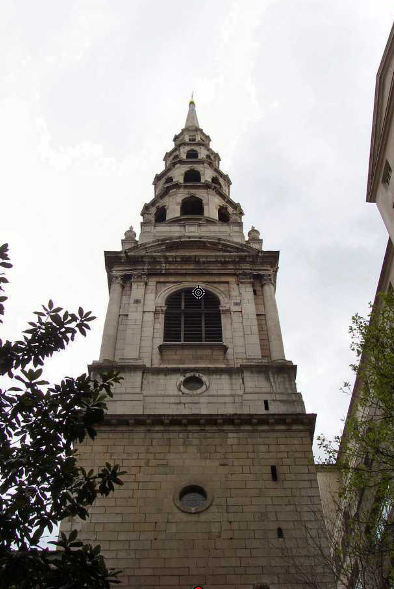
Steeple of St Brides Fleet Street
Steeple of St Brides Fleet Street, photo K Flude

The steeple of St Brides is the origin of the tiered Wedding Cake, which, in 1812, inspired a local baker to bake for his daughter’s wedding.

February signs of life

Imbolc and St Bridget’s Day are the time to celebrate the return of fertility to the earth as spring approaches. In my garden and my local park, the first snowdrops are out. Below the bare earth, there is a frenzy of bulbs and seeds budding, and beginning to poke their shoots up above the earth, ready for the Spring. In the meadows, ewes are lactating, and the first lambs are being born.

Violets, bulbs, and my first Daffodil of the year. Hackney (2022), London by K Flude

And let’s end with the Saint Brigid Hearth Keeper Prayer Courtesy of SaintBrigids.org

Brigid of the Mantle, encompass us,
Lady of the Lambs, protect us,
Keeper of the Hearth, kindle us.
Beneath your mantle, gather us,
And restore us to memory.
Mothers of our mother, Foremothers strong.
Guide our hands in yours,
Remind us how to kindle the hearth.
To keep it bright, to preserve the flame.
Your hands upon ours, Our hands within yours,
To kindle the light, Both day and night.
The Mantle of Brigid about us,
The Memory of Brigid within us,
The Protection of Brigid keeping us
From harm, from ignorance, from heartlessness.
This day and night,
From dawn till dark, From dark till dawn.

For more about go to this webpage St Bridget. To read my post on Mary Musgrove’s Candlemas Letter in Jane Austen’s Persuasion follow this link.

Imbolc and Myths and Legends Walks

I give walks about Imbolc and other Celtic festivals, and at May Eve, the Solstices, Equinoxes, Halloween and Christmas (when I have time). You might like to attend these walks or virtual tours. The following are currently in my calendar. I will be adding other walks to the calendar as the year progresses.

The Spring Equinox London Virtual Tour 7.30pm Fri 20th March26 To book

The London Equinox and Solstice Walk 2:30pm Sat 21st March26 To book

For more of my walks see the walks page of this blog here: https://www.chr.org.uk/anddidthosefeet/walks

First published in 2023, revised and republished Feb 2024, 2025, 2026

British Exceptionalism Brexit Day January 31st

Today is the Anniversary of the day Britain left the European Union in 2020. It is possible to argue the case that one of the reasons so many people were willing to vote to leave the Union was English or British Exceptionalism. I think most people would be thinking of Winston Churchill and World War 2, and the British Empire. But you can argue a case that there has long been important distinctions between Britain and Europe.

I find it amusing that we left Europe at 11pm on January 31st 2020, which was midnight in the European Union. See the BBC round up on Britain and Europe.

This Island Story

When I was at school, there was a lot of emphasis on Great Britain being an Island. This is rarely emphasised in the 21st Century. But it was part of the Imperial story of the British Empire and helped distance ourselves from ‘the Continent’.

That Island story didn’t begin until the Mesolithic period. Before that, Britain was physically part of Europe, and the Thames was but a tributary of the Rhine. Then the land bridge that is now called Doggerland was swept away by rising meltwater. By 8,000 years BP. Britain was an Island.

Around 4000BC, the so-called Neolithic Revolution spread farming throughout Europe. But, the Channel acted as a barrier. So, it took an extra hundred years or so for farming to begin to penetrate Britain. The early farmers brought with them not only the domestic animals, crops, pottery and ground axes but also a new form of housing consisting of long, rectangular wooden houses. The DNA of the people of Britain, was radically changed and the so-called Western Neolithic DNA mostly took over. Strangely, the long house did not survive very long as a popular design. Britain while accepting the new farming technology, seem to have reverted to their own form of housing

Post Roman divergence?

While most major style and technology changes over the next 4 millenia were shared with Europe, Britain often had its own versions. Britain shared with Europe the adoption of the Celtic Languages and eventual integration into the Roman Empire. But, when the western part of the Roman Empire fell in the 5th Century, Britain had a different experience to much of Europe. On the face of it, a similar sequence happened. The Western Empire was taken over by Germanic Kings. The Franks in France and Germany; the Anglo Saxons in England; the Lombards in Italy and Goths, Visigoths, Vandals in Spain (and N. Africa). A similar sequence on the surface.

But on the mainland the German Kings allowed the local cultures to continue and adopted the Latin language, and Christian religion as their own. They maintained a strong tradition of Roman law and culture. French, Italian, Spanish, Rumanian are all romance languages based on Latin.

But across the Channel to England, it was different. Our German Kings didn’t adopt the Latin language and the native Celtic dialects died out (except of course in Cornwall, Wales, Scotland and Ireland ), They also maintained their pagan beliefs. So English culture is Germanic and not Roman. We do not have a foundation in Latin culture and Roman law. This is very different to western Europe.

Napoleon founder of modern Western Europe

Of course the Anglo-Saxons eventually soon adopted Christianity. In the 16th Century Britain turned against the universal Catholic Church. This was a rupture that had a similar impact to Brexit. But the next really significant difference was the changes instituted by Napoleon. He subdued then rationalised and liberalised the continent. He had dreams of a United Europe of Nations (in contrast to the Empires that held sway (such as the Holy Roman Empire, and the Austro-Hungarian Empirehttps://www.napoleon-series.org/research/napoleon/c_unification).

Most legal systems in Europe are based on Roman Law as amended by the Napoleonic code. England by contrast is based on the Common Law.

So these differences combined with our arrogance derived from Empire, the Industrial Revolution and belief we won World War 2. And our cultural pride based on our perception of the preeminence of people such as Shakespeare, Newton and Darwin etc etc). All this probably lay behind ‘British Exceptionalism’. This helped a nationalistic and misguided belief that we are held back by Europe despite all the evidence to the contrary.

And the future?

Opinion polls make it clear that most people think Brexit was a mistake, and they blame it on the Conservatives, Boris Johnson and Nigel Farage. Economists are clear the damage it has done to Britain’s financial position. And yet the main parties have been very reluctant to consider a return to Europe. Instead, Sunak and Starmer have tried to sort problems out on a case by case basis, without suggesting we go back into the European Union.

However, there is a dawning awareness that Europe cannot depend upon the US playing its usual leading role in maintaining the international status quo, and this may accelerate our move back towards Europe. Canadian Prime Minster Carney is proposed the formation of an alternative economic alliance to replace dependence on the US, and this may be our route back into the European Single Market.

Advice for Lambs

From ‘ FIUE HUNDRED POINTES OF GOOD HUSBANDRIE. BY THOMAS TUSSER.

The Edition of 1580 collated with those of 1573 and 1577.

Januaries husbandrie.

Yoong broome or good pasture thy ewes doo require,warme barth and in safetie their lambes doo desire.Looke often well to them, for foxes and dogs,for pits and for brembles, for vermin and hogs.

More daintie the lambe, the more woorth to be sold, the sooner the better for eaw that is old. But if ye doo minde to haue milke of the dame, till Maie doo not seuer the lambe fro the same.

Ewes yeerly by twinning rich maisters doo make, the lamb of such twinners for breeders go take. For twinlings be twiggers, encrease for to bring, though som for their twigging Peccantem may sing.

Note ewes who had twin lambs were thought to be better and fetched more at market. They were called twinlings.

On This Day

1606 – Guy Fawkes and fellow conspirators are hanged, drawn and quartered for plotting to blow up Parliament and King James. See my post on the Gunpowder Plot.

1865 – Congress passes the Thirteenth Amendment to the United States Constitution, abolishing slavery.

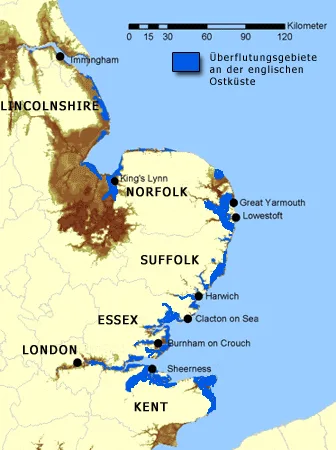
1953 – The North Sea Flood assail the east coast of Britain killing 280 people. ‘The combination of wind, high tide, and low pressure caused the sea to flood land up to 5.6 metres (18 ft 4 in) above mean sea level.’ (Wikipedia).

Map of
Map illustrating the extent of the Great Flood of 1953 in the United Kingdom
Deutsch: Sturmflut von 1953 Date 25 September 2008 Source: Draco. GNU Free Documentation License

You might like to see some great pictures of the floods here.

First Published 2025, revised and OnThis Day added 2026
Pax, the Concordia Peace Festival, Elagabalus, and Carausius January 29th

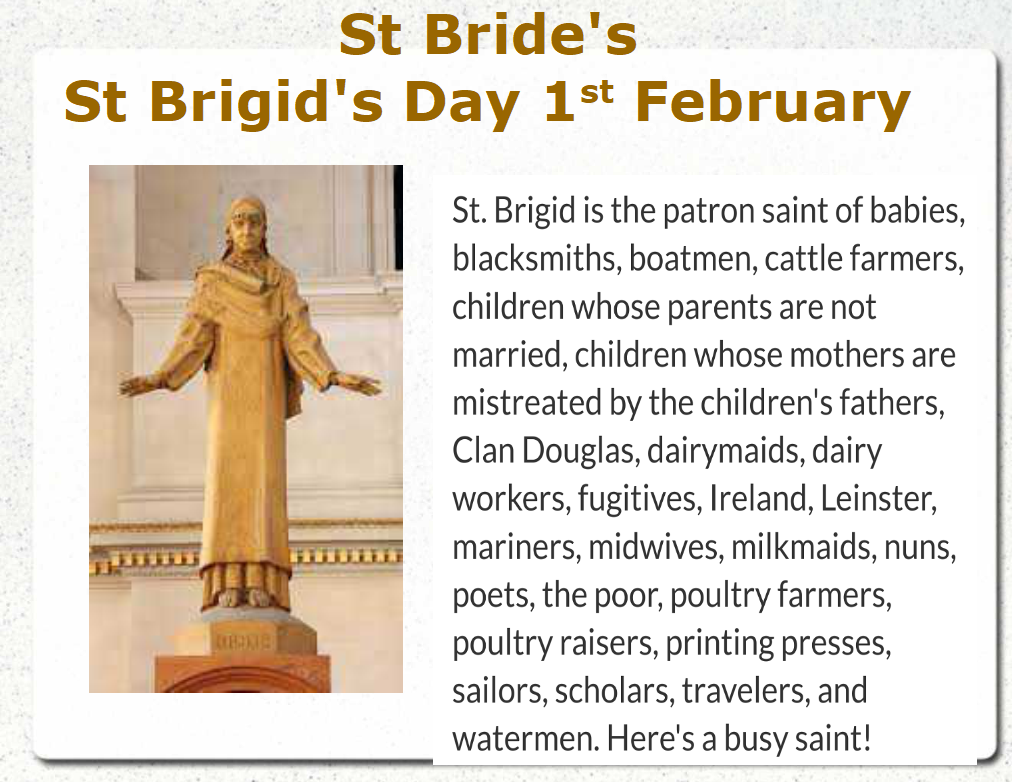
Photo from ebay sale of coin of Carausius, showing the reverse with image of the Roman Goddess Pax.

The Goddess Book of Days (Diane Stein) lists today as the birthday of Pax and her Greek equivalent Irene. She is the Goddess of Peace and the daughter of Jupiter and the Justitia, Goddess of Justice. This suggests that a lasting peace can only be assured by strength and justice. The usurping Emperor Carausius (whose coin you can see above) had good reason to use Pax on his coins. He took control of Britain and some of Gaul from the Roman Empire. But he hoped he might rule alongside the Tetrachy of Emperors set up by Diocletian.

This is what Eutropius wrote:

Image of a quotation by Eutropius translation from 'Literary Sources for Roman Britain.' and from
Page from ‘In Their Own Words’ by Kevin Flude

He was murdered by Allectus, his financial minister in 296AD. Text above taken from my book In Their Own Words where you can read the rest of Carausius’ story.

Concordia

The Goddess book also says this is the day of the Concordia Peace Festival in Rome. Concordia is the Goddess of agreement, in war, marriage and in civic society. Harmonia is the Greek equivalent. Ovid has special days to Concordia on January 17th and January 30th. I’m led to the idea that much of January was dedicated to Concordia and Pax. For more on Concordia, look at my January 17th post here.

Pax in Ovid

Pax had her festival on the 30th January. Ovid in Fasti writes:

Book I: January 30
My song has led to the altar of Peace itself.
This day is the second from the month’s end.
Come, Peace, your graceful tresses wreathed
With laurel of Actium: stay gently in this world.
While we lack enemies, or cause for triumphs:
You’ll be a greater glory to our leaders than war.
May the soldier be armed to defend against arms,
And the trumpet blare only for processions.
May the world far and near fear the sons of Aeneas,
And let any land that feared Rome too little, love her.
Priests, add incense to the peaceful flames,
Let a shining sacrifice fall, brow wet with wine,
And ask the gods who favour pious prayer
That the house that brings peace, may so endure.
Now the first part of my labour is complete,
And as its month ends, so does this book.

Translated by A. S. Kline 2004 (Tony has a lovely site here: where he makes his translations freely available.)

Concordia, Julia Aquilia Severa & Elagabalus

Roman coin, showing both sides, of the Goddess Concordia
A patera is a sacrificial bowl, and a cornucopia is a horn of plenty (Image from Wikipedia)

The coin above is of Empress Julia Aquilia Severa. She was a vestal virgin, who married the Emperor Elagabalus (c. 204 – 11/12 March 222). She was his 2nd and 4th wife. Normally, the punishment for a vestal Virgin losing their virginity was to be buried alive.

The Trouble with Pronouns

But I could have said ‘her 2nd and 4th wife’. Some sources suggest Elgabalus wanted to be known as a woman. The Wikipedia page of his wife has Elagabalus with the pronoun, ‘Her’. While the Emperor’s own web page uses ‘him’ throughout. He or she married several women. And also married to several men. They were also accused of prostituting himself in Taverns and Brothels. Clear? Confusing pronouns? Sorry to hedge my bets, but we don’t know what Elagabalus would want us to use? Wikipedia says:

‘In November 2023, the North Hertfordshire Museum in Hitchin, United Kingdom, announced that Elagabalus would be considered as transgender and hence referred to with female pronouns in its exhibits due to claims that the emperor had said “call me not Lord, for I am a Lady”‘

Elagabalus was born Sextus Varius Avitus Bassianus. He adopted the name of Elagabalus as he was a supporter of the Syrian Sun God Elagabal. He, a Syrian, wanted to promote the God to the top of the Roman Pantheon of Gods. Elagabalus rose to power partly because of his strong Grandmother, Julia Maesa. She was the sister of Julia Domna, the wife of African Emperor Septimus Severus (who lived for some time in York). Their children are the Emperors in Gladiator II starring Paul Mescal. Caracalla was Elagabalus’s cousin.

Elagabalus’s reign was fairly chaotic. He lost power, when his Grandmother transferred support to his cousin, Alexander. Elagabalus and his mother were assassinated.

Here, is a fascinating article in the Guardian about the Pax Romana. ‘Their heads were nailed to trees.’

Pax & Tagging

Posh boys in England, playing tagging games, used to shout ‘Pax’ to claim immunity or to call a temporary halt in the contest. I remember my childhood friends using the word ‘vainites’ as well as pax. But we were not by any means posh. There are many other ‘truce’ terms in tagging games. See them in this fascinating. Wikipedia page. From which I discover that Vainites comes from the medieval period and means: ‘to make excuses, hang back or back out of battle’.

First Published in January 2024, and revised, expanded and retitled in January 2025. Republished 2026

News from the Almanac of the Past January 22nd 2026

May Day Bedfordshire

This has become the day in which I update readers on the purpose and future plans for the Almanac of the Past.

What is the Almanac of the Past?

The nature of an almanac is to be a pot-pourri. They are about seasons, time, folklore, history, important events, and anniversaries. I also like to cover history, famous people and discoveries. Gods, Goddesses, Saints, sinners, and archaeology. What I want it to be is something that makes us more mindful about the passing of the year. How seasons and time change the way people see their world. My focus is mostly on the UK, but also on Rome and Greece. With occasional excursions to other ages, places and universes. I am also trying to find more content that is London-based.

What is the plan for the Almanac of the Past?

I plan to have one entry for each day. The problem with this, is that as I fill in the empty days, I will be republishing the already filled days. So subscribers will be seeing content they have seen before. Currently, I am trying to improve and extend existing content so it is worth reading again. And I am groping towards a final format for each day.

This is what I think it is. Each page will have the following sections:

Seasonal content: folklore about the day in question. Including historic texts about gardening, farming, cooking, witchcraft superstitions etc.

Saint or God/Goddess of the day

Calendar content: about epochs, ages, years, months, days, hours, and everything calendrical

Major article about something that happened on this day in history

On This Day section where other things that have happened on this day have happened.

I guess rather than a post it will be more like a newsletter of the day?

The almanac of the Past Publication

If I get the formula right, I will attempt to get a publication from it. Otherwise, it will remain online. So:

How’s it doin’?

The first graph, above, shows a steady growth from 2,000 views in 2020 to 26,000 views for 2025. Although encouraging, it has not gone ‘Kardashian viral’ as yet. 75% increase last year. This was partly achieved by taking more care of SEO – search engine optimisation. I’ve been doing a lot more of this. But if you are interested in this read last year’s ‘News from the Almanac of the Past’.

Screenshot from Jetpack showing the geographic reach of the Almanac of the Past from 2020 – 2025

The second graphic shows where the readers come from: mostly from the UK and the US, followed by France and Germany. It shows vast stretches of the world not registering as converts to the Almanac of the Past, including Greenland (or do I mean Iceland?).

Next up ‘Favourite pages, and referrers

Screenshot from Jetpack showing the most viewed pages (left and Referrers (Right)

The Skimmity Ride is way out ahead, the most popular post. The page is about a procession ‘designed to humiliate a member of the community.’ Why is it top? I think because hardly anyone else posts about it, so if you want to know what Thomas Hardy was writing about in the Mayor of Casterbridge my site is the go-to place.

Next is the ‘Beginning of the Universe‘ Post. This pleases me because it is something I discovered myself while writing the blog. It explains the beginning of the universe, the beginning of the year, the beginning of spring, and the Birthdays of Adam, Lilith, & Eve; the conception of Jesus, and why the year began in the medieval period on March 25th. So again, you won’t find this information easily in any one other place. The Almanac of the Past explains it all.

Queen Elisabeth I’s Nicknames are third. She is always popular and the nicknames she gave to her advisers are fun, and either flattering or rude.

Then we have the post on Antarctic explorer Lawrence Oates. It is an interesting post, of course, but why it rates highly I have no idea. Maybe people know this expression ‘I am just going outside and may be some time’ and want to track it down?

The last one I shall mention is the Miracle of the Testicles. This is one of my favourite posts! (I just typed: ‘because it’s nuts’ without realising the pun, so please forgive me!) But, really, it shows the often risible ways the early Saints became famous. And yet beneath that there is a real need in the community for spiritual help which the origin stories touch. Its high ranking must be down to the word ‘testicles?’ No?

The other side of the graphic shows referrers, which are mostly the obvious ones like search engines and facebook. But there is also a fansite for Damien Lewis, the actor who was in Band of Brothers and Henry VIII in Wolf Hall. One of his pages mentioned my page.

Screenshot from Jetpack showing the posting ativity for the past year. Grey means no posts, Dark green 2 or more, light green one post a day.

Posting Activity shows you how far I am from achieving one Almanac post a day. Not far in the winter, more to do in the summer.

So how can you help?

If you have a website or a blog or a social media page, post a reference to one of my pages, and encourage people to have a look. If you receive the email as a subscriber, occasionally visit the site, and like it? Send a WhatApp group a link to my page. Help me go properly viral, then, I can get a publishing deal, publish my Almanac and then my novels …… do it before you forget!

Any problems for the Almanac of the Past?

Please continue to forgive my wretched proofreading.

First Published in 2026

To Concordia on the Day of Peace January 17th

“To Concordia,¹ the Sixth Legion, Victorious, Loyal and Faithful and the Twentieth Legion [dedicates this].” found at  Roman Corbridge (Coriosopitum)
“To Concordia,the Sixth Legion, Victorious, Loyal and Faithful and the Twentieth Legion [dedicates this].” Found at Roman Corbridge (Coriosopitum)

Concordia on the Day of Peace

Today, doesn’t seem a great day for peace. But, Concordia was the Roman goddess of conciliation and harmony. The 17th January is also the Day of Peace for the Goddesses Felicitas, and Pax. So, let’s hope the Roman Goddesses can dispense some peaceful balm and wisdom on our leaders.

There are altars to Concordia in Britain at Corbridge and Carlisle on the Roman Frontier. The Gods of Roman Britain points out that the altars are found where there were:

detachments of troops from more than one Roman legion posted in the same place’.

Does this suggest that the soldiers needed to be reminded that they should not fight each other?

The altar stone pictured above is dedicated to the VI Legion and the Twentieth. The Twentieth, called Valeria Victrix, was stationed in Deva – Chester. But there are stones such as the one above which shows a detachment (or vexillation) was sent to Hadrian’s Wall. For more on the stone and Corbridge see this site. The VIth Victrix legion served on Hadrian’s Wall and their HQ was at Eboracum (York).

Ovid & Concordia

The Roman Poet, Ovid seemingly locates the Day of Peace on the 16th January. But for the 16th he writes: ‘Radiant One, the next day places you in your snow-white shrine’. The Goddess Book of Days puts her on the 17th. So, perhaps, I’m right placing her on the 17th, afterall?

The translator of Ovid’s almanac poem, the Fasti, A. S. Kline, explains that the Goddess Concordia:

symbolised the harmonious union of citizens. A temple was erected to her in 367BC (on the Capitol, near the temple of Juno Moneta) It was erected by Marcus Furius Camillus at the time when the plebeians won political equality. The Temple of Concord was restored by the Emperor Tiberius from his German spoils in AD10.

This is how Ovid puts it:

The Fasti, by Ovid

Book I: January 16
Radiant one, the next day places you in your snow-white
shrine,
Near where lofty Moneta lifts her noble stairway:
Concord, you will gaze on the Latin crowd’s prosperity,
Now sacred hands have established you.
Camillus, conqueror of the Etruscan people,
Vowed your ancient temple and kept his vow.
His reason was that the commoners had armed themselves,
Seceding from the nobles, and Rome feared their power.
This latest reason was a better one: revered Leader,
Germany
Offered up her dishevelled tresses, at your command:
From that, you dedicated the spoils of a defeated race,
And built a shrine to the goddess that you yourself
worship.
A goddess your mother honoured by her life, and by an
altar,
She alone worthy to share great Jupiter’s couch.

Book I: January 17
When this day is over, Phoebus, you will leave Capricorn,
And take your course through the sign of the WaterBearer.

Camillus was a semi-legendary military leader who is said to have built the Temple to Concordia in 367BC. The Temple was rebuilt several times. In 121 BC is was rebuilt at a larger size. Thereafter, the Senate would meet there during and after political conflict. Ovid’s revered Leader above is Tiberius, and his mother is Livia, the wife of Augustus. Tiberius filled the Temple full of art treasures. So, it became a museum and a tourist attraction for visitors to Rome. For more on Concordia and Pax look at my post here. For more Ovid, read my post here.

On This Day!

1752 – Today is also Twelfth Night Old style which is the date of the celebration of the last night of Christmas according to Julian Calendar which was replaced by the Gregorian in 1752. So Old Style time to Wassail the Orchard! Wassails are currently being held in various places in London. See here for the Bermondsey Wassail. See below for more details.

1773 – Captain Cook captained the first Ship (the Resolution) to cross the Antarctic Circle

1917 – The United States pays Denmark $25 million for the Virgin Island

Today is St Antony’s Day – father of Monasticism, curer of St Antony’s Fire, patron Saint of domestic animals, especially pigs. The runt of a litter is a ‘tantony pig’ and the smallest bell in a chime is a ‘tantony bell’. His symbols are pigs and bells.

Wassail Day at the Village Orchard Dulwich

London Wildlife Trust Wassail Day Website landing page

Run by the London Wild Life Trust. The web site says:

Celebrate Wassail Day with us on Saturday

London Wildlife Trust welcomes the local community to awaken the apple trees to ensure a good harvest of fruit in autumn in a traditional Wassailing event.

Activities on the day will include apple inspired crafts, bird feeders, warming bread on the fire (weather permitting), pinning toast to trees (this apparently helps with a good harvest!) and more! 

First written in Jan 2023, revised and republished in Jan 2024,2025,2026

Ice age Lunar Calendar in the Palaeolithic (20,000 years ago) 14th January

The Moon over 28 days, sketch from photo.

This page is about the discovery of evidence for an Ice age Lunar Calendar. The alignment of Neolithic and Bronze Age monuments shows that there was a calendar of the year in use. But in 2023, evidence of a Palaeolithic Calendar was discovered by an ‘amateur’. Furniture maker Ben Bacon studied markings in cave paintings at Lascaux, Altamira and other caves.

Sketch of 23,000 year old cave painting, below the head of the animal are  dots which arethought to be lunar months of the mating season
Sketch of 23,000 year old cave painting, below the head of the animal are 4 dots which are thought to be lunar months of the mating season

He collaborated with Professors at UCL and Durham. They interpreted markings showing the use of an Ice age Lunar Calendar to mark the mating season of particular animals. A Y shaped mark he interpreted as meaning ‘giving birth’. The number of dots or dashes drawn by or in the outline of the creature coincided with their mating season. They determined this by studying the mating season of modern animals, which corresponded with the palaeolithic markings.

For further details, read the article in Cambridge Archaeology here.

At Stonehenge, there are suggestions that the alignments to Midsummer and Midwinter Solstices stretch further back into the Mesolithic period. (For more about Stonehenge see my post).

On this Day! A Whopping, whopping mallard!

1437 – Workmen discovered a giant Mallard which inaugurated ‘Mallard Day’ at All Souls, College, Oxford. It must have been colossal, as they celebrated with an annual torch lit duck hunt on the nearby River Thames.

Sadly, it is no longer annual and has been relegated to a once-a-century event. Each year, however, all they do is sing the song:

Griffin, Bustard, Turkey, Capon,
Let other hungry mortals gape on,
And on the bones their stomach fall hard,
But let All Souls men have their Mallard.
Oh! by the blood of King Edward.
It was a whopping, whopping mallard.

Therefore, let us sing and dance a galliard,
To the remembrance of the mallard.
And as the mallard dives in pool,
Let us dabble, dive and duck in bowl.
Oh! by the blood of King Edward.
It was a whopping, whopping mallard

Chambers. Book of Days, 1864

1872 Greyfriars Bobby died. Bobby was a Skye Terrier or Dandie Dinmont Terrier. When his master died, he spent 14 years guarding his owner’s grave in the famous Greyfriars’ graveyard in Edinburgh. There are books, there are films, there are statues. But facts are in short supply. One claim is that stray dogs have been known to find their way into graveyards, people feed them. The dog makes it their home. So Bobby may not have been related to anyone buried there, and was devoted to the food he was given. But then that ruins a good story.

Photos K Flude

1896 – First public screening of a motion picture was given in London at the Royal Photographic Society. But was it, as with most inventions, much more complex than that? So read WHO? WHAT? WHEN? WHERE? A mini chronology of the start of cinema to see how it really was.

Finale

All together now What was it? ‘A Whopping, whopping mallard!.’

First published 2023, Whopping Mallard! Introduced, 2025, Greyfriars Bobby developed 2026