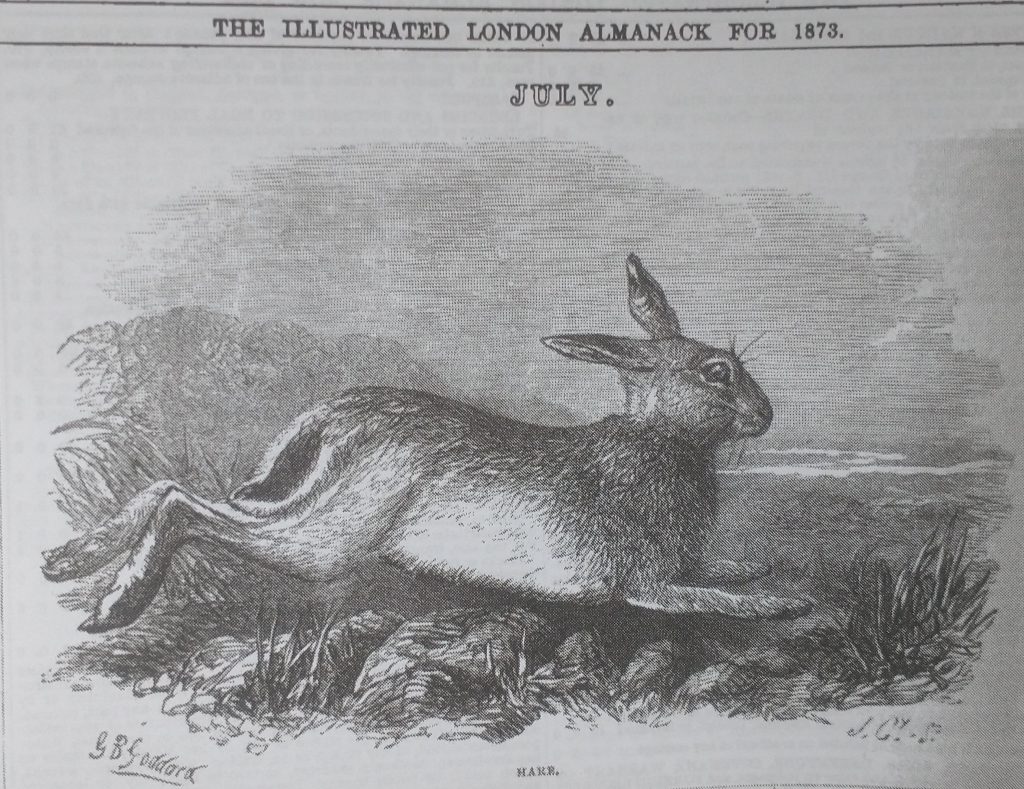
The expression ‘Mad as a March Hare’ comes from the displays of hare boxing that takes place as the Hare mating season begins. And no, it’s not the male March Hare fighting in the spirit of romantic rivalry. It is the female hares fighting off unwanted attention from the males. Hares are solitary creatures, and the mating season is, perhaps, particularly difficult for them. The Country File website has more on the subject. www.countryfile.com
Not only March Hares but March Kittens too
There are also March Kittens and March Chickens. Edward Topsell in his ‘History of Four-footed Beasts‘ 1607 says the best Kittens to keep are those born in March. ‘The Closet of Sir Kenelm Digby Opened‘ 1669 says:
‘Keep a black cock hatched in March as a protection against evil spirits: his crowing terrifies them.’
He also gives a recipe for Cock Ale:
Eight gallons of Ale, a boiled March Cock, four pounds of stoned Raisins, half a pound of dates, nutmegs, mace. Beat the ingredients in a mortar, add to two quarts of Sherry. Add to the ale. Stop it in a container for 6 or 7 days. Bottle it, drink after a month.
Very weird. I challenge my readers to try it and let me know how it goes?
Was the March Hare Sacred?
But it’s not only March Hares because the hare itself was a sacred animal. It was sacred to Aphrodite because of their prodigious ability to have offspring:
‘For you know, I imagine, what is said of the hare, that it possesses the gift of Aphrodite to an unusual degree. At any rate it is said of the female that while she suckles the young she has borne, she bears another litter to share the same milk; forthwith she conceives again, nor is there any time at all when she is not carrying young.’
Classical Texts Library. Philostratus the Elder, ‘Imagines’ Book 1.1-15 c 3rd Century AD. Translated by Arthur Fairbanks.
Divine Celtic & Neolithic Hares
Research reported by Exeter University suggests that hares were worshipped in pre-Roman Britain. Julius Caesar wrote:
“The Britons consider it contrary to divine law to eat the hare, the chicken, or the goose.”
‘The Battle for Gaul’ Translation by Wiseman, Anne, Wiseman, T. P. Published by Penguin Random House, 1980 ISBN 10: 0701125047 (TP Wiseman was my professor for Classical Studies at Leicester University).
Hares are thought to be the original Easter Bunny. But finding good evidence before Germany in the early modern period is difficult. There is a tradition that witches can be scared away at Easter. Exactly, how this works is not at all clear to me. But it has been said that witches could take on the form of a hare. So eating Hare Pie at Easter helps rid the land of the witches.
Jugged Hares
You could have a jugged hare. Jugging is cooking a whole animal in a container over water. Follow this link for a recipe for jugged wild hare. Remember, you are not allowed to shot or trap them on a Sunday or on Christmas Day! For a discussion of hares and folklore, click here:
Hare’s Feet Totems
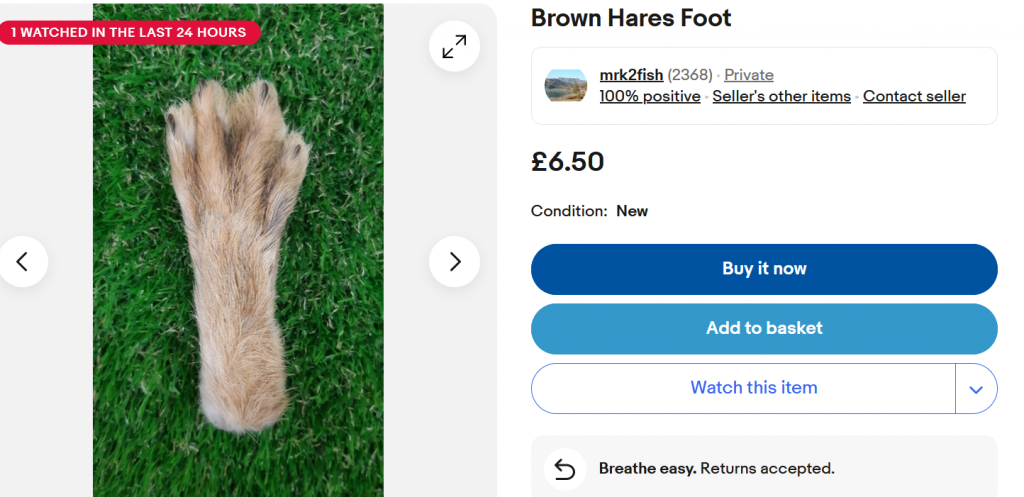
A jointed hare’s foot was considered very lucky and a remedy against gout, stomach pains and insomnia. (The Perpetual Almanack of Folklore by Charles Kightly, which I have used several times in this piece.) You can buy one on eBay. (Don’t click the links, it’s not an advert but a picture of an advert). I remember friends having rabbit feet which they carried around with them for luck. The foot would often be on a key rings.
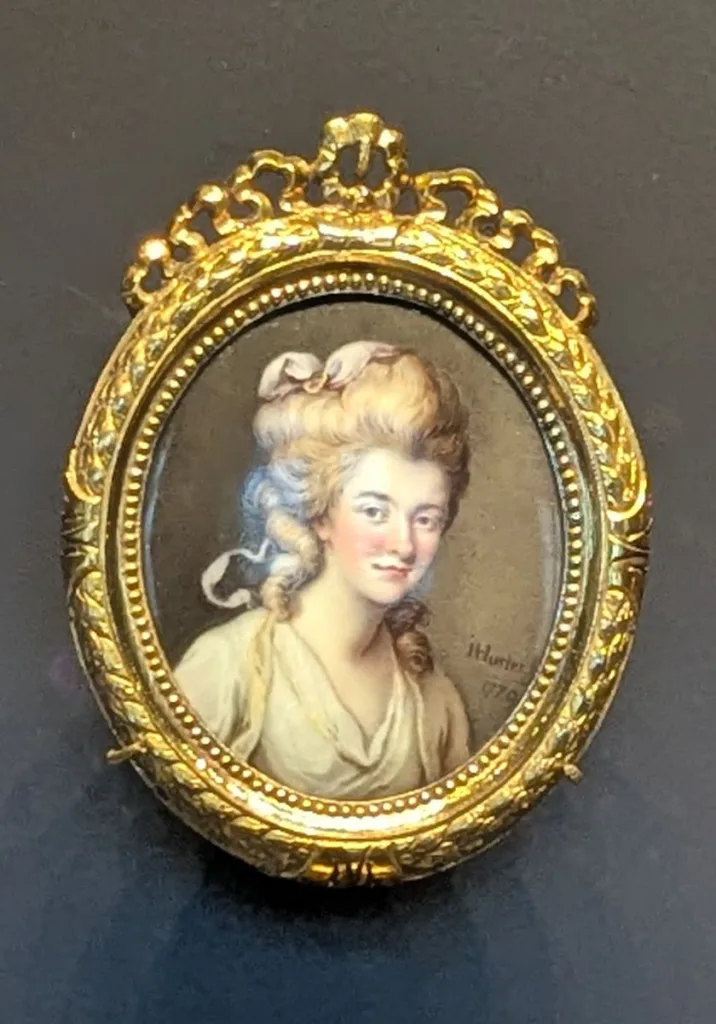
Georgiana, Duchess of Devonshire (Johann Heinrich Hurter after Angelica Kaufman). Photo by K Flude of the miniature at the Victoria and Albert Museum
The Gilbert Collection has been re-displayed in the V&A in London. It has just opened, and is one of the most opulent displays you could hope to see! But, I loved this miniature of Georgiana. She was one of the richest women in Britain, a compulsive gambler, and a powerful political force for the Whig Party. And despite the Georgian Hairstyle the artist has contrived to make a very down to earth portrait. I can imagine bumping into her at the local Overground Station! She became better known after the bio graphy by Amanda Foreman, followed by the Film starring Keira Knightly. The Museum label says the portrait is ‘after Angelica Kaufman’. But I cannot find a Kaufman of Georgiana, that has this charming informality.
I have just heard news that the Arts Council wants to charge overseas visitors to visit our wonderful free national Museums, while allowing British Citizens free entry. Now, there are lots of arguments to be made about it, particularly in a time where money is in short supply. But, one result will be longer waits to get into Museums and Galleries. I am not sure how we Brits, are going to be asked to prove our nationality. If they have to inspect our Electricity Bills, Drivers Licenses, Passports, Library Cards, or Bank Statements, expect chaos.
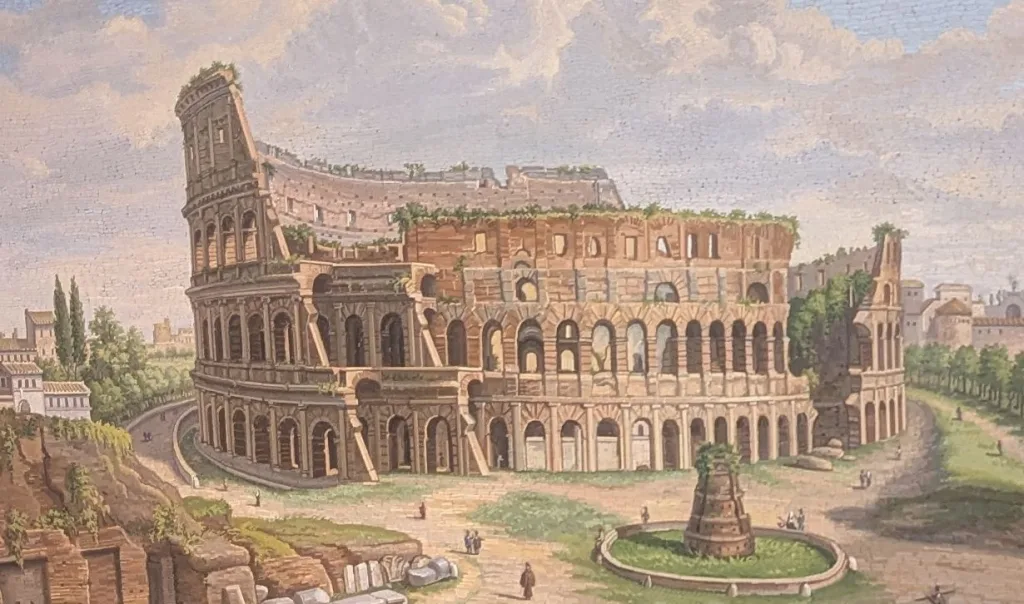
One more object from the Collection is made of minature mosaics, and the V&A has several, But I have chosen this fabulous image of the Colosseum in Rome:
Colosseum by Domenico Moglia c1851
First published March 28th 2023, revised 2024, 2025. 2026 Object of the Day added and post revised 2026
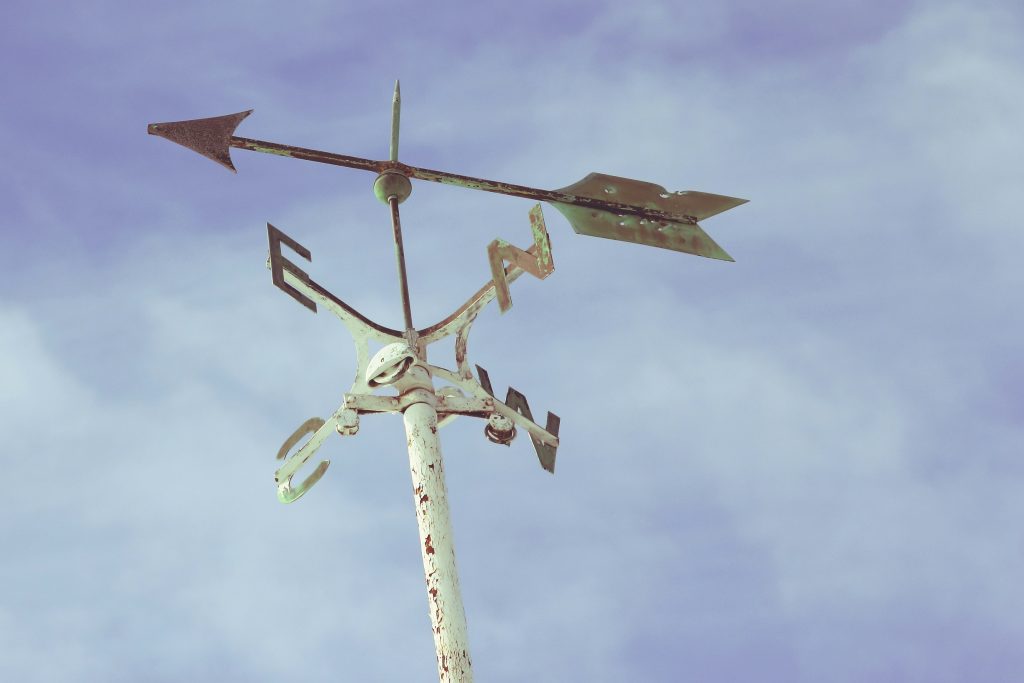
The day after the Equinox we look at the cardinal points of the compass:
“chief, pivotal,” early 14c., from Latin cardinalis “principal, chief, essential,” (online etymological dictionary).
The Importance of South
On its annual cycle, the Sun is always on the move. At the Equinox the Sun now rises due East, and sets due West. It then rises every day further towards the north and sets further to the South until the Solstice. The Solstices mark the extreme Northerly and Southerly rising and settings. Dawn and Dusk vary accordingly.
So, the only real fixed point in the Sun’s entire journey (as seen from Earth) is Noon. Every day of the year, every day of our lives, the Sun is at the highest point at Noon. And this is the definition of South. But the Sun never strays into the North. So the North is the polar opposite of the South- cold, remote, more mysterious.
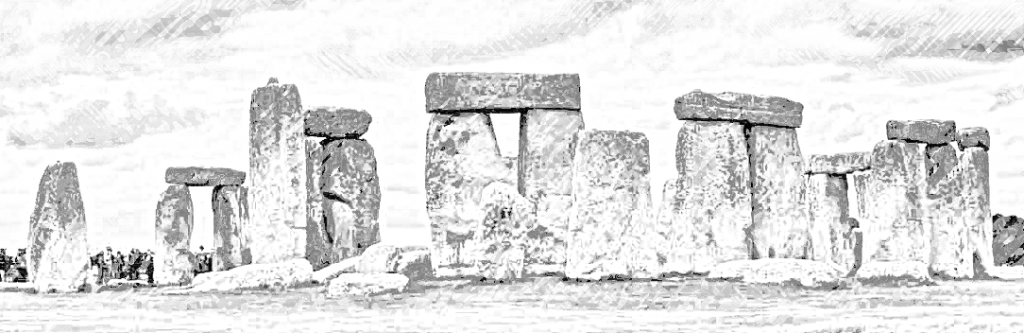
To my mind, it makes, of the Cardinal Points, the South very special. At Stonehenge, there are two exits. The biggest is aligned to the Midsummer Sunrise and Midwinter Sunset axis. But there is a smaller second entrance and this aligned due South. There is also a uniquely small standing stone in the main circle of Sarsens, which is aligned to the South. (Although we don’t know if this stone is original). However, there was some sort of corridor heading South through the mysterious wooden phase which precedent the stone Stonehenge. So, we can be sure South was important at Stonehenge.
Sketch of Stonehenge showing the smallest Sarsen stone near the Southern Entrance
Noon, derives from ‘nona hora’ in Latin and is ‘one of the seven fixed prayer times in traditional Christian denominations.’ (Wikipedia)
The Predominance of the North?
And yet, North, has come to be the principal of the cardinal points. It is shown on virtually all modern maps. It is the direction that people of my generation and hemisphere think of as being ‘up’.
The Google generation sees things differently. There are countless tourist maps on walls or plinths where North is no longer at the top. Up is shown as being the way you are facing. Users have to fight with Google Maps to put North at the top of the map. My children mock me when I say ‘Out of the Tube station, turn up the High street northwards.’ Their view of maps is completely contextual. They do not see any reason to know where the cardinal points are. I point out that the Tube probably has two exits on either side of the road. So, it doesn’t work to say ‘turn left out of the tube’.
There may also be an element of sexual difference, with men more likely to have a cardinal point view while women navigate more by landmarks. ‘Walk past the M&S, turn left to the Park and straight on’. One paper says: ‘during spatial navigation, women typically navigate an environment using a landmark strategy, whereas men typically use an orientation strategy.’
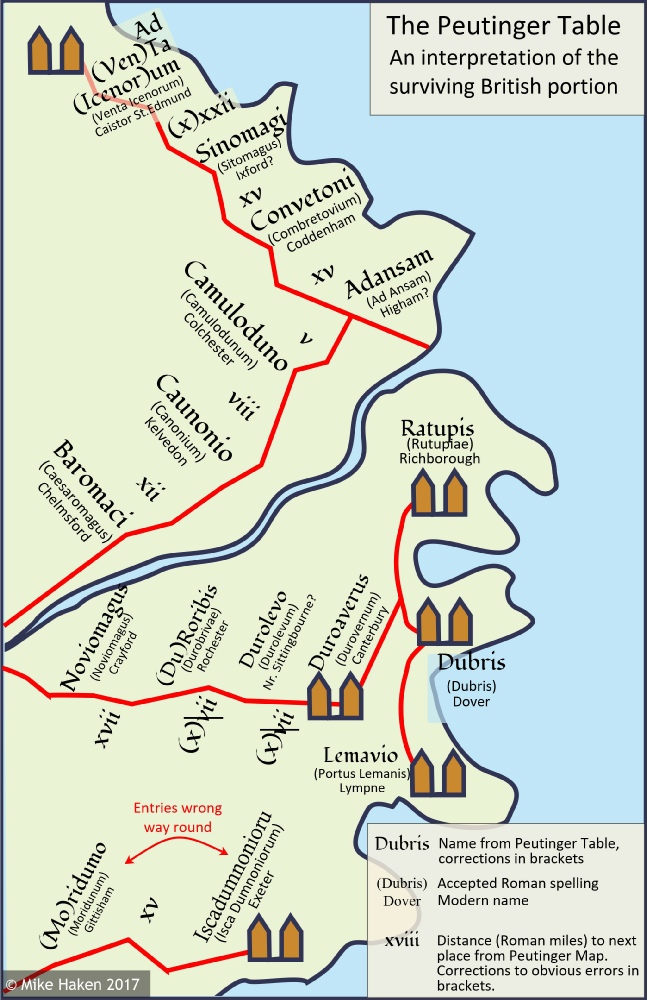
Although I see this decline of the north as being part of the Decline of the West. I also ‘things were better in my day’. But in fact it is simply returning to the way maps were produced in the past. Here is an example below, which has East at the top.
Representation of a Roman Map with the top being roughly East.
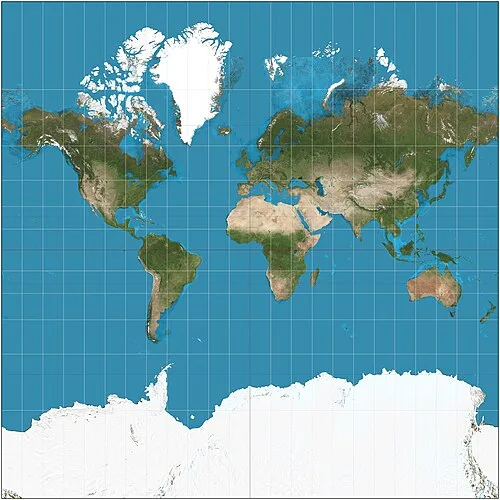
I have since looked further on this subject of North and Maps, particularly finding my answers on this web site: why-is-north-up-on-maps. It tells me that the earliest map the Turin Papyrus, has South at the top. This is probably because the Nile was the fount of all things in Egypt so it is in pride of place at the top of the Map. Other maps tend to have East at the top. The thinking is that the North was cold and who would want to go there?, The West was where the Sun went down, so the Sunrise direction should be at the Top. Often Jerusalem was in the middle with the East at the top. To this day, we talk about orienting ourselves, which means literally means finding your direction eastwards. But the 16th Century things flipped, and North became the top of the map. Was this because the Age of Exploration depended on the North Star? Maybe not because it was used for navigation for a long time before the 16th Century. Was it because of the use of the compass which pointed North? Perhaps not because the compass was first used in the 10th Century. The answer seems to be that Flemish geographer and mapmaker Gerardus Mercator in 1569 put North on top of the map. His projection became the most used map, and everyone started to follow suit.
Mercator projection of the world between 85°S and 85°N. Note the size comparison of Greenland and Africa, and the massive inflation of Antarctica’s landmass. CC BY-SA 3.0
The Magnetic Poles
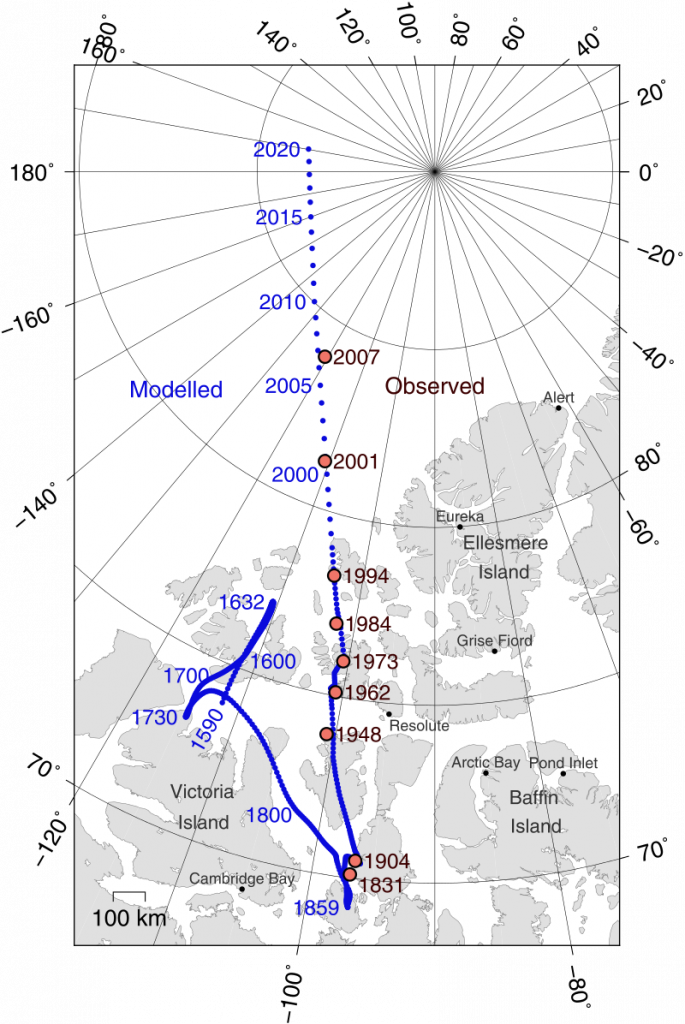
Of course, there is another version of the cardinal points: the magnetic cardinal points. The magnetic North wanders over time. It does not necessarily coincide with geographic north. In recent times they are close enough. But in the past there have been huge variations. Occasionally, the earth has had geomagnetic reversals when the North Pole has pointed in different directions, including south. The last one was 780,000 years ago. On average, they take place very roughly every 500,000 years.
The magnetic pole is caused by the molten iron in the earth’s core and mantle, which creates a dipole. Fluctuations in the dynamo flow of the molten iron cause occasional reverses. The science is very complicated and, even now, not entirely understood. Is it a random consequence of flow dynamics? Or do external events, like sinking continents, or meteor strikes cause the reversal?
Since the first use of compasses for navigation in the 11th/12th Centuries, the magnetic pole hasn’t wandered enough to be of concern to navigation. It has wondered a few hundred miles over the last 500 years. Now, it is speeding up, from 9km a year to 52km (since 1970). This Wikipedia page is pretty good at an explanation.
My Job Tracking the Cardinal Points
My first proper job after university was as a technician then research assistant at Oxford University studying these phenomena. I say ‘proper’ because when I left University, I became an itinerant archaeologist. This led me to digs in Switzerland, Northampton, East Anglia and Nottingham. Then, I got the job at the Research Laboratory for Archaeology and the History of Art, at Keble College, Oxford.
I worked for Dr. Mike Barbetti who was an expert on the wanderings of the Magnetic Pole. His interest was firstly in the pure science of the subject. But he was keen to explore the applied uses in Archaeology as well. So, after being appointed as a Research Fellow at Oxford, he set up an epic journey from his native Australia to Oxford. It went via some of the iconic sites of Palaeolithic Archaeology, including Olduvai Gorge, Tanzania. The site of excavations by Mary and Louis Leakey.
To plot the movements of the magnetic north, scientists needed dated samples. Early human sites provided dated sites over a long time span. Also, archaeomagnetism, as the discipline became known, offered the possibility of dating sites. Another application was to determine whether deposits were fired or not. One of the sites Mike sampled was a candidate for the first evidence of fire in human existence.
Cutting up Samples
As I said, Mike’s interest was discovering how the magnetic field of the earth changed over time. And, more importantly, what was the mechanism. He shipped back to Oxford samples of soil cast in Plaster of Paris. My job was to cut the samples up. I cut them up with an electric saw in a shed in the backyard of the Laboratory. Then we measured the direction and intensity of the magnetic field in the samples.
Soil contains particles of iron, and they align randomly. So a sample of soil has a low magnetic intensity and a random direction of magnetic field. But once heated up, the iron particles align to the current direction of the magnetic pole. Its intensity is proportional to the intensity of the Earth’s magnetic field. These measurements provide a method of plotting the changes of the magnetic field over time. And from these data, models can be constructed explaining how the iron in the earth’s core worked as a giant magnet.
Once we had built a reference curve for the movements and intensity of the magnetic pole over time, we hoped to develop another dating method. Other methods such as radio carbon, thermoluminescence, and tree ring dating, were being developed at the Research Laboratory in Oxford at the same time.
My part in Digital Heritage Part 1
Having got the results, I took them to the Oxford University Computer Centre. There, I typed them up onto machine-readable cards. Added a copy on cards of our computer programme written in Fortran, and gave them to the Computing Staff. The program and data were run through the Centre’s mainframe computer. (probably an IBM or ICL computer, the size of a house!) 24 hours later, I received a print-out to proofread.
I located mistakes, ran an editing run of punched cards, essentially instructing the computer: ‘on card two replace 2.5 with 2.6, and run the programme again’. I would pick up the results 24 hours later. It seems extraordinarily primitive now, but then it was an enormous saving of time.
And that, patient reader, was my early contribution to Digital Heritage and pure science. Mike published many articles of which I was joint author of three articles, two in the prestigious Science Journal Nature. And it is annoying that my citations in the groves of academia are still dominated by articles I co-wrote in the late 1970s/80s!
Mike’s work was important in the development of the study of the earth’s magnetic field. However, the use of archaeomagnetism has never risen above strictly limited. Occasionally, in specific circumstances, it can be useful. But those circumstances tend to be times when no other methods have worked. Most often, it is used in attempting to date kilns.
These are the papers:
Barbetti. M and K. Flude, ‘Palaeomagnetic Field Strengths from Sediments baked by Lava flows of the Chaine des Puys, France.’ Nature, Vol. 278 No 5700. 1979
Barbetti M., Y. Taborin, B. Schmider and K. Flude ‘Archaeomagnetic Results from Late Pleistocene Hearths at Etoilles and Marsangy, France’. Archaeometry 22. 1980
More on my contribution to Digital Heritage in posts to come.
OnThis Day
630 – Emperor Heraclius returns the True Cross, one of the holiest Christian relics, to Jerusalem. (see my post on the True Cross and Roodmas)
1152 – Annulment of the marriage of King Louis VII of France and Queen Eleanor of Aquitaine. She went on to marry Henry II of England which makes this one of the most amazing events of the medieval period. The transfer of lands from French control to English control as a result was huge. She eventually was imprisoned by her new husband for supporting their children’s rebellion.
1556 – Former archbishop of Canterbury Thomas Cranmer executed for heresy in Oxford. He had recanted, but recanted his recantation when he discovered there were still going to burn him. By rights, he should have been reprieved, but Queen Mary was determined to make an example of the man who help Henry VIII and Thomas Cromwell make England a Protestant state. The fire was on Broad Street, and he is said to have thrust his arm that signed the recantation into the fire, calling it ‘that unworthy hand.’
1829 – Duel Day is celebrated at Kings College when the Duke of Wellington fought a duel against George Finch-Hatton, 10th Earl of Winchilsea, because of disagreement about Roman Catholic Emancipation. The duel took place in an asparagus fields which would later become Battersea Fields. Wellington shot first and either missed or deliberately shot wide, and Winchilsea aimed high. He then apologised to Wellington. For more details see www.kcl.ac.uk/duel-day.
First written March 2023, revised 21st March 2024, Revised and Mercator added 2026
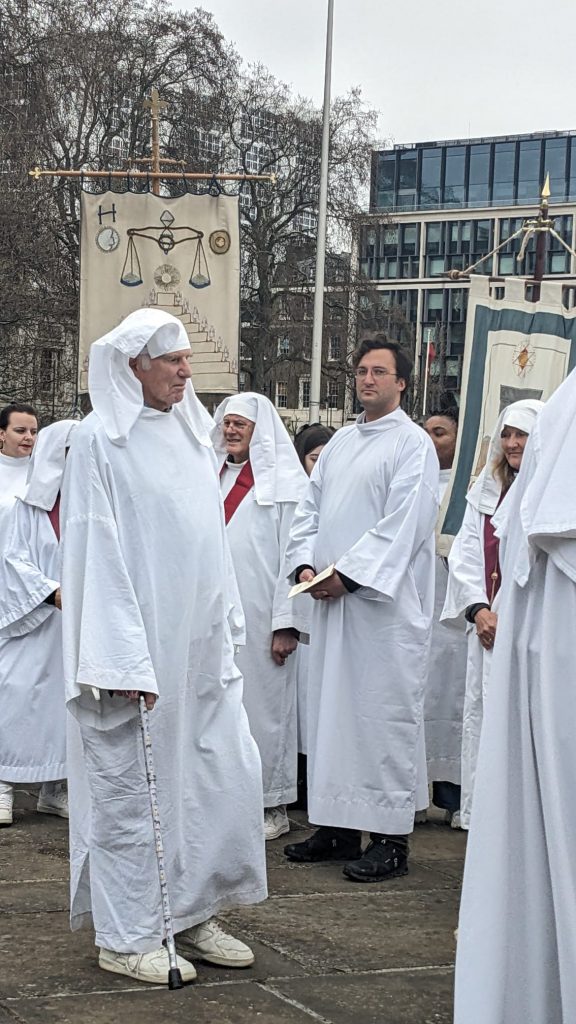
Video by Heike Herbert of Druids at the Spring Equinox at Tower Hill, London
New content will be found at the bottom in the ‘On This Day section.’ So, Spring has sprung, not only meteorologically speaking but also astronomically. We are 20 days into the meteorological Spring which started on 1 March (see my post here.) Today, we are starting the astronomical or solar Spring.
The 20th of March is the Spring Equinox, or Vernal Equinox, midway between the Winter Solstice and the Summer Solstice. The sun has been rising further north each day since December 21st. Today it rises due East, and sets due West. The day and night are roughly equal in length (although by no means exactly). At 14:45 today, the Sun is directly overhead at the Equator.
The term vernal comes from the Latin for Spring, and today is the Primavera, the first day of Spring. The Anglo-Saxons originally used the word lencthen (Lent) for Spring. But later adopted the idea of the ‘springing’ of the year when the plants bud. In Middle English, the word Spring is also used for sunrise, the waxing of the moon and the rising tides. These are called spring tides. But also for the sprouting of the beard and the first appearance of pubic hair! Happy Spring Time!
Printemps
Up to the 15th Century, the English also used the French term ‘prime-temps’ in the sense of ‘first times’. This follows the idea that the year is young, while Winter represents old age. As we shall see, on March 25th, there was also a belief that the world was created in Spring at the Equinox. Jesus was also conceived at this point of the annual cycle. (see my post /march-25th-the-beginning-of-the-universe-as-we-know-it-birthday-of-adam-lilith-eve-conception-of-jesus-start-of-the-year)
Zodiacally, if that is a word, Spring is Aries (brave and impulsive); Taurus (sensual and stubborn), and Gemini (dynamic and talented).
Druids at Tower Hill
Druids at the Spring Equinox Tower Hill London, Photo by Heike Herbert
The Druids have a ceremony at Tower Hill every year on the Spring Equinox. When I last attended I remember the druid costumes were often made with nylon sheets, and their footware was mostly tennis shoes. I see from the photos the nylon has at least been replaced with cotton, and the plimsolls with trainers. Not quite sure what that pair of black trainers are doing in the picture!
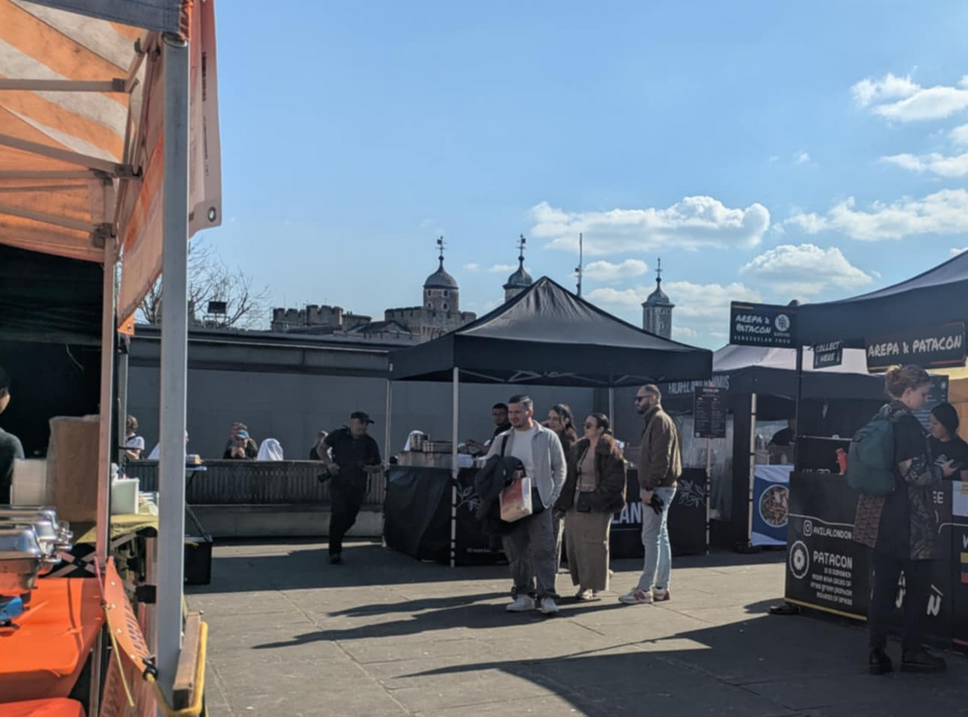
As my photos are getting long in the teeth, I have used photos by Heike Herbert. She attends most years. The ones above from 3 years ago. In 2025, she reported that the atmosphere has been affected by a street food market,. This restricted the space for the Druid Circle. The food stalls are there every Thursday, so it only impacts the Druid assembly once every 7 years! In 2026 the Druids meet at Tower Hill at 12 noon.
Tower Hill, Spring Equinox, 2025 and street food, Photo by Heike Herbert
Modern Druids
I say modern druids because there is no convincing evidence that the modern fellowships of Druids can trace their origins back to prehistory. Druidry was reinvented in the 18th Century — for example, the Ancient Order of Druids was formed in 1781. They were set up as societies in the tradition of the Freemasons. They held to belief in the fundamental importance of nature. However, one group, the British Circle of the Universal Bond, claim descent from a group persecuted by the Bishop of Oxford in 1166. Look at their website for more details and for an idea of their beliefs.
Prehistoric Spring Equinox
When did the Equinox first had importance for human society? The answer is, probably, at least as long as we have been reasoning creatures. On January 14th, I draw attention to a recent discovery by an amateur ‘citizen scientist’. He suggested there was evidence in Cave Painting for the use of a Palaeolithic Calendar. Follow this link to see the post.
Stonehenge and the Sun
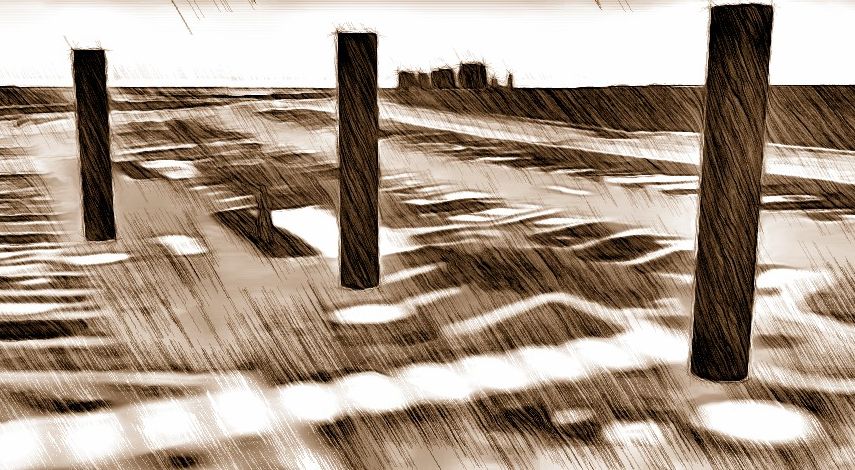
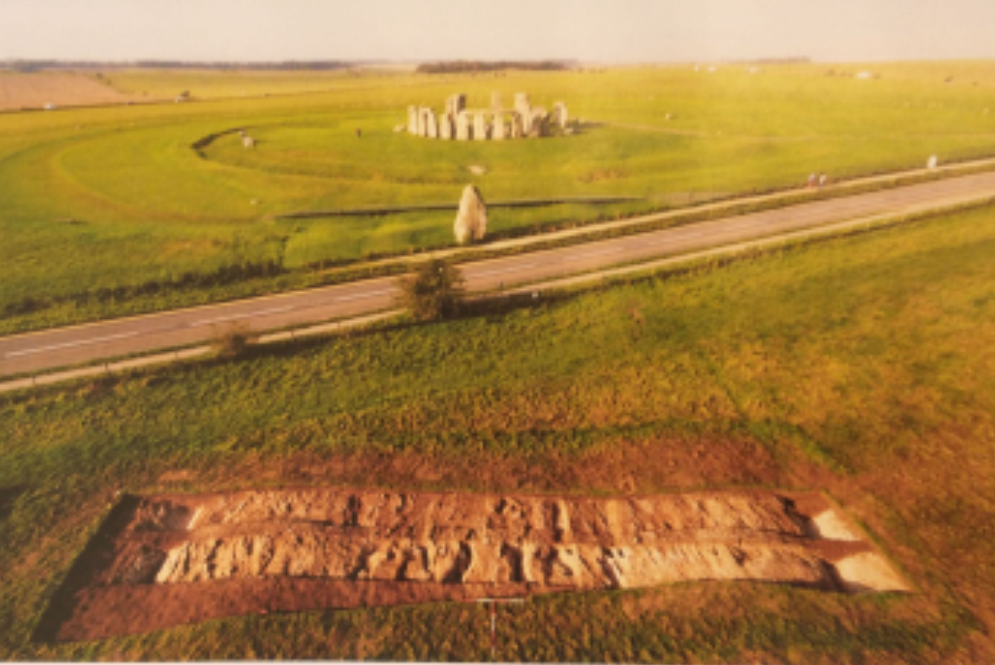
At Stonehenge, in the old Car Park, they found three huge Pine post-holes in a line. Dating evidence shows they were erected in the Mesolithic period, thousand of years before Stonehenge. They align to the direction of the Mid-Summer Sunrise and Mid-Winter Sunset (NNE/SSW). If, and it’s a big if, you were sighting from Stonehenge itself, which was built some 5000 years in the future.
Imaginary reconstruction of the Carpark Postholes
It is a bit of a stretch using two pieces of evidence so far apart in time. But recent excavations have revealed that there are natural periglacial striations in the soft chalk bedrock at Stonehenge. These lines point to the Solstices. They not only predate Stonehenge but also the three post holes. The striations may well have been visible from the time they were created when the glaciers melted.
Around 12,000 years ago (date from my memory so approximate), the climate changed and the glaciers melted. This left a lot of water rushing around the landscape. At Stonehenge, it gouged out striations in the chalk. By chance, or as ordered by the Gods/Goddesses/Divine Nature, the striations pointed to the Solstice Axis. Richard Jacques excavations in the Stonehenge area revealed that the aurochs came to the Stonehenge area for grazing and water. Aurochs are huge wild cows with enough meat on them to feed 200 people. So, the solar axis is near a place where the Gods/Goddesses/Divine Nature provided super-abundance in the guise of herds of Aurochs.
Foreground shows the periglacial striations aligned on the Solstice. Source Current Archaeology?
Burial Mounds aligned to the Equinox
That the major movements of the Sun were of interest to Neolithic and Bronze Age society is confirmed by the alignment of many megalithic monuments dating from 3,600 BC onwards, including, of course, Stonehenge. All around the UK are long barrows and other burial mounds, many of which are indeed sited/sited E-W to the Equinoxes. Many are fairly approximate. But at Loughcrew, County Meath in Ireland the Vernal Equinox shines right into the burial chamber. The sun’s light shines onto a stone marked by stone carvings. Similar alignments exist at Knowth and Dowth in the Boyne Valley. More about Loughcrew in my post here)
Harmony & the Spring Equinox.
The Equinox also has another role, which is to be the anchor of the cardinal points. The world is orientated to North, South, East, West. The Equinox is a time when there is a harmony, a balance in the universe. Therefore, it is a fortunate, a lucky time, a time to fall in love or undertake notable undertakings. But, in the Christian world marriage traditionally had to wait a little longer, until after the commemoration of the death of the Messiah,
On This Day
Today, is The International Day of Happiness. This was set up by the UN on 28 June 2012. This year’s theme:
‘explores the relationship between social media and happiness, highlighting thepotential challenges for our wellbeing as well as ways we can all use tech for good.‘
Go to the web site for more information. But these are the three steps they suggest: (I’ve cut and pasted them from the site)
Step 1: Choose
Be mindful of if, when and how much you are on social media.
Pause and ask yourself, “What do I really want to do right now?” Keep a list of analogue activities you can do instead, like playing music, drawing, gardening or going outside for a walk.
Set a timer so scrolling is a short snack rather than a wormhole.
Give your mind space to think, keep the bedroom phone free, try a ‘digital sabbath’.
Step 2: Connect
Don’t let scrolling be a substitute for real connection.
Phone a friend for a chat, or send some voice notes, instead of scrolling.
Make plans offline, get excited about your next adventure with loved ones.
Use social media to connect with supportive friends and communities that are meaningful to you.
Step 3: Curate
Personalise your experience to support your wellbeing.
Share and amplify uplifting stories, messages and ideas, be aware of misinformation.
Be kind in the comments, it matters more than you think.
If you have found this useful, spread the word and encourage others to do the same. Use the hashtag #InternationalDayOfHappiness.
The World Happiness Report
This is published annually by the Wellbeing Research Centre at the University of Oxford. More details here. Finland is top for the 9th year in a row. US is 23rd, UK is 29th. These are the top 25 happy countries:
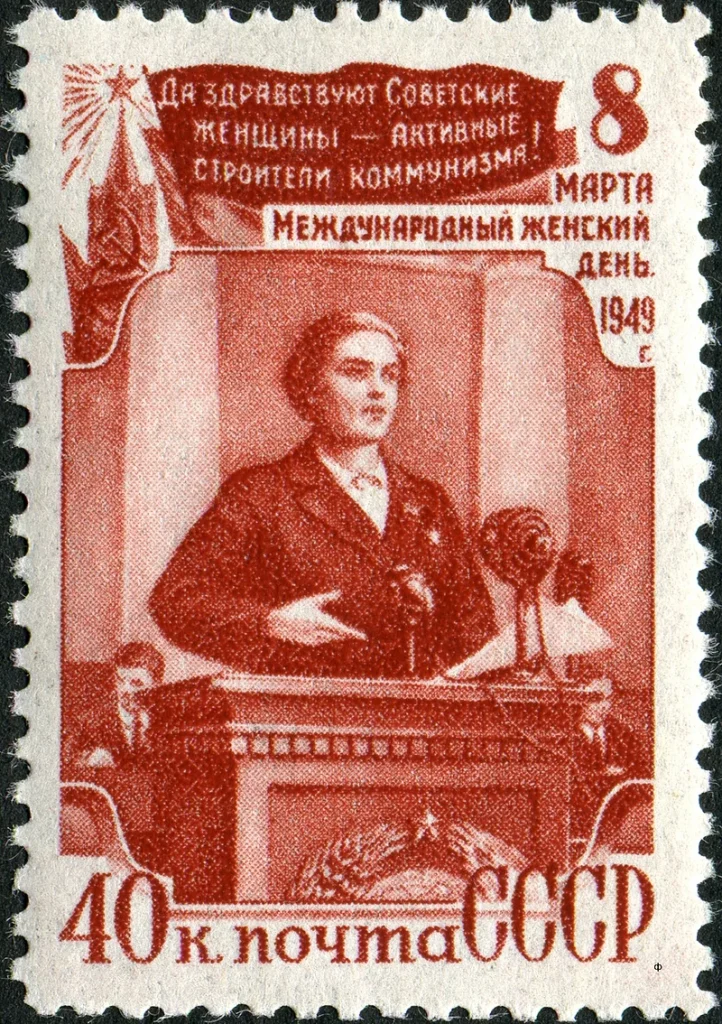
The Soviet Union 1949 CPA 1368 stamp (International Women’s Day, March 8. (Wikipedia)
Today, is International Women’s Day. It began, as an idea within Socialist organisations in 1909/1910. Following the February Revolution in Russia and women gaining the vote, March 8th was chosen as the day to celebrate. The wider feminist movement adopted it in the 1960s followed by the UN in 1977. Since when, it has been a day to celebrate women’s achievements and campaigns worldwide.
Harper’s Road burial
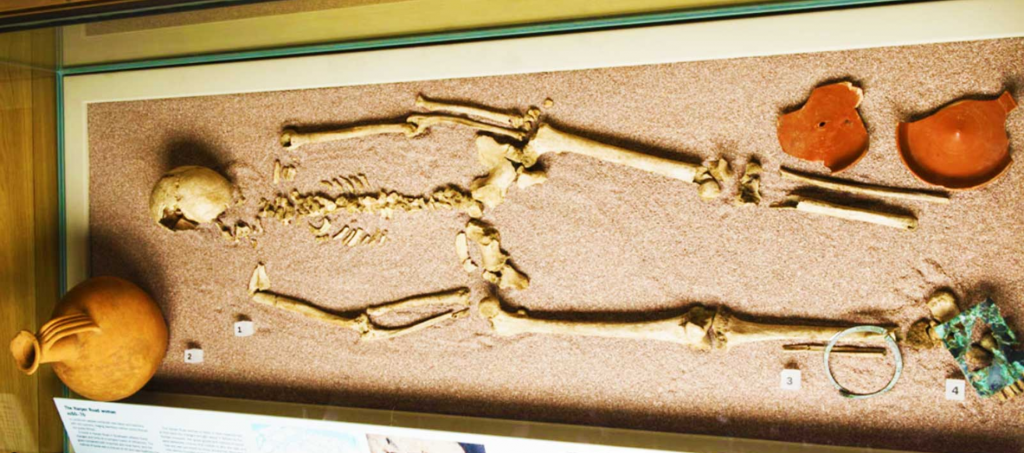
The Harper Road Burial Southwark (museum of London web site)
Another important historic female was found in an excavations at the Harper’s Road. . I was reminded about it by reading Dominic Perring’s new book ‘London in the Roman World.’ He uses it to establish that Southwark was a place where people lived both before and after the Roman Conquest in 43AD. The burial was found in the 1970s’ and dated to 50 – 70 AD (Roman Invasion of Britain was in 43 AD). Recent scientific analysis has shown that the burial was of a woman (21 – 38 years of age). She had brown eyes and black hair and was brought up in Britain. Her grave goods indicate she was wealthy. She had both imported Roman pottery but also typically British Iron Age objects. The combination shows some adaption between her native culture and the new Roman ways.
Her British objects included a bronze necklace (a torc possibly of Catevalaunian or Trinovantian origin) and a mirror. Dr Rebecca Redfern & Michael Marshall on the Museum of London’s website make a case for her being a:
‘Powerful women in late Iron Age London’.
Mirrors of Power?
They make a case for the mirror being
‘used by women for divination and magic, and were a source of knowledge that only women could command. Being able to use and read the mirror meant that the woman was highly regarded by her community.’
Iron age burials are often found either with a sword or a mirror and the thinking is that the mirror reflects an equivalent status to a sword. I think we can say that the finds do reflect someone of standing, but as to the use of the mirror that must be speculation. Divination using a mirror is called ‘scrying’ and the British Museum has John Dee’s scrying apparatus from the 16th Century. You can buy scrying mirrors on etsy. https://www.etsy.com/uk/market/scrying_mirror. But to make a case that Mirrors were not just utilitarian and prestige objects but also in use for supernatural/religious purposes is surely just speculation?
Melanie Giles & Jody Joy in ‘Mirrors in the British Iron Age: performance, revelation and power published in 2007 (and available to read here) concludes:
‘Iron Age mirrors, whether made of iron or bronze were beautiful, powerful, and potentially terrifying or dangerous objects. They were used in the preparation and presentation of the body and prestigious displays, but may also have been associated with powers of augury and insight into the past, or access to ancestral or spiritual worlds.’
Women in the Age of Iron
The evidence we have for iron communities is for a powerful role for women in contrast to the Romans. The Romans dismissed women when they wrote that Boudicca was ‘uncommonly intelligent for a women’. In fact, she nearly forced the Romans to abandon their conquest of Britain. We also know that Queen Cartimandua of the Brigantes had executive power in the North of Britain. The Britons also worshipped the three Mother Goddesses, which focussed on the value of woman as maidens, mothers, and grand-mothers.
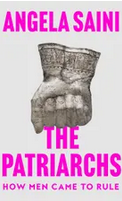
A book to order for International Women’s Day is ‘Patriarchs’ in which Angela Saini investigates when the Patriarchy took over. I heard her talk about it and it seems an excellent introduction.
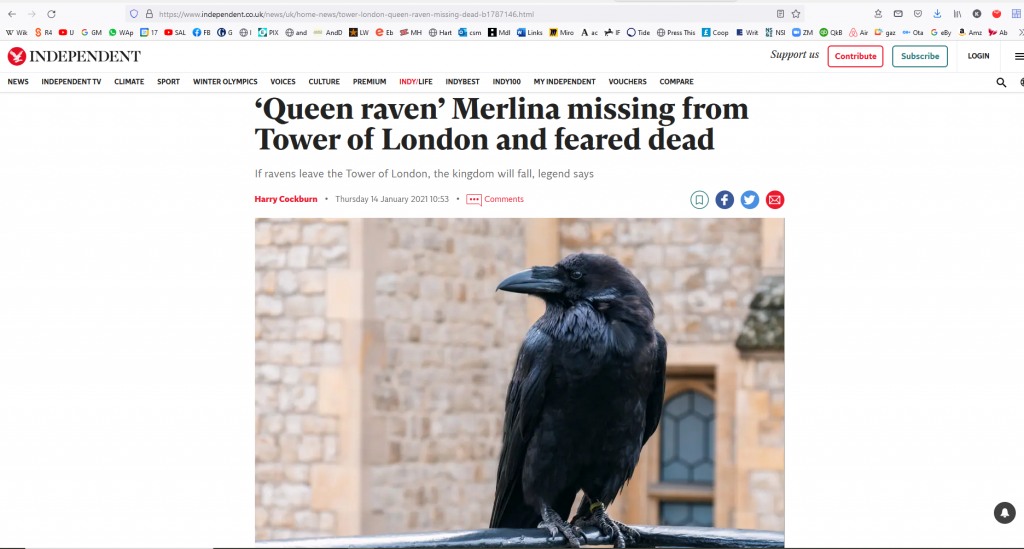
The Independent January 2021 The Raven the Palladium of Britain
The Raven – the Palladium of Britain
Corvus corax is hatching. An early nesting bird, the Raven is the biggest of the Corvids. They were pushed to the west and north by farmers and game keepers but are making a comeback. Ravens are finding towns convenient for their scavenging habits. So they, again, cover most of the UK except the eastern areas. The Raven is one of the Palladiums of Britain.
A Palladium is something that keeps a city or country safe, They are named after a wooden statue of Pallas Athene, which protected Troy. Perceiving this, Odysseus and Diomedes stole the Palladium from Troy shortly before the Trojan Horse episode. Troy fell and the palladium went to Italy (I’m guessing with Diomedes who is said to have founded several cities in Italy). It ended up in Rome.
The Romans claimed to be descendants of Trojan exiles led by Aeneas. So it was back with its rightful owners. It protected Rome until it was transferred to the new Roman capital at Constantinople. It then disappeared, presumably allowing the Ottoman Turks to conquer the City of Caesar? To read of London Stone as a Palladium see my post here.
The Ravens habits (it is said they know where the battlefields are before they are fought) and their black plumage have made them harbingers of death. In poetry, Ravens glut on blood like the warriors whose emblem they are. Here is a very famous quotation from Y Gododdin, a medieval poem but thought to derive from a poem by the great poet Aneirin from the 7th Century.
‘He glutted black ravens on the rampart of the stronghold, though he was no Arthur.’
This is one of the much argued-about references to King Arthur in the ‘Was he a real person’ trope. The point being, it doesn’t make sense to mention Arthur if King Arthur wasn’t a real person. The story at the Tower of London is that the Ravens kept in the Tower, with clipped wings, keep Britain safe from Invasion. (But see below).
Bran’s Head – the original Palladium of Britain?
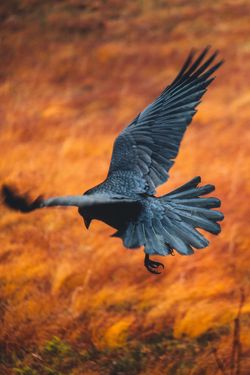
By Sonny Mauricio from Unsplash
The Raven was also the symbol of the God-King Bran. Bran was one of the legendary Kings of Britain. His sister, Branwen, was married to the King of Ireland. To cut a long story short, Branwen was exiled by her Irish husband to the scullery. She trained a starling to smuggle a message to her brother, to tell of her abuse.
So Bran took an army over the Irish Sea to restore her to her rightful state. But the ships were becalmed. Mighty Bran blew the boats across the sea – he was that much a hero. Bran was mortality wounded in the fighting that followed. This was a problem because he had previously given away his cauldron of immortality. He gave it to the Irish King in recompense for the insults given to the Irish by Bran’s brother, who hated anyone not British.
Bran’s Head Returns to London
So, the dying Bran, told his companions to cut off his own head and take it back to the White Hill in London. His head was as good a companion on the way back as it was on the way out, and the journey home took 90 years.
At last, they got to London, where Bran told his men to bury his head on the White Hill. As long as it stays here, he said, Britain would be safe from foreign invasion. The White Hill is said to be Tower Hill with its summit at Trinity Gardens, although Primrose Hill is sometimes offered as an alternative.
This was one of the Three Fortunate Concealments and is found in ‘the Triads of the Island of Britain.’ The Triads are from medieval manuscripts which preserve fragments of folklore, mythology and history. They are grouped in groups of three.
Arthur and Bran’s Head
But many years later, King Arthur saw no need for anybody or anything other than himself to protect the realm. So he had the head dug up. Calamity followed in the shapes of Sir Lancelot and Mordred which led to the end of the golden age of Camelot and conquest of Britain by the Saxons. This was one of the Three Unfortunate Disclosures.
If we want a rational explanation for the story, there is evidence that Celtic cultures venerated the skull, and palladiums play a part in Celtic Tales.
So what was Arthur doing destroying the palladium that kept Britain safe? Vanity is the answer the story gives. But, perhaps, it’s a memory of Christian rites taking over from pagan rituals? God, Arthur might have thought, would prefer to protect his people himself rather than Christians having to rely on a pagan cult object.
Ravens in the Tower of London
The story of Bran’s head is inevitably linked to the Ravens in the Tower who, it is still said, keep us safe from invasion. As you can see from the photo at the top we still get in a tizz when one goes missing.
Sadly, and I am probably sadder about this than most, the link between the Tower, Bran, and the Ravens cannot be substantiated. Geoffrey Parnell, who is a friend of mine, told me that while working at the Tower of London he searched the records assiduously for the story of the ravens. He found no evidence of the Raven myth & the Tower before the 19th Century, and concluded that it was most likely a Victorian invention. IanVisits has a 2025 story about the Ravens, and also concurs that the Ravens are a recent myth.
The Welsh Triads give a total of two palladiums for Britain, a couple of nationalistic fighting dragons.
The Head of Bran the Blessed, son of Llyr, which was concealed in the White Hill in London, with its face towards France. And as long as it was in the position in which it was put there, no Saxon Oppression would ever come to this Island; The second Fortunate Concealment: the Dragons in Dinas Emrys, which llud son of Beli concealed; And the third: the Bones of Gwerthefyr the Blessed, in the Chief Ports of this Island. And as long as they remained in that concealment, no Saxon Oppression would ever come to this Island.
All good but then came:
The Three Unfortunate Disclosures:
And there were the Three Unfortunate Disclosures when these were disclosed. And Gwrtheyrn the Thin disclosed the bones of Gwerthefyr the Blessed for the love of a woman: that was Ronnwen the pagan woman; And it was he who disclosed the Dragons; And Arthur disclosed the head of Bran the Blessed from the White Hill, because it did not seem right to him that this Island should be defended by the strength of anyone, but by his own.
Gwrtheyrn is Vortigen, the leader of the Britons after the fall of the Roman Empire in Britain, one or two leaders before Arthur. Vortigern, which means something like strong leader in Welsh was a real person in so far as he, unlike Arthur, is mentioned by Gildas a near contemporary source.
The story of the dragons is supposedly from the pre-Roman Iron Age. Every May Day, the Dragons made a terrible noise, causing miscarriages and other misfortunes. So, King Ludd, whom legends says gave his name to London (Ludd’s Dun or Ludd’s walled City), drugged the dragons. He had them buried in a cavern at Dinas Emrys in Eryri (Snowdonia). The Red Dragon represented the Britons (also called the Welsh) and White Dragons the Saxons.
Vortigern, Merlin and Vortimer
Hundreds of years later, (five hundred?) after the Romans had come and gone. Vortigern was trying to build a castle in Eryri at Dinas Emrys. But the walls keep falling down. ‘You need the blood of a boy born not of man’, his necromancers say. They find a boy called Ambrosius aka Merlin whose mother had lain with an incubus. Merlin accused the necromancers of ignorance and explains the wall collapse is caused by two dragons. They find the cavern and let the dragons go. The walls now stand undisturbed. But the Welsh Red Dragon and the Saxon White Dragon can not now be at peace, and the Britons are defeated by the Saxons.
Vortigern betrayed his own people for the lust of Rowena the daughter of Hengist, the Saxon. Hengist was given the province of Kent as his reward, and thus began the Anglo-Saxon take over.
Vortigern’s son is Gwerthefyr (or Vortimer). He was a better man than his dad and fought to keep the Saxons out. After Vortimer’s death his bones were buried at the chief ports on the South Coast. Here they acted as a palladian and they kept the country safe. But they were moved to Billingsgate, in London and put in a Tower. The loss of the palladium allowed the Saxons to land safely on the Kent coast and consolidate their increasing hold over Britain and turning it into England.
Birds in Love
Here is a lovely little medieval poem. It was found in 1931 in the end leaf of a manuscript where someone had been testing their goose quill and scribbled these three lines:
Why it is so wet in the UK at the moment (February 18th)? The answer seems to be that there is a block of cold weather over the States that is moving the Jet Stream south, bringing lots of wet weather. But there is also another block of cold weather over Scandinavia. This means that the low pressures being driven by the Jet Stream, have no where to go and are stopping and dumping their rain all over the UK.
3102 BC – the death of Krishna starts Kali Yuga, the fourth and final yuga of Hinduism.
1478 – George, Duke of Clarence, traitor to his Brother, Edward IV, was executed in private at the Tower of London. It is said he was drowned in a vat of Malmsey Wine.
1678 – First Part of Pilgrim’s Progress by John Bunyan published.
1991 – The IRA plant bombs at Paddington station and Victoria station in London. The IRA gave warnings, and the Victoria bomb went off at 4.20am and caused no casualties. At or just before 7am, the IRA warned that all London Stations were to be bombed in 45 minutes time. The Authorities were slow to clear the stations and at Paddington a bomb went off at 7:40am. 1 person was killed and 38 people were injured. 11 days earlier, the IRA attacked Downing St with a mortar bomb attack.
Written on February 21 revised in February 18th 23, 24, 25, Birds in Love, Wet Weather and On This Day added in 2026
The Celtic Year showing Imbolc, the new Irish Bank Holiday
I just came across this which I published last in 2023. I should have republished it last weekend. But here it is. The Irish created a brand new Bank Holiday for St Bridget. The first one was Monday 6th February 2023. It followed a public holiday given in 2022 for Health Workers in March. The timing of the Bank Holiday is explained by the Irish Post:
St Brigid’s Day itself falls on February 1 each year but going forward the Imbolc/St Brigid’s Day public holiday will fall on the first Monday in February, unless February 1st falls on a Friday.
This means that Ireland now has a public holiday on the 4 Celtic festivals of Samain (Halloween), Imbolc (St Bridget’s Day), Beltane (May Day) and Lughnasa (Lammas Day). These festivals are quarter-days, which mean they fall halfway between the Solstices and Equinoxes.
The Independent wrote that ‘then-Tánaiste, Leo Varadkar, said‘ ….“This will be the first Irish public holiday named after a woman.” He also is quoted as saying:
“It marks the half-way point between the winter solstice and the equinox, the beginning of spring and the Celtic New Year.”
Extra Bank Holidays in the UK?
There are occasional calls for a new Bank Holiday in the UK. It’s often a Conservative MP calling for a National Day for the British. More often than not they suggest Trafalgar Day 21st October would be a suitable date. This commemorates the great Naval battle in 1805 in which Nelson was fatally wounded. It has several virtues in their eyes. Firstly, it is a day that confirmed Britain’s mastery of the Seas , an ideal day for celebrating patriotism. Secondly, it is the school half-term, and gives a much-needed day off between summer and Christmas. Thirdly, they can propose the day should be taken from the May Day Bank holiday. This coincides with the International Worker’s Day, which is obviously ‘a bad thing’.
Here is an example: the MP for Portsmouth MP’s supported a call for Trafalgar Day here: . The report says: ‘there are currently no bank holidays in the UK which celebrate battles or war victories’. (Portsmouth News 2016).
This, I think, leaves the rest of us thinking: ‘What planet do these people live on?’ Yes, Trafalgar Day would have been a great day for a Bank Holiday, if this were 1839. Maybe even 1939. But now Trafalgar is just not on any ordinary person’s radar. We don’t think so very much about the Napoleonic War or Nelson. Nor do we often sing ‘Heart of Oaks, are our Men’ any more. In short, it is a reminder how distant from the rest of us some MPs are. By contrast, how progressive Ireland seems.
Productivity
The Trade Union Congress proposed the need for more bank holidays. We only have the usual eight annual bank holidays for workers in England and Wales. Scotland has nine or ten; the average for the EU is ‘12.3 bank holidays a year. Finland and Romania get 15, while workers in Japan have 16 public holidays in total’.
A radio programme ‘The Bottom Line’ compared productivity in Britain and France. It revealed that Britain is now 20% less productive than France, (10% worse since Brexit). And how do we make up that productivity deficit? Yes, indeed, by working longer hours for lower wages. It appears that the French high tax, high workers’ protection regime, means they have to find ways of getting more out of their workers in their working hours. While we can just hire and fire, and are happy to make people work in a more inefficient way. Strange isn’t we are told that the French economy is a victim of socialism. Turns out Socialism is more productive.
February From the Illustrated London Almanac 0f 1873 for Candalmas
Candlemas is an important festival of the Church, celebrated throughout the Christian world. It is the day Jesus was presented to the Temple as a young boy and prophesied to be ‘a light to lighten the Gentiles’. The day is therefore celebrated by lighting candles. Hence its name.
It is also called the Feast of the Purification of the Blessed Virgin Mary. It is 40 days after the birth of Jesus which was fixed as the 25th December by Pope Liberius by AD 354. So it is the end of the postpartum period ‘as the mother’s body, including hormone levels and uterus size, returns to a non-pregnant state’. Mary went to the Temple to be ritually cleansed. This later became known as ‘churching’.
Candlemas a Cross Quarter Day.
It is also one of the cross quarter days of the Celtic tradition, that is halfway between Winter Solstice and May Day. The candles also suggest a light festival marking the lengthening days. It is probably another of those festivals where the Christian Church has taken on aspects of the pagan rituals, so Brigantia’s (celebrated at Imbolc on February 1st) role in fertility is aligned with the Virgin Mary’s.
Weather Lore for Candlemas
Folklore prophecies for today: ‘If it is cold and icy, the worst of the winter is over, if it is clear and fine, the worst of the winter is to come.’ Looking overhead I can see a little blue sky but I can’t say it is ‘clear and fine’. But it is certainly not ‘cold and icy’. So, for what it is worth, we are in for some cold weather.
Candlemas – the Last day of medieval Christmas and the Lords of Misrule.
It’s also the official end of all things Christmas. For most of us Christmas decorations were supposed to be pulled down on January 5th, but, the Church itself puts an end to Christmas officially at Candlemas so Cribs and Nativity tableaux need to be removed today.
John Stow, in the 16th Century describes the period between Halloween and Candlemas as the time when London was ruled by various Lords of Misrule and Boy Bishops (see my post here). In the piece below, Stow also talks about a terrible storm that took place in February 1444.
Against the feast of Christmas every man’s house, as also the parish churches, were decked with holm, ivy, bays, and whatsoever the season of the year afforded to be green. The conduits and standards in the streets were likewise garnished; amongst the which I read, in the year 1444, that by tempest of thunder and lightning, on the 1st of February, at night, Powle’s steeple was fired, but with great labour quenched; and towards the morning of Candlemas day, at the Leaden hall in Cornhill, a standard of tree being set up in midst of the pavement, fast in the ground, nailed full of holm and ivy, for disport of Christmas to the people, was torn up, and cast down by the malignant spirit (as was thought), and the stones of the pavement all about were cast in the streets, and into divers houses, so that the people were sore aghast of the great tempests.’
Robert Herrick has a 17th Century poem about Candlemas:
Ceremony Upon Candlemas Eve
Down with the rosemary, and so Down with the bays and misletoe; Down with the holly, ivy, all Wherewith ye dress’d the Christmas hall; That so the superstitious find No one least branch there left behind; For look, how many leaves there be Neglected there, maids, trust to me, So many goblins you shall see.
1602 – Twelfth Night by William Shakespeare performed for the first time.
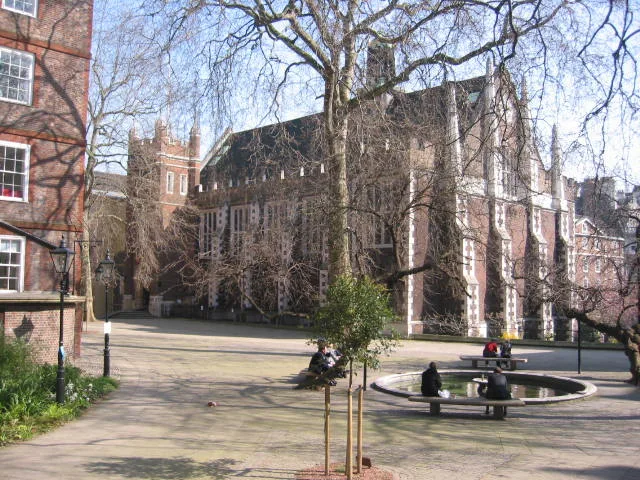
Middle Temple Hall. Photo K Flude.
This play was commissioned by the Lawyers of Middle Temple, in Fleet Street London for the end of the Christmas Season. It was written by Shakespeare and first performed in Middle Temple Hall which is still standing. For the folklore of Twelfth Night see my post here.
1880 – First shipment of frozen meat arrives in London from Australia. It was in excellent condition despite a leaving Melbourne in Dec 1879. Hay’s Gallerie in London was one of the world’s first warehouses with refrigeration.
1943 – German Army surrenders ending the Battle of Stalingrad, marking the beginning of the end of the WW2.
Today is Groundhog Day in the USA. This is when the groundhog comes out to see what the weather is like. If it is dull and wet he stays up because winter will be soon over, if it is sunny and bright he goes back to his burrow to hibernate for another 6 weeks. Originally, a German custom associated with the badger. A groundhog is a woodchuck which is a marmot. Does this workas a forecast method? Not being in America I don’t know but what I do know is:
How much wood could a woodchuck chuck If a woodchuck could chuck wood? As much wood as a woodchuck could chuck, If a woodchuck could chuck wood.
Snowdrops in late January 2024, Gilbert White’s House Selborne (Photo Kevin Flude)
Imbolc and St Bridget’s Day
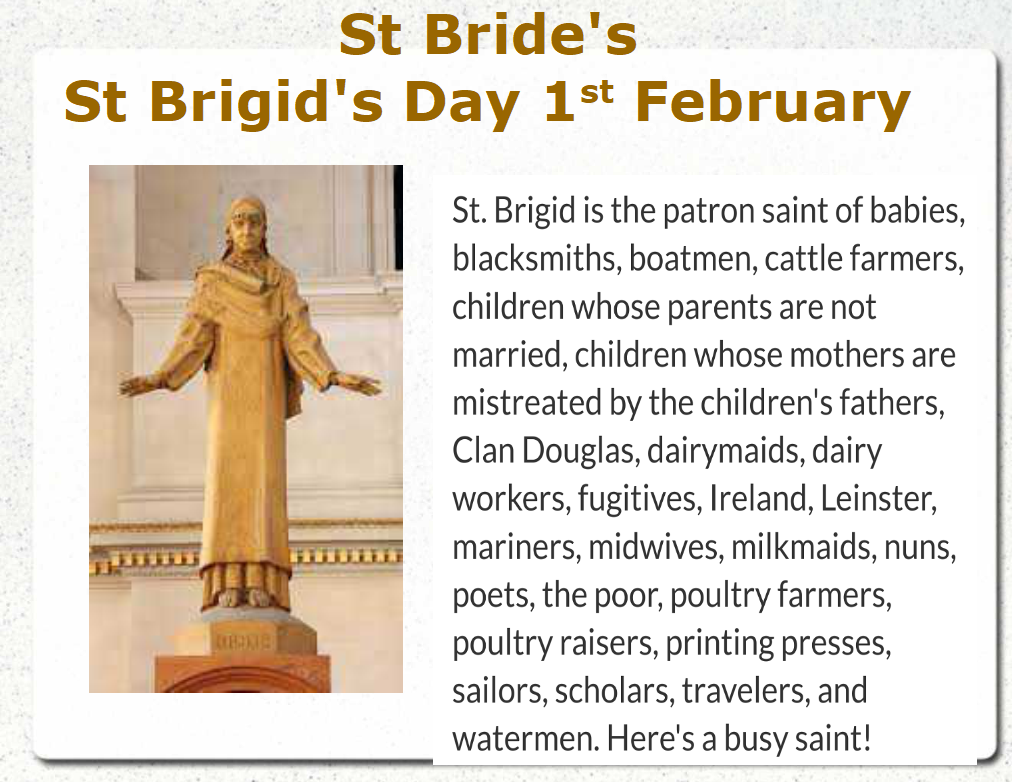
Today is Imbolc, one of the four Celtic Fire Festivals. It corresponds with St Bridget’s Day, which is a Christian festival for the Irish Saint, and is the eve of Candlemas. Bridget is the patron saint of all things to do with brides, marriage, fertility, and midwifery (amongst many other things, see below). And in Ireland, 2026 was the third St Bridget’s/ Imbolc Day Bank Holiday.
St Briget or St Bride’s Statue, St Bride’s Church. Fleet Street from K.Flude’s virtual tour on Imbolc
St Bridget, aka Briddy or Bride, converted the Irish to Christianity along with St Patrick in the 5th Century AD. Despite being a Christian, she appears to have taken on the attributes of a Celtic fertility Goddess. Her name was Brigantia, and it is difficult to disentangle the real person from the myth.
Brigantia
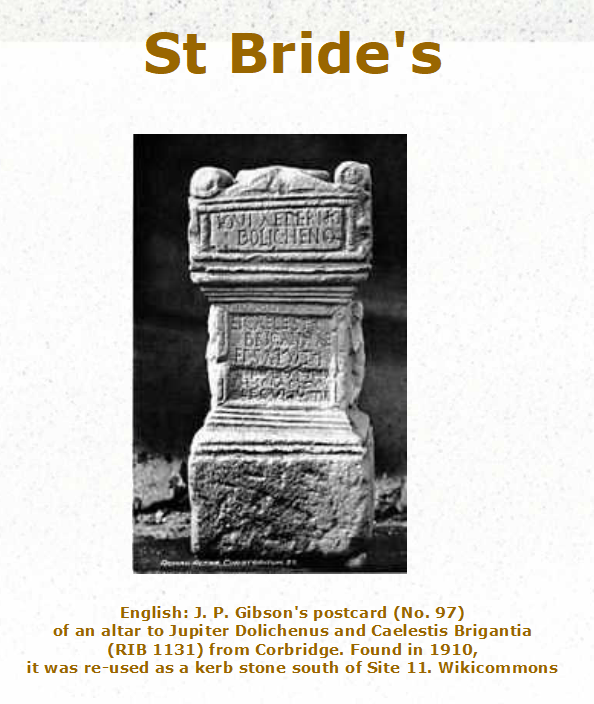
Archaeologists have found various Roman altars dedicated to Brigantia. The Brigantes tribe in the North are named after the Goddess (probably). They were on the front line against the invading Romans in the 1st Century AD, and led by Queen Cartimandua. The Queen tried to keep her tribe’s independence by cooperating with the Romans. A few years later, Boudica took the opposite strategy. But both women had executive power as leaders of their tribes. This suggests a very different attitude to woman to the misogyny of the Romans.
Altar to Brigantia from K Flude’s virtual tour on Imbolc
Wells dedicated to St Bridget
St Bridget’s Well, Glastonbury
St Bride is honoured by many wells dedicated to her. Often they are associated with rituals and dances concerned with fertility and healthy babies. And perhaps, the most famous, was near Fleet Street. This was Bridewell, which became the name of Henry VIII’s Palace, and later converted into an infamous prison. St Bride’s Church, built near to the Well, has long been a candidate as an early Christian Church. Sadly, the post World War Two excavations found nothing to suggest an early Church. But, they did find an early well near the site of the later altar of the Church, and remains of a Roman building, possibly a mausoleum. Perhaps the Church may have been built on the site of an ancient, arguably holy, well. However, this is only a guess.
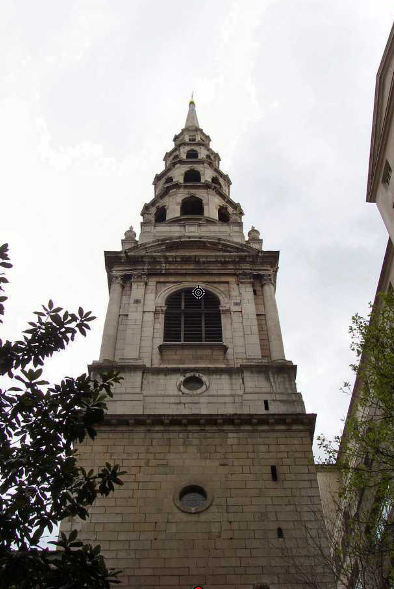
Steeple of St Brides Fleet Street, photo K Flude
The steeple of St Brides is the origin of the tiered Wedding Cake, which, in 1812, inspired a local baker to bake for his daughter’s wedding.
February signs of life
Imbolc and St Bridget’s Day are the time to celebrate the return of fertility to the earth as spring approaches. In my garden and my local park, the first snowdrops are out. Below the bare earth, there is a frenzy of bulbs and seeds budding, and beginning to poke their shoots up above the earth, ready for the Spring. In the meadows, ewes are lactating, and the first lambs are being born.
Violets, bulbs, and my first Daffodil of the year. Hackney (2022), London by K Flude
And let’s end with the Saint Brigid Hearth Keeper PrayerCourtesy of SaintBrigids.org
Brigid of the Mantle, encompass us, Lady of the Lambs, protect us, Keeper of the Hearth, kindle us. Beneath your mantle, gather us, And restore us to memory. Mothers of our mother, Foremothers strong. Guide our hands in yours, Remind us how to kindle the hearth. To keep it bright, to preserve the flame. Your hands upon ours, Our hands within yours, To kindle the light, Both day and night. The Mantle of Brigid about us, The Memory of Brigid within us, The Protection of Brigid keeping us From harm, from ignorance, from heartlessness. This day and night, From dawn till dark, From dark till dawn.
I give walks about Imbolc and other Celtic festivals, and at May Eve, the Solstices, Equinoxes, Halloween and Christmas (when I have time). You might like to attend these walks or virtual tours. The following are currently in my calendar. I will be adding other walks to the calendar as the year progresses.
The Spring Equinox London Virtual Tour 7.30pm Fri 20th March26 To book
The London Equinox and Solstice Walk 2:30pm Sat 21st March26 To book
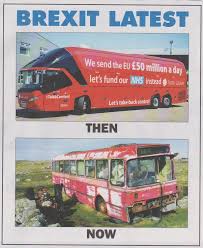
Today is the Anniversary of the day Britain left the European Union in 2020. It is possible to argue the case that one of the reasons so many people were willing to vote to leave the Union was English or British Exceptionalism. I think most people would be thinking of Winston Churchill and World War 2, and the British Empire. But you can argue a case that there has long been important distinctions between Britain and Europe.
I find it amusing that we left Europe at 11pm on January 31st 2020, which was midnight in the European Union. See the BBC round up on Britain and Europe.
This Island Story
When I was at school, there was a lot of emphasis on Great Britain being an Island. This is rarely emphasised in the 21st Century. But it was part of the Imperial story of the British Empire and helped distance ourselves from ‘the Continent’.
That Island story didn’t begin until the Mesolithic period. Before that, Britain was physically part of Europe, and the Thames was but a tributary of the Rhine. Then the land bridge that is now called Doggerland was swept away by rising meltwater. By 8,000 years BP. Britain was an Island.
Around 4000BC, the so-called Neolithic Revolution spread farming throughout Europe. But, the Channel acted as a barrier. So, it took an extra hundred years or so for farming to begin to penetrate Britain. The early farmers brought with them not only the domestic animals, crops, pottery and ground axes but also a new form of housing consisting of long, rectangular wooden houses. The DNA of the people of Britain, was radically changed and the so-called Western Neolithic DNA mostly took over. Strangely, the long house did not survive very long as a popular design. Britain while accepting the new farming technology, seem to have reverted to their own form of housing
Post Roman divergence?
While most major style and technology changes over the next 4 millenia were shared with Europe, Britain often had its own versions. Britain shared with Europe the adoption of the Celtic Languages and eventual integration into the Roman Empire. But, when the western part of the Roman Empire fell in the 5th Century, Britain had a different experience to much of Europe. On the face of it, a similar sequence happened. The Western Empire was taken over by Germanic Kings. The Franks in France and Germany; the Anglo Saxons in England; the Lombards in Italy and Goths, Visigoths, Vandals in Spain (and N. Africa). A similar sequence on the surface.
But on the mainland the German Kings allowed the local cultures to continue and adopted the Latin language, and Christian religion as their own. They maintained a strong tradition of Roman law and culture. French, Italian, Spanish, Rumanian are all romance languages based on Latin.
But across the Channel to England, it was different. Our German Kings didn’t adopt the Latin language and the native Celtic dialects died out (except of course in Cornwall, Wales, Scotland and Ireland ), They also maintained their pagan beliefs. So English culture is Germanic and not Roman. We do not have a foundation in Latin culture and Roman law. This is very different to western Europe.
Napoleon founder of modern Western Europe
Of course the Anglo-Saxons eventually soon adopted Christianity. In the 16th Century Britain turned against the universal Catholic Church. This was a rupture that had a similar impact to Brexit. But the next really significant difference was the changes instituted by Napoleon. He subdued then rationalised and liberalised the continent. He had dreams of a United Europe of Nations (in contrast to the Empires that held sway (such as the Holy Roman Empire, and the Austro-Hungarian Empirehttps://www.napoleon-series.org/research/napoleon/c_unification).
Most legal systems in Europe are based on Roman Law as amended by the Napoleonic code. England by contrast is based on the Common Law.
So these differences combined with our arrogance derived from Empire, the Industrial Revolution and belief we won World War 2. And our cultural pride based on our perception of the preeminence of people such as Shakespeare, Newton and Darwin etc etc). All this probably lay behind ‘British Exceptionalism’. This helped a nationalistic and misguided belief that we are held back by Europe despite all the evidence to the contrary.
And the future?
Opinion polls make it clear that most people think Brexit was a mistake, and they blame it on the Conservatives, Boris Johnson and Nigel Farage. Economists are clear the damage it has done to Britain’s financial position. And yet the main parties have been very reluctant to consider a return to Europe. Instead, Sunak and Starmer have tried to sort problems out on a case by case basis, without suggesting we go back into the European Union.
However, there is a dawning awareness that Europe cannot depend upon the US playing its usual leading role in maintaining the international status quo, and this may accelerate our move back towards Europe. Canadian Prime Minster Carney is proposed the formation of an alternative economic alliance to replace dependence on the US, and this may be our route back into the European Single Market.
Advice for Lambs
From ‘ FIUE HUNDRED POINTES OF GOOD HUSBANDRIE. BY THOMAS TUSSER.
The Edition of 1580 collated with those of 1573 and 1577.
¶Januaries husbandrie.
Yoong broome or good pasture thy ewes doo require,warme barth and in safetie their lambes doo desire.Looke often well to them, for foxes and dogs,for pits and for brembles, for vermin and hogs.
More daintie the lambe, the more woorth to be sold, the sooner the better for eaw that is old. But if ye doo minde to haue milke of the dame, till Maie doo not seuer the lambe fro the same.
Ewes yeerly by twinning rich maisters doo make, the lamb of such twinners for breeders go take. For twinlings be twiggers, encrease for to bring, though som for their twiggingPeccantem may sing.
Note ewes who had twin lambs were thought to be better and fetched more at market. They were called twinlings.
On This Day
1606 – Guy Fawkes and fellow conspirators are hanged, drawn and quartered for plotting to blow up Parliament and King James. See my post on the Gunpowder Plot.
1865 – Congress passes the Thirteenth Amendment to the United States Constitution, abolishing slavery.
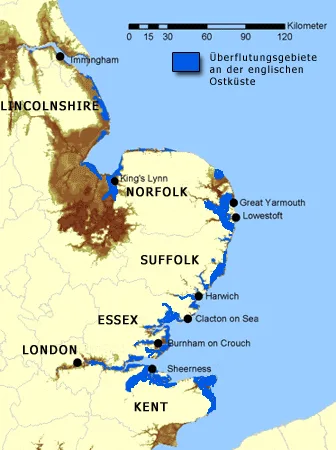
1953 – The North Sea Flood assail the east coast of Britain killing 280 people. ‘The combination of wind, high tide, and low pressure caused the sea to flood land up to 5.6 metres (18 ft 4 in) above mean sea level.’ (Wikipedia).
Map illustrating the extent of the Great Flood of 1953 in the United Kingdom Deutsch: Sturmflut von 1953 Date 25 September 2008 Source: Draco. GNU Free Documentation License
You might like to see some great pictures of the floods here.
First Published 2025, revised and OnThis Day added 2026
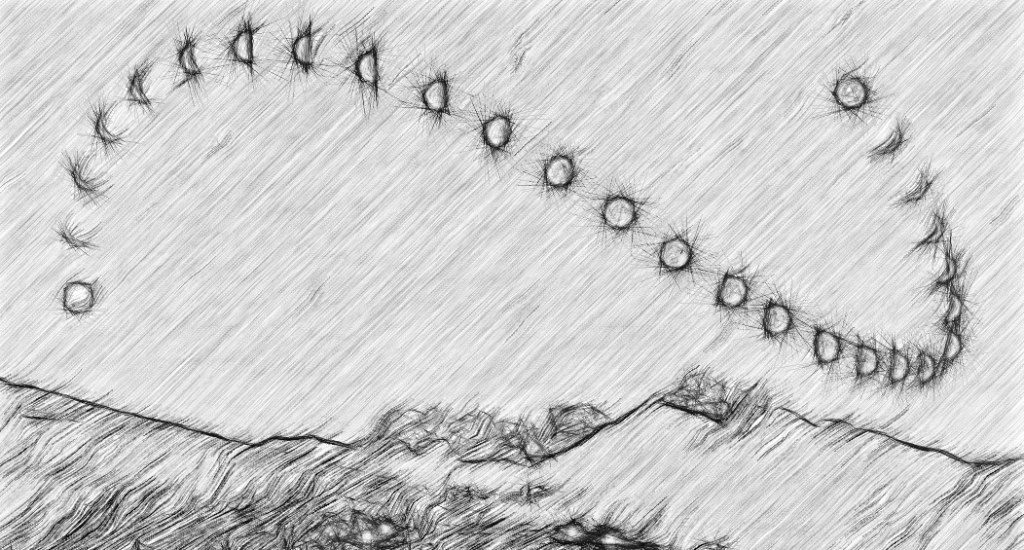
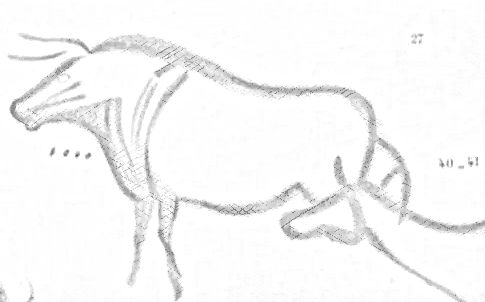
This page is about the discovery of evidence for an Ice age Lunar Calendar. The alignment of Neolithic and Bronze Age monuments shows that there was a calendar of the year in use. But in 2023, evidence of a Palaeolithic Calendar was discovered by an ‘amateur’. Furniture maker Ben Bacon studied markings in cave paintings at Lascaux, Altamira and other caves.
Sketch of 23,000 year old cave painting, below the head of the animal are 4 dots which are thought to be lunar months of the mating season
He collaborated with Professors at UCL and Durham. They interpreted markings showing the use of an Ice age Lunar Calendar to mark the mating season of particular animals. A Y shaped mark he interpreted as meaning ‘giving birth’. The number of dots or dashes drawn by or in the outline of the creature coincided with their mating season. They determined this by studying the mating season of modern animals, which corresponded with the palaeolithic markings.
At Stonehenge, there are suggestions that the alignments to Midsummer and Midwinter Solstices stretch further back into the Mesolithic period. (For more about Stonehenge see my post).
On this Day! A Whopping, whopping mallard!
1437 – Workmen discovered a giant Mallard which inaugurated ‘Mallard Day’ at All Souls, College, Oxford. It must have been colossal, as they celebrated with an annual torch lit duck hunt on the nearby River Thames.
Sadly, it is no longer annual and has been relegated to a once-a-century event. Each year, however, all they do is sing the song:
Griffin, Bustard, Turkey, Capon, Let other hungry mortals gape on, And on the bones their stomach fall hard, But let All Souls men have their Mallard. Oh! by the blood of King Edward. Oh! by the blood of King Edward. It was a whopping, whopping mallard.
Therefore, let us sing and dance a galliard, To the remembrance of the mallard. And as the mallard dives in pool, Let us dabble, dive and duck in bowl. Oh! by the blood of King Edward. Oh! by the blood of King Edward. It was a whopping, whopping mallard
Chambers. Book of Days, 1864
1872 Greyfriars Bobby died. Bobby was a Skye Terrier or Dandie Dinmont Terrier. When his master died, he spent 14 years guarding his owner’s grave in the famous Greyfriars’ graveyard in Edinburgh. There are books, there are films, there are statues. But facts are in short supply. One claim is that stray dogs have been known to find their way into graveyards, people feed them. The dog makes it their home. So Bobby may not have been related to anyone buried there, and was devoted to the food he was given. But then that ruins a good story.
GreyfriarsInformation Board for statue of Greyfriars BobbyStatue of Greyfriars BobbyBurial Stone marking the grave of Greyfriars Bobby