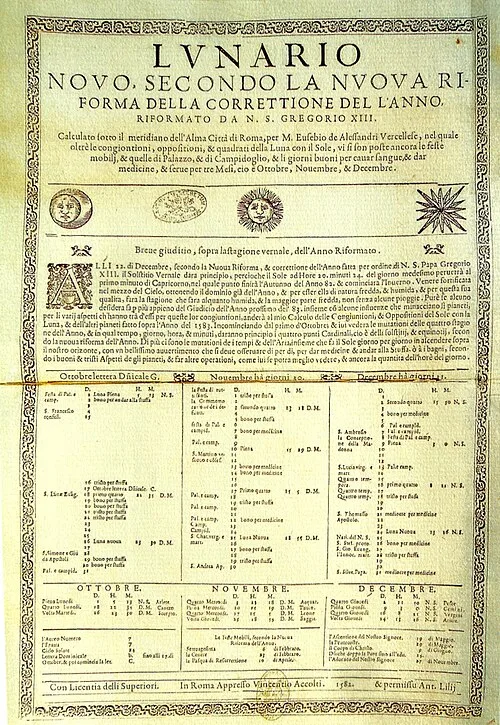
Gregorian Calendar, Lunario Novo, Secondo la Nuova Riforma della Correttione del l’Anno Riformato da N.S. Gregorio XIII,[k] printed in Rome by Vincenzo Accolti in 1582, one of the first printed editions of the new calendar
On February 24th 1582 – Pope Gregory XIII published the papal bull Inter gravissimas. This announced amendments to the Julian Calendar created by Julius Caesar and created the Gregorian Calender. Caesar had realigned the Roman Calendar with the Solar Year, creating a ‘Year of Confusion’. The year was 445 days long but it resynced the days to their proper season.
The Julian Calendar
The Julian Calendar used leap years to align the Calendar Year with the Solar Year. But the earth does not cycle the Sun in 365.25 days. This is an overestimate of 1 day every century. So, since the time of Caesar, the year had got 10 days out of kilter. Gregory chopped those 10 days out of the Calendar. The 4th of October 1582, was to be followed by the 15th October 1582. This might seem simple, but imagine you are receiving your salary for October, and you find it 10 days short? Or you have a month to pay your debt and find it called in 10 days early? So the Pope ordered that these 10 missing days shouldn’t be used in calculating financial matters.
Computus
One of the main reasons for the reform was the ‘Computus’. This was the method of calculating Easter. Easter was a festival that followed the movements of the Moon but was synced into the Vernal Equinox. (The timing of Easter is the first full moon after the Vernal Equinox.). So the chopping of 10 days meant that the vernal equinox was set back to its proper place on March 21st. Arguments over the correct calculations of Easter had, in the 7th Century been a major stumbling block in uniting the Celtic Church in Britain with the Roman Catholic Church. (See my post on Easter here).
But this still left the drift caused by Caesar’s faulty leap year system. Gregory’s reforms stopped future drift by fine-tuning the leap years. From 1582 there would not be a leap year in those centurial years which were not divisible by 400. So 2000 was a leap year, but 2100 is not. This skips ‘three Julian leap days in every 400 years, giving an average year of 365.2425 mean solar days long.’ (Wikipedia). This keeps us aligned, although there is still a small error.
If you enjoy this sort of calendrical detail, you will love ‘The Calendar’ by David Ewing Duncan.
British Exceptionalism
Of course, Britain refused to join a Catholic innovation for nearly 200 years. But, religious prejudice at last gave way to reason, when we adopted the Gregorian Calendar in 1752. In the process, we lost 11 days, much to the horror of the London mob, who rioted against their loss.
Greece was the last European state to join in 1923. Japan joined in 1873, China in 1912, and Saudi Arabia in 2016. Ethiopia, Iran, Afghanistan, and Nepal keep distinct calendrical traditions. (see seasia.co for more details.) Strictly, we are using the Gregorian amendment to the Julian Calendar because it has all the elements of the Julian Calendar except a couple of adjustments.
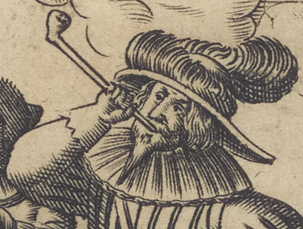
Coltsfoot is a daisy-like plant which is flowering about now. Gerard’s Herbal of 1633 suggests that the ‘fumes of the dried leaves taken through a funnel’ is good for those with coughs and shortness of breath. He suggests that it is smoked like tobacco and it ‘mightly prevaileth.’
This idea, Mrs Grieves says in her herbal (1931), is endorsed by ‘Dioscorides, Galen, Pliny, and Boyle’. And Coltsfoot is ‘nature’s best herb for the lungs’. (This is historic information re herbs and NOT current medical advice, as Coltsfoot can be very dangerous!).
Detail from Lobspruch deß edlen hochberühmten Krauts Petum oder Taback Nuremberg, 1658 New York Public Library Public Domain
My grandson and parents found a 19th Century pipe bowl, much like the one pictured here, by the Thames where there were many fragments of clay pipe. For more on 17th Century smoking, have a look here.
On This Day
In Rome February 24th was the day of the 4 yearly leap day. The way they did it was to have two days called February 24th! It was the sixth day before the Calendars (March 1). This practice gradually got replaced by adding a new day, February 29th, at the end of the Month. In England, February 29th starts appearing in the 15th Century. But Wikipedia tells me:
‘the proceedings of the House of Commons of England continued to use the old system until the middle of the sixteenth century. It was not until passage of the Calendar (New Style) Act 1750 that 29 February was formally recognised in British law.’
It is said that the owner and playwright Richard Brinsley Sheridan replied to someone who was surprised to see him sitting quietly having a drink while his theatre burnt down: “A man may surely be allowed to take a glass of wine by his own fireside?” londonist.com
1832 – Cholera in London
‘The news of the Cholera being in London has been received abroad. According to the feelings of the different nations towards England, France, who wish to court us has ordered a quarantine in her ports of three days; Holland, who feels aggrieved by our conduct at the conference, one of 40 days. The fog so thick in London that the illuminations for the Queen’s Birthday were not visible. ‘
24th February 1832 Thomas Raikes, Diary 1832 (from ‘A London Year’ Compiled by Travis Elborough and Nick Bennison, 2013,
This was the second Cholera Pandemic, but the first to reach the UK. The second landed in Sunderland in October 1831. Cholera killed over 6,000 in London. It was called the Asiatic Cholera based on its origin. The Cholera came more virulently in subsequent decades. It was thought to be spread by a miasma in the air. But, John Snow proved it was caused by polluted water, but I will tell that story in another post.
I think the Conference mentioned above was the London Conference of May 1832, which aimed to establish a Kingdom of Greece with King. It was set up by Foreign Secretary Lord Palmerston without discussion with the Greeks and ended up giving them a Bavarian King. King Otto. Otto was forced from the throne in a revolution in 1862, and replaced by a Danish King, from whom Prince Philip, Duke of Edinburgh was descended.
1920 –The Conservative MP, Nancy Astor becomes the first woman to speak in the House of Commons. Constance Markievicz was the first woman elected as an MP in 1918, but she was a member of Siin Fein and did not take her seat.
First published in February 2024, republished in 2025, The Gregorian Calendar added in 2026, and On This Day also added. And Retitled too.
I was failing to find anything of significance to post when I came across a London Walks post about Stanley Green. Green was born on February 22nd in 1915. Most people who lived in London at the time, knew of him. He was always to be seen patrolling Oxford Street and other Central London Streets with his placard. He mounted a one-man campaign against too much protein. He thought it was a factor in promoting Lust. Lust was a bad thing. He campaigned, religiously, from 1969 to 1993, when he died.
Whether you agree with his views or not it is doesn’t diminish the impact an ordinary person had on an entire City. For more about him, including a podcast, have a look at the London Walks page here:
This post is dedicated to those people who are prepared to give up their normal lives to campaign for something they really believe in. If move of us did, the world would be a better but perhaps more eccentric world.
Mr Stop Brexit
Steve Bray, also known as Stop Brexit Man. (Wikipedia CC0)
Another one man campaigner, Mr Stop Brexit, Steve Bray, was to be seen outside Parliament, most days in the run up to Brexit. He perfected photobombing techniques, appearing in the background of interviews of prominent Brexit campaigners, or was heard over his megaphone. He is from Splott in Wales, and said he lost all his friends because they supported Brexit. He continues to campaign.
I must admit, I briefly considered dedicating my life to going to events Jacob Rees-Mogg attended, shouting ‘Brexit Opportunities!’ and collapsing in ironic laughter.
On this day contains items I come across. But more often from looking at Chambers Book of Days, or Wikipedia’s page for the date (today February 22nd). Occasionally I use the Perpetual Almanac of Folklore by Charles Kightley, or other almanacs, and random websites.
Sadly, i cannot find very much that interests me to day!
In Ancient Rome, today, was the Caristia, the day of family peace and household accord, dedicated to Concordia. The previous days have been dedicated to the dead. Today is for the living family members. Ovid seems pleased to return to the living but makes it clear the day is best enjoyed without the really annoying members of the family!
Ovid writes of the day as follows:
Book II: February 22 The next day has its name, Caristia from our dear ‘cari’ (kin), When a throng of relations gathers to the family gods. It ís surely pleasant to turn our faces to the living, Once away from our relatives who have perished, And after so many lost, to see those of our blood Who remain, and count the degrees of kinship. Let the innocent come: let the impious brother be far, Far from here, and the mother harsh to her children, He whose father ís too long-lived, who weighs his mother’s years, The cruel mother-in-law who crushes the daughter-in-law she hates. Be absent Tantalides, Atreus, Thyestes: and Medea, Jason’s wife: Ino who gave parched seeds to the farmers: And Procne, her sister, Philomela, and Tereus cruel to both, And whoever has gathered wealth by wickedness. Virtuous ones, burn incense to the gods of the family, (Gentle Concord is said to be there on this day above all) And offer food, so the robed Lares may feed from the dish Granted to them as a mark of esteem, that pleases them. Then when moist night invites us to calm slumber, Fill the wine-cup full, for the prayer, and say: Health, health to you, worthy Caesar, Father of the Country! And let there be pleasant speech at the pouring of wine.
From A S Kline’s translation of Fasti which can be found here.
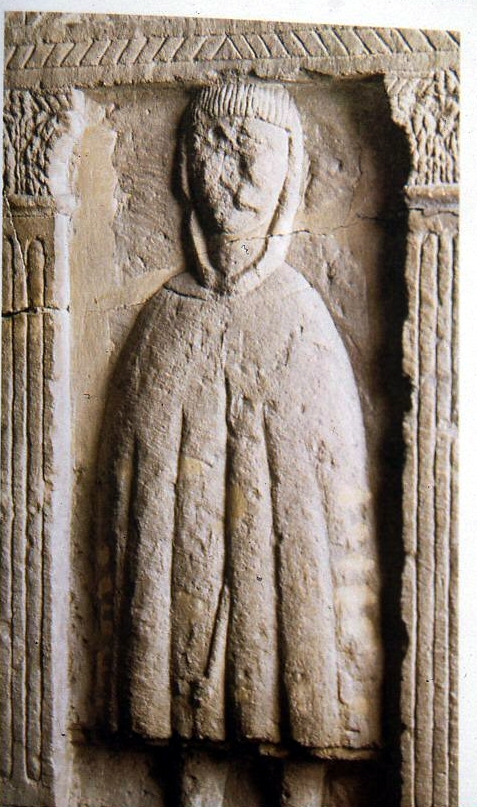
Tombstone of Philus from Cirencester (Corinium Dobunnorum) showing his rain cloak
Feralia & Parentalia
Feralia is the last day of Parentalia a 9-Day Festival for the spirits of the Dead. It is described in some detail by the Roman Poet, Ovid, in his Almanac of the year called the ‘Fasti’. Here, he describes how to honour a parent:
And the grave must be honoured. Appease your father’s Spirits, and bring little gifts to the tombs you built. Their shades ask little, piety they prefer to costly Offerings: no greedy deities haunt the Stygian depths. A tile wreathed round with garlands offered is enough, A scattering of meal, and a few grains of salt, And bread soaked in wine, and loose violets: Set them on a brick left in the middle of the path. Not that I veto larger gifts, but these please the shades: Add prayers and proper words to the fixed fires.
There is much more Ovid says about Feralia, and you can read it for free, in translation by A. S. Kline (which I used above, at www.poetryintranslation.com)
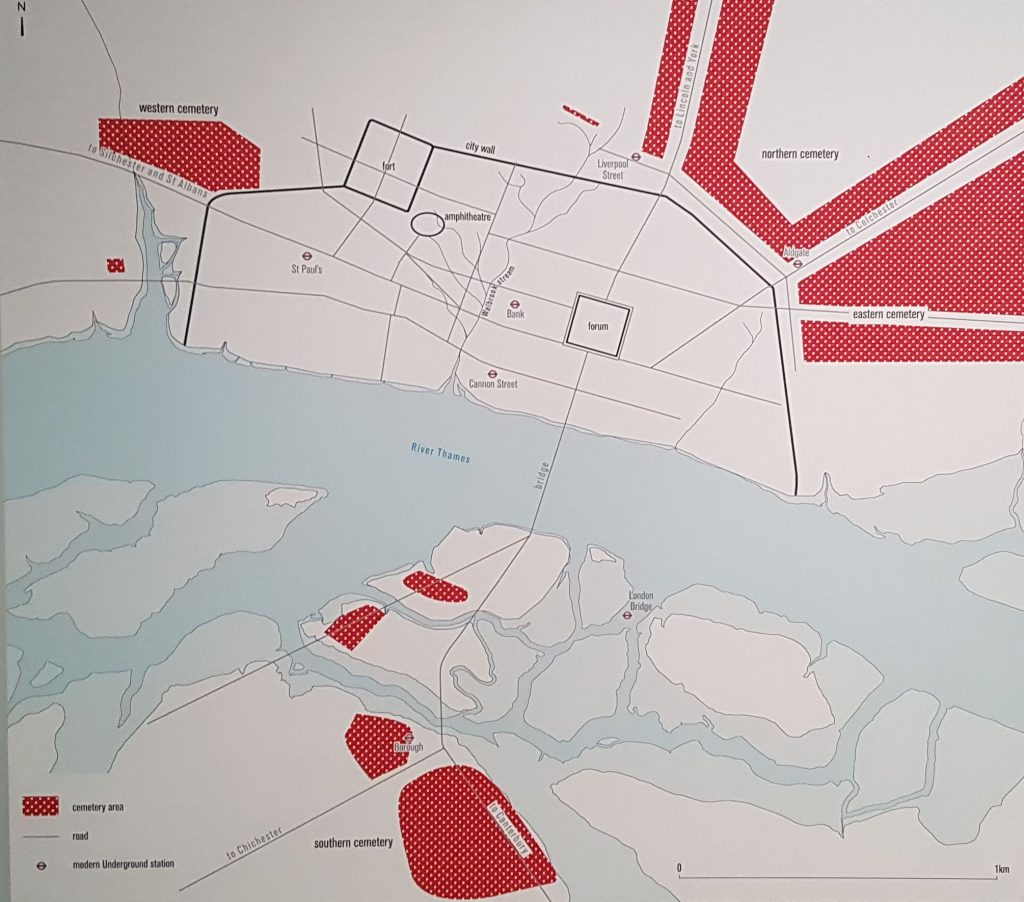
In London, archaeologists have found many Roman cemeteries around the City of London. The Romans forbade burial inside the City limits. So, the dead were buried alongside the main roads out of the City Gates. Aldgate towards Colchester, Bishopsgate to the North. Ludgate along Fleet Street to the West. Newgate to Holborn and the North West. From London Bridge to Southwark and the South. These are the places that parents would be remembered at Feralia.
Map of Roman Cemeteries from the Museum of London exhibition on the Roman Dead, showing the River Thames and River Fleet. Holborn is to the left, marked ‘Western Cemetery’.
Roman Burials
Roman Mortaria
Various rites have been observed. Both inhumation and cremation were practised. I remember excavating a Roman mortaria with a hole in the bottom with the ashes of the dead in it. These large bowls were used as a mortar for grinding foodstuffs. The bottom was deliberated gritted, but they often wore through, and sometimes were reused to hold cremation ashes. I like to imagine, granny being buried in her favourite cooking vessel (or maybe a grandad who baked?).
Many bodies were covered in chalk, perhaps to help preserve the body. A surprising number of bodies are found with the head by the knees. The large number of cases fuels speculation that this was a burial rite, of whom only a percentage were beheaded as a punishment. In York, near Micklegate archaeologists found a large number of beheaded graves in a cemetery thought to be of gladiators. Other graves shown signs of a funeral pyre.
Author’s photograph of a skeleton displayed at the Roman Dead Exhibition, Museum of London, She was between 26 and 35 years old, who lived a hard life, and possibly had anaemia. Her head was severed either: before and causing death, or shortly after death, and placed between her legs as shown.
Procurator Classicianus.
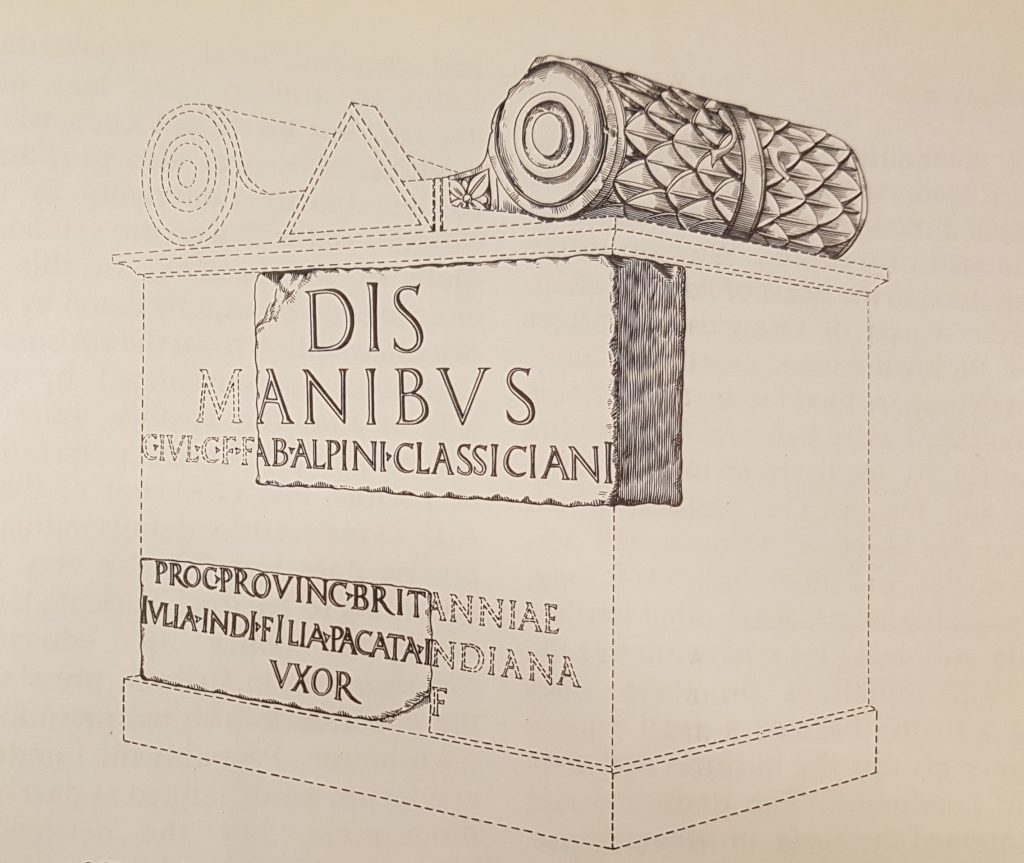
The rich and powerful were remembered with huge monuments, prominently sited along the main roads. The most famous are the burial stones found at Tower Hill of the Procurator Classicianus. What makes this special is that he is mentioned in Roman accounts of the Boudiccan Revolt of AD 60-61. He suggested to Nero that the Province would only be saved if the revenge against the British was de-escalated. Nero wisely withdrew the vengeful Roman Governor Suetonius Paulinus and replaced him with someone ready to conciliate. The Romans held the province successfully for 350 years or so more.
Reconstruction drawing of two stones found while building Tower Hill Underground Station. They read, something like, ‘To the Spirits of the Dear Departed Fabius Alpini Classicianius, Procurator of the Province of Britannia.Julia, Indi (his wife) Daughter of Pacata of the Indiana voting tribe. Had This Set up.
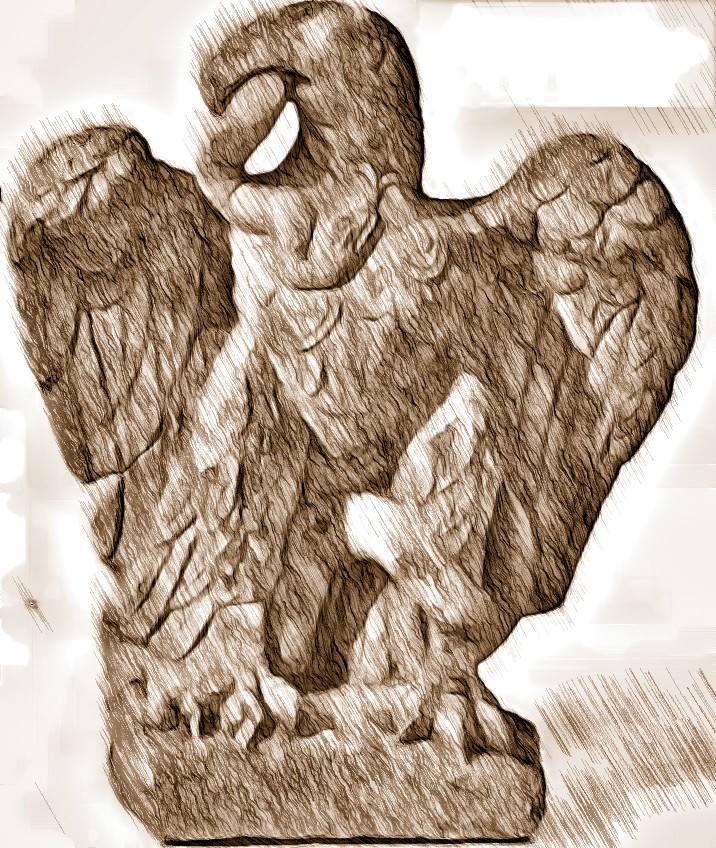
Sketch of a stone Eagle found in 2013 at an excavation at the Minories just outside the eastern side of the Roman Wall in the City of London.
A beautiful carved eagle which adorned a tombstone was found in the Cemetery in Tower Hamlets. Recently, a very grand mausoleum was excavated in Southwark. To find out more, have a look at the BBC website here:
Funerary Bed in Holborn
Finally, a couple of years ago an excavation ran by MOLA discovered a ‘funerary bed’ just outside Newgate in Holborn. It was on the banks of the River Fleet, a tributary to the River Thames. The fluvial location meant that there were extraordinary levels of preservation, which included this bed. It was dismantled and buried in the grave. It may have been a bed used as a grave good, perhaps for use in the hereafter. Or it might have been the bed upon which the deceased was carried to the funeral. (Or both?)
Reconstruction of a Roman ‘Funerary’ Bed found dismantled in Holborn, London (Sketch from a MOLA reconstruction drawing)
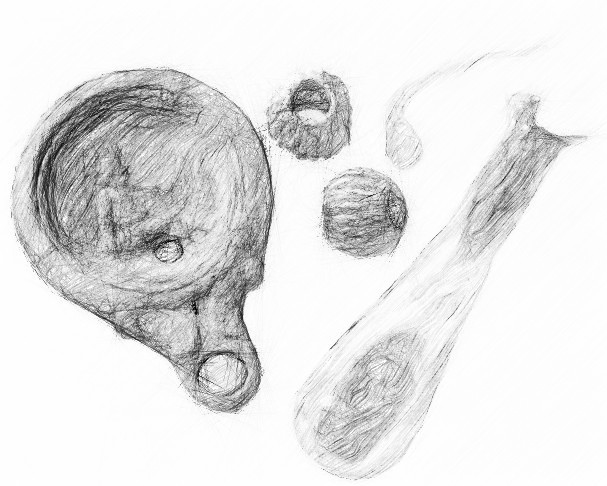
They found other grave goods. These included an olive oil lamp decorated with an image of a gladiator; jet and amber beads and a glass phial.
1804 – Richard Trevithick‘s steam locomotive is put on wheels at the Pen-y-Darren Ironworks in Wales. and shows its capability for pulling heavy loads. Unfortunately, the Engine weighs so much it breaks the rails, so the wheels are taken off.
Toad, Frogs & Newts Migration – as the weather warms up a little, later in February is when the amphibians wake up from hibernation, and begin their annual migration to their home pond for spawning. They may walk/hop/slither up to 2 kilometres. The kind people at www,froglife.org coordinate Toad Patrols to help toads across the roads that have sprung up along their traditional migration paths.
In the Garden – prune deciduous shrubs such as Buddleia and Spiraea. Sow seeds indoors. Order lots of compost.
First Published in February 2024, revised 2025, On this Day added 2026
Photo Mohammad Amiri from unsplash. Notice the crimson stigma and styles, called threads, Crocus is one of the characters in Ovid’s Metamorphoses
The story of Crocus and Smilax is in Ovid’s Metamorphoses. The book tells the story of myths which involve the metamorphosis of a person to a flower, or to a constellation, or to an echo or some supernatural change in being. This poem is one of the most famous in the world, written in about 6 AD. It influenced Dante, Bocaccio, Chaucer, Shakespeare, Keats, Bernard Shaw, and me. Seamus Heaney and Ted Hughes have translated modern versions of some of the tales.
The mechanicals in ‘The Midsummers Night Dream’ perform Ovid’s story of Pyramus and Thisbe, Titian painted Diana and Actaeon. Shaw wrote about Pygmalion, and we all know the story of Arachne. She claimed to be better than Athene at weaving. And then was turned into a spider.
The poem is about love, beauty, change, arrogance and is largely an Arcadian/rural poem. This is a contrast to Ovid’s ‘Art of Love’ which I use for illustrations of life in a Roman town. The stories are all about metamorphoses, mostly changes happening because of love. But it is also an epic as it tells the classical story of the universe from creation to Julius Caesar.
Ovid’s Metamorphoses and the Crocus
‘Crocus and his beloved Smilax were changed into tiny flowers.’ Ovid tell us, but chooses to give us no more details. So we have to look elsewhere. There are various versions. In the first, Crocus is a handsome mortal youth, beloved of the God Hermes (Mercury). They are playing with a discus which hits Crocus on the head and kills him. Hermes, distraught, turns the youth into a beautiful flower. Three drops of his blood form the stigma of the flower. In another version, Crocus and the nymph Smilax, fall in love. And are rewarded by immortality as a flower. One tale has Smilax turned into the Bindweed.
Morning Glory or Field Bindweed photo Leslie Saunders unsplash
Ovid’s Metamorphoses and Bindweed
It turns out that Smilax means ‘bindweed’ in Latin. Bindweed is from the Convolvulus family, and I have grown one very successfully in a pot for many years. But they have long roots. According to the RHS ‘Bindweed‘ refers to two similar trumpet-flowered weeds. Both of which twine around other plant stems, smothering them in the process. They are difficult to remove. This, could suggest that Smilax is either punished for spurning Crocus, or that she smothered him with love. Medically, Mrs Grieve’s Modern Herbal says all the bindweeds have strong purgative virtues, perhaps another insight into Smilax’s psychology?
The Metamorphosis of Data and the correct use of the plural
Apparently, in the UK some say crocuses and others use the correct Latin plural, croci. On an earlier version of this post I used the incorrect plural crocii.
On the subject of Roman plurals, the Financial Times editorial department made an earth-shattering decision, a couple of years ago. They updated their style guide to make the plural word data (datum is the singular form) metamorphise into the singular form.
So it is now wrong to say ‘data are’ but right to say ‘data is’. For example, it was correct to say: ‘the data are showing us that 63% of British speakers use crocuses as the plural’ but now, it is better to write ‘the data is showing us that 37% of British people prefer the correct Latin form of croci’.
Violets and Crocuses
Violets and crocuses are coming out. They often come out for St Valentine’s Day, and so obviously associated with Love. White croci usually represented truth, innocence, and purity. The purple variety imply success, pride and dignity. The yellow type is joy.’ according to www.icysedgwick.com/, which gives a fairly comprehensive look at the Crocus.
Crocus & Saffron
The autumn-flowering perennial plant Crocus sativus, is the one whose stigma gives us saffron. Roman civilisation spread the plants around Europe. They used it for medicine, as a dye, and a perfume. It was much sought after as a protection against the plague, and extensively grown in the UK. Saffron Walden was a particularly important production area in the 16th and 17th Centuries.
Saffron in London
Snowdrop, Crocus, Violet and Silver Birch circle in Haggerston Park. (Photo Kevin Flude, 2022)
The Bishop of Ely grew Saffrom in his beautiful Gardens just outside of the City of London. The area remembered by the London street name: Saffron Hill. It is home to the fictional Scrooge. This area became the London home of Christopher Hatton, the favourite of Queen Elizabeth 1. His garden was on the west bank of the River Fleet, in London EC1, in the area now known as Hatton Garden. (For more on Christopher Hatton see my post on nicknames Queen Elizabeth I gave to her favourites).
I found out more about Saffron from listening to BBC Radio 4’s Gardener’s Question time and James Wong.
Croydon (on the outskirts of London) means Crocus Valley. A place where Saffron was grown. The Saffron crops in Britain failed eventually because of the cost of harvesting, and it became cheaper to import it. So, we now import it from Spain, Iran, and India amongst other places. But it is being reintroduced in Norfolk, Suffolk, Kent, and Sussex. These are – the hot and dry counties. The plant enjoys a South-facing aspect. But it needs protection from squirrels and sparrows who love it. To grow it, look at this post from the Garden Doctor.
Saffron Photo by Vera De on Unsplash
Violets
Viola odorata CC BY-SA 2.5 Wikipedia
The Celts used Violets as cosmetics; the Athenians to moderate anger; the Iranians for insomnia, and are loved by all because of their beauty and fragrance. They have been symbols of death for the young, and used as garlands, nosegays posies, which Gerard says are ‘delightful’.
For more on Ovid, use the search facility (click on menu) or read my post here.
On This Day
197 – The Battle of Lugdunum sees the victory of Septimius Severus over Clodius Albinus reputedly the bloodiest battle between Roman armies. The previous emperor Pertinax died in 193 during the Year of the Five Emperors. Three main contenders emerged Severus who was African, Niger was from Central Italy, Albinus was the Governor of Britain.
1800 – Napoleon proclaims himself First Consul making him the dictator of France.
1846 – The Republic of Texas officially transfers power to the State of Texas government and becomes part of the United States.
1878 – Thomas Edison patents the phonograph.
1945 – Battle of Iwo Jima began with the landing of 30,000 US troops.
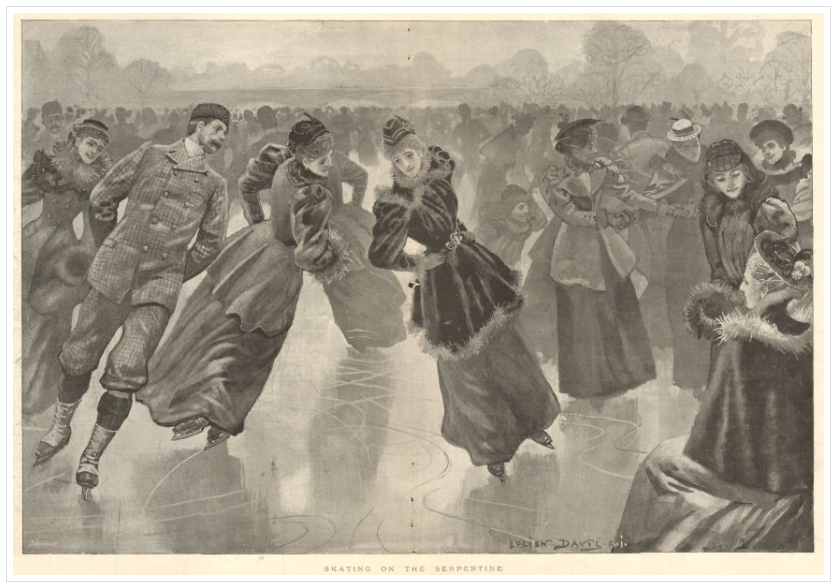
The Greeat Freeze. ‘Skating on the Serpentine’ by Lucien Davis Antique wood-engraved print. Illustrated London News double page from 2 March 1895 (print owned by K Flude)
The Great Freeze
London, February 12, (1895). There is no abatement of the abnormally cold weather which has prevailed in northern Europe for the last week. The Upper Thames is frozen over, and huge blocks of ice breaking away from the mass are floating down the river, causing much damage to the smaller shipping craft. Water traffic is consequently at a complete standstill.
Many cases of death from cold and exposure are reported, the privation and distress in the East End of the city being particularly severe. The cold is so intense that birds are found frozen to death on the branches of the trees, and thousands are perishing. The severe weather has also directly caused considerable mortality, a number of deaths from exposure having been reported among postmen, omnibus drivers, cabmen, and labourers.
Winter of 1895 Limehouse to left, Tower of London to right. Images from Isle of Dogs blog.
The year 1895 was the culmination of a decade of particularly cold winters (and for some the end of the so-called Little Ice Age). On the 11th February, the coldest day in British History was recorded at Braemar at −27.2 °C. February 1895 was the second coldest on record, with the lowest minimum temperatures on record. Shipping in the biggest port in the world was stopped. Therefore, many workers were laid off, and had to resort to what were then called ‘soup kitchens’ and now ‘food banks’. Winter death rates were said to be doubled, with people dying in the street and in unheated homes.
Record minima were set for these dates in February 1895:
7th: −21.7 °C or −7.1 °F
8th: −25.0 °C or −13.0 °F
9th: −23.9 °C or −11.0 °F
10th: −25.6 °C or −14.1 °F
11th: −27.2 °C or −17.0 °F
12th: −20.6 °C or −5.1 °F
13th: −21.9 °C or −7.4 °F
14th: −21.7 °C or −7.1 °F
16th: −23.9 °C or −11.0 °F
17th: −23.9 °C or −11.0 °F
18th: −23.9 °C or −11.0 °F
19th: −22.2 °C or −8.0 °F
Source Wikipedia.
On the flip side people resorted to ponds around London particularly the Serpentine which had 6 inches of ice and 50,000 skaters, with speed skating competitions.
1554 – Lady Jane Grey was executed after a trial at the Guildhall. Her husband was executed on the same day. Her adoption as heir to the throne was ordered by her cousin Edward VI. His minister, John Dudley, Duke of Northumberland, (and Jane’s Father-in-Law) arranged for the Privy Council to accept Jane as the next monarch. They were trying to prevent Henry VIII’s Catholic daughter, Mary taking the throne. Jane was Queen for 9 Days. The Privy Council swapped sides as support for Jane collapsed. Jane was the Great-granddaughter of Henry VII and cousins to Mary, Elizabeth and Edward VI.
1993 – The South African Government agrees with the African National Congress to form an elected interim government comprised of both black and white members.
Published February 12th 2024, and republished 2025, 2026
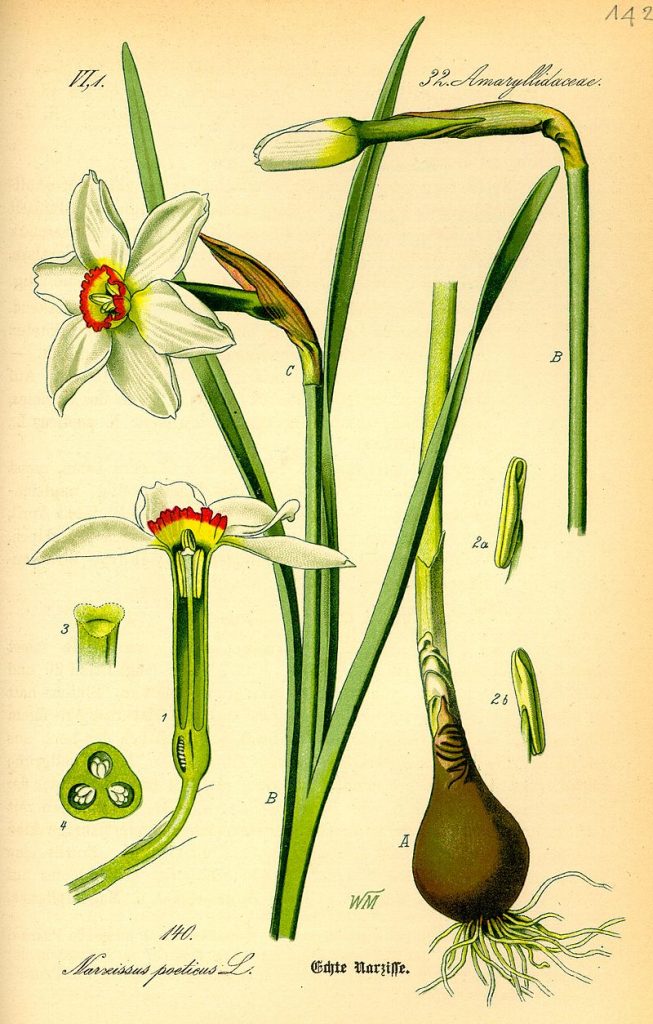
Daffodils & Narcissus. In 2023, I saw my first Daffodil in Hackney in a Council Estate on 12 January. My first daffodil in 2024 was outside my first floor window in early February. On February 11th, 2025, I saw the shoots of Daffodils in my garden but nothing blooming. However, there were daffodils on another Council Estate. In 2026, my first daffodil came out in early January. And the Estates and Parks around have been showing daffodils since late January. They bring such joy and hope for the return of the Sun.
12 Jan 2023. Hackney, London, the first Daffodil.
Narcissus the Flower
Their formal name is Narcissus. The Roman natural historian, Pliny tells us that the plant was:
‘named Narcissus from narkē not from the fabulous boy.’
Narkē is the Greek word from which we derive the word narcotic. It is a reference to the narcotic properties of the narcissus. An extract of the bulb applied to open wounds produced numbness of the whole nervous system and paralysis of the heart. The flowers are also slightly poisonous. So, they were used as an emetic. They brought on vomiting when it was felt necessary that the stomach be emptied. It was used to treat hysteria and epilepsy. They treated children with bronchial catarrh or epidemic dysentery. Among Arabian doctors, it was used to cure baldness and as an aphrodisiac. (Source: A Modern Herbal by Mrs M Grieve.) Please remember these are not recommendations for use medicinally, but are historic uses and may be dangerous.
The Fabulous Boy
The fabulous boy, mentioned by Pliny, was Narcissus. He, according to the Roman Poet Ovid, met the nymph Echo, and she fell in love with the beautiful boy. He spurned her, and she faded until all that remained of her was her voice – the echo we hear.
Nemesis, the Goddess of Revenge (the one with the fiery sword) decided on revenge upon the handsome boy. She lured the thirsty youth to a fountain, where, in the pool around the fountain, he saw an image of a breathtakingly handsome boy. He fell instantly in love with such beauty. But it was an image of himself. Realising he would never meet anyone as fabulous as himself, he faded from life. He eventually metamorphised into a white and yellow flower, which was named after him.
Nemesis, with her fiery sword, from the painting on the Staircase at Hampton Court by Antonio Verrio, Photo K Flude
Daffodils & Shakespeare
Daffodils are mentioned in a list of Spring Flowers by Shakespeare in the pastoral play The Winter’s Tale:
(Please note that as you read Shakespeare’s words below that Prosperpina is the wife of Pluto, the God of the Underworld, Dis, is another name for him, Cytherea is the Goddess of Beauty and Love. Phoebus is the Sun God. And the Spring Flowers are Daffodils, violets, primroses, oxlips (primula), Crown Imperial (Fritillaria imperialis), Lilies, flower-De-luce (Iris)
Perdita to Camillo
Out, alas! You’d be so lean that blasts of January Would blow you through and through. (To Florizel) I would I had some flowers o’th’ spring, that might Become your time of day – (to the Shepherdesses) That wear upon your virgin branches yet Your maidenheads growing. O Proserpina, For the flowers now that, frighted, thou let’st fall From Dis’s waggon! Daffodils, That come before the swallow dares, and take The winds of March with beauty; violets, dim, But sweeter than the lids of Juno’s eyes Or Cytherea’s breath; pale primroses, That die unmarried ere they can behold Bright Phoebus in his strength – a malady Most incident to maids; bold oxlips and The crown imperial; lilies of all kinds, The flower-de-luce being one: O, these I lack To make you garlands of, and my sweet friend To strew him o’er and o’er!
WT IV.iv.110.2
The reference to Daffodils suggests that for Shakespeare they are around to withstand the March Winds before the Swallows arrive in April. With selective breeding, early flowering species have been developed. Now February and even January are within the scope of the glorious bulb. (here is a post on winter flowering varieties). For my post on Shakespeare & Winter see here.
Once a noisy Nymph, (who never held her tongue when others spoke, who never spoke till others had begun) mocking Echo, spied him as he drove, in his delusive nets, some timid stags.—For Echo was a Nymph, in olden time,—and, more than vapid sound,—possessed a form: and she was then deprived the use of speech, except to babble and repeat the words, once spoken, over and over. Juno confused her silly tongue, because she often held that glorious goddess with her endless tales, till many a hapless Nymph, from Jove’s embrace, had made escape adown a mountain.
But for this, the goddess might have caught them. Thus the glorious Juno, when she knew her guile; “Your tongue, so freely wagged at my expense, shall be of little use; your endless voice, much shorter than your tongue.” At once the Nymph was stricken as the goddess had decreed;—and, ever since, she only mocks the sounds of others’ voices, or, perchance, returns their final words.
One day, when she observed Narcissus wandering in the pathless woods, she loved him and she followed him, with soft and stealthy tread.—The more she followed him the hotter did she burn, as when the flame flares upward from the sulphur on the torch. Oh, how she longed to make her passion known! To plead in soft entreaty! to implore his love! But now, till others have begun, a mute of Nature she must be. She cannot choose but wait the moment when his voice may give to her an answer. Presently the youth, by chance divided from his trusted friends, cries loudly, “Who is here?” and Echo, “Here!” Replies. Amazed, he casts his eyes around, and calls with louder voice, “Come here!” “Come here!” She calls the youth who calls.—He turns to see who calls him and, beholding naught exclaims, “Avoid me not!” “Avoid me not!” returns. He tries again, again, and is deceived by this alternate voice, and calls aloud; “Oh let us come together!” Echo cries, “Oh let us come together!” Never sound seemed sweeter to the Nymph, and from the woods she hastens in accordance with her words, and strives to wind her arms around his neck.
He flies from her and as he leaves her says, “Take off your hands! you shall not fold your arms around me. Better death than such a one should ever caress me!” Naught she answers save, “Caress me!” Thus rejected she lies hid in the deep woods, hiding her blushing face with the green leaves; and ever after lives concealed in lonely caverns in the hills. But her great love increases with neglect; her miserable body wastes away, wakeful with sorrows; leanness shrivels up her skin, and all her lovely features melt, as if dissolved upon the wafting winds—nothing remains except her bones and voice—her voice continues, in the wilderness; her bones have turned to stone. She lies concealed in the wild woods, nor is she ever seen on lonely mountain range; for, though we hear her calling in the hills, ’tis but a voice, a voice that lives, that lives among the hills.
Thus he deceived the Nymph and many more, sprung from the mountains or the sparkling waves; and thus he slighted many an amorous youth.—and therefore, some one whom he once despised, lifting his hands to Heaven, implored the Gods, “If he should love deny him what he loves!” and as the prayer was uttered it was heard by Nemesis, who granted her assent.
There was a fountain silver-clear and bright, which neither shepherds nor the wild she-goats, that range the hills, nor any cattle’s mouth had touched—its waters were unsullied—birds disturbed it not; nor animals, nor boughs that fall so often from the trees. Around sweet grasses nourished by the stream grew; trees that shaded from the sun let balmy airs temper its waters. Here Narcissus, tired of hunting and the heated noon, lay down, attracted by the peaceful solitudes and by the glassy spring.
There as he stooped to quench his thirst another thirst increased. While he is drinking he beholds himself reflected in the mirrored pool—and loves; loves an imagined body which contains no substance, for he deems the mirrored shade a thing of life to love. He cannot move, for so he marvels at himself, and lies with countenance unchanged, as if indeed a statue carved of Parian marble. Long, supine upon the bank, his gaze is fixed on his own eyes, twin stars; his fingers shaped as Bacchus might desire, his flowing hair as glorious as Apollo’s, and his cheeks youthful and smooth; his ivory neck, his mouth dreaming in sweetness, his complexion fair and blushing as the rose in snow-drift white. All that is lovely in himself he loves, and in his witless way he wants himself:—he who approves is equally approved; he seeks, is sought, he burns and he is burnt.
And how he kisses the deceitful fount; and how he thrusts his arms to catch the neck that’s pictured in the middle of the stream! Yet never may he wreathe his arms around that image of himself. He knows not what he there beholds, but what he sees inflames his longing, and the error that deceives allures his eyes. But why, O foolish boy, so vainly catching at this flitting form? The cheat that you are seeking has no place. Avert your gaze and you will lose your love, for this that holds your eyes is nothing save the image of yourself reflected back to you. It comes and waits with you; it has no life; it will depart if you will only go.
Nor food nor rest can draw him thence—outstretched upon the overshadowed green, his eyes fixed on the mirrored image never may know their longings satisfied, and by their sight he is himself undone. Raising himself a moment, he extends his arms around, and, beckoning to the murmuring forest; “Oh, ye aisled wood was ever man in love more fatally than I? Your silent paths have sheltered many a one whose love was told, and ye have heard their voices. Ages vast have rolled away since your forgotten birth, but who is he through all those weary years that ever pined away as I?
Alas, this fatal image wins my love, as I behold it. But I cannot press my arms around the form I see, the form that gives me joy. What strange mistake has intervened betwixt us and our love? It grieves me more that neither lands nor seas nor mountains, no, nor walls with closed gates deny our loves, but only a little water keeps us far asunder. Surely he desires my love and my embraces, for as oft I strive to kiss him, bending to the limpid stream my lips, so often does he hold his face fondly to me, and vainly struggles up. It seems that I could touch him. ‘Tis a strange delusion that is keeping us apart. Whoever thou art, Come up! Deceive me not! Oh, whither when I fain pursue art thou? Ah, surely I am young and fair, the Nymphs have loved me; and when I behold thy smiles I cannot tell thee what sweet hopes arise. When I extend my loving arms to thee thine also are extended me—thy smiles return my own.
When I was weeping, I have seen thy tears, and every sign I make thou cost return; and often thy sweet lips have seemed to move, that, peradventure words, which I have never heard, thou hast returned. No more my shade deceives me, I perceive ‘Tis I in thee—I love myself—the flame arises in my breast and burns my heart—what shall I do? Shall I at once implore? Or should I linger till my love is sought? What is it I implore? The thing that I desire is mine—abundance makes me poor. Oh, I am tortured by a strange desire unknown to me before, for I would fain put off this mortal form; which only means I wish the object of my love away. Grief saps my strength, the sands of life are run, and in my early youth am I cut off; but death is not my bane—it ends my woe.—I would not death for this that is my love, as two united in a single soul would die as one.”
He spoke; and crazed with love, returned to view the same face in the pool; and as he grieved his tears disturbed the stream, and ripples on the surface, glassy clear, defaced his mirrored form. And thus the youth, when he beheld that lovely shadow go; “Ah whither cost thou fly? Oh, I entreat thee leave me not. Alas, thou cruel boy thus to forsake thy lover. Stay with me that I may see thy lovely form, for though I may not touch thee I shall feed my eyes and soothe my wretched pains.” And while he spoke he rent his garment from the upper edge, and beating on his naked breast, all white as marble, every stroke produced a tint as lovely as the apple streaked with red, or as the glowing grape when purple bloom touches the ripening clusters.
When as glass again the rippling waters smoothed, and when such beauty in the stream the youth observed, no more could he endure. As in the flame the yellow wax, or as the hoar-frost melts in early morning ‘neath the genial sun; so did he pine away, by love consumed, and slowly wasted by a hidden flame. No vermeil bloom now mingled in the white of his complexion fair; no strength has he, no vigor, nor the comeliness that wrought for love so long: alas, that handsome form by Echo fondly loved may please no more.
But when she saw him in his hapless plight, though angry at his scorn, she only grieved. As often as the love-lore boy complained, “Alas!” “Alas!” her echoing voice returned; and as he struck his hands against his arms, she ever answered with her echoing sounds. And as he gazed upon the mirrored pool he said at last, “Ah, youth beloved in vain!” “In vain, in vain!” the spot returned his words; and when he breathed a sad “farewell!” “Farewell!” sighed Echo too. He laid his wearied head, and rested on the verdant grass; and those bright eyes, which had so loved to gaze, entranced, on their own master’s beauty, sad Night closed. And now although among the nether shades his sad sprite roams, he ever loves to gaze on his reflection in the Stygian wave. His Naiad sisters mourned, and having clipped their shining tresses laid them on his corpse: and all the Dryads mourned: and Echo made lament anew. And these would have upraised his funeral pyre, and waved the flaming torch, and made his bier; but as they turned their eyes where he had been, alas he was not there! And in his body’s place a sweet flower grew, golden and white, the white around the gold.
Elbridge signed a bill which created a voting district packed with voters for the Democratric-Republican Party. It was said to be shaped like a salamander, and so by joining his name to the last part of salamander the name gerrymandering was created. Gerry was Vice-President under Madison. Please, could someone tell me how gerrymandering is at all compatible with Democracy and the Constitution of the United States? And why it is tolerated in so brazen a fashion?
1826 – University College London was founded.
It was originally called London University. Until this time, England only had Oxford and Cambridge as Universities. In order to attend or teach, the candidates had to belong to the Church of England. ‘No Catholics, No Jews, no Hindus’. But UCL was created to be open to all faiths. This alarmed conservatives so much that they founded King’s College in London as a counterweight. This created a collegiate University of London, which now has 17 constituent colleges. Imperial College left the federation to become a separate University in 2007. It now brands itself as ‘A world-leading university. 2nd in the world, 1st in the UK and Europe’. Here is a promo for the 200th Anniversary of UCL. I’m proud to have been an honorary lecturer for a few years.
1945 – Yalta Conference agrees to set up the United Nations to help prevent future World Wars.
1975 – Mrs Thatcher defeats Ted Heath to become leader of the Conservative Party.
First published in February 2023, revise and republished in February 2024, 2025, 2026
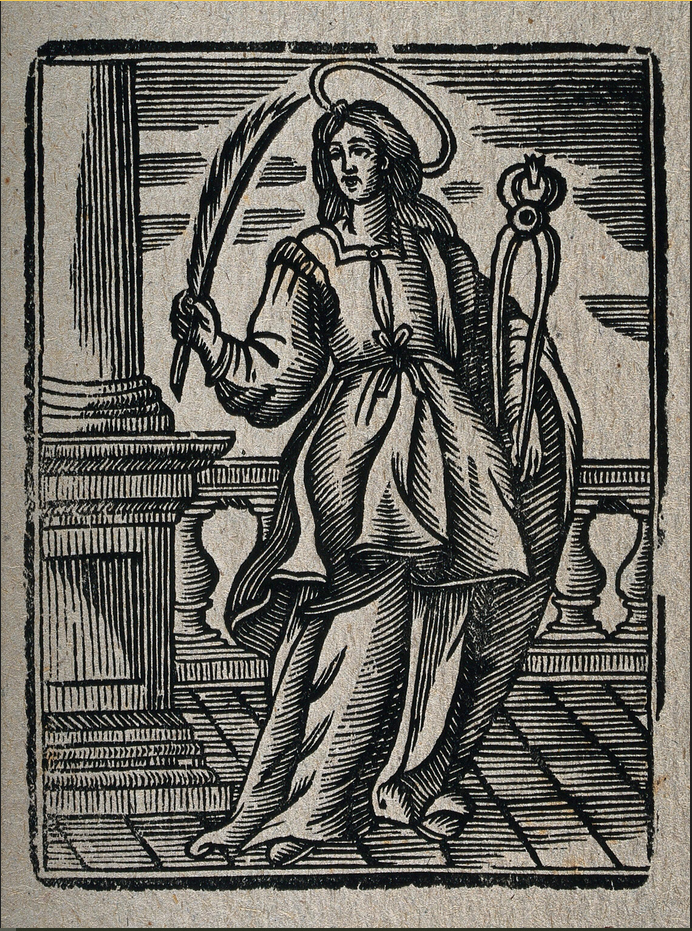
Saint Apollonia. Woodcut. Saint of Toothache Wellcome Collection. Public Domain Mark. She is shown with forceps, extracted tooth and the martyr’s palm.
The 9th of February is the Feast of St Apollonia. She was martyred at Alexandria in 249 AD during the persecution of Emperor Decius. (see also my post on St Agatha) She was attacked during an anti-Christian riot and struck around the face knocking her teeth out. Then, she was taken to a bonfire and told they would throw her in if she did not renounce her faith. So, without waiting, she spoke a prayer and walked into the fire. This information is recorded in a near-contemporary letter from St Dionysius of Alexandria. This is rare well documented martyrdom. Because her teeth were knocked out she is, therefore, Saint of Toothache.
Suicide or Martyrdom?
St Augustine of Hippo touches on this spat of martyrs, often young women, killing themselves rather than losing their virginity, or like St Apollonia embracing death in the face of violent persecution. His answer is that like Samson, they are commanded by God to take their own lives, which is ok. Elsewhere, he condemns suicide as it is against the commandment ‘Thou shalt not kill’. He explains that God did not add ‘thy neighbour’ to it so it also forbids killing oneself. By contrast, it was added to ‘Thou shalt not bear false witness against thy neighbour’. The rest of St Augustine’s argument comes from Plato’s Phaedo. The introduction to the book on the Project Gutenberg web site sums up the arguments:
According to one explanation, because man is a prisoner, who must not open the door of his prison and run away—this is the truth in a ‘mystery.’ Or (2) rather, because he is not his own property, but a possession of the gods, and has no right to make away with that which does not belong to him.
The Project Gutenberg EBook of Phaedo, by Plato translated by Benjamin Jowett
Cloves for Toothache
I can remember my Grandmother prescribing cloves for me when I had toothache. And this was, and is, a common remedy. In my case, we would keep a clove or two in the mouth close to the site of the pain. According to Natural Ways to Sooth an Toothache cloves contain
‘Eugenol, a natural form of anaesthetic and antiseptic that helps get rid of germs. Eugenol is still used in dental materials today’
Dr John Hall, Shakespeare’s son-in-law, tended to use a pill to soothe sore gums. He also used an oil from a wood called ‘Ol. Lig. Heraclei’ which may be oil from the Bay Tree. (‘John Hall and his Patients’ by Joan Lane). Most of his tooth cases seem to be sore gums. This suggests to me Dr John Hall did not generally do dental work.
Death by Toothache
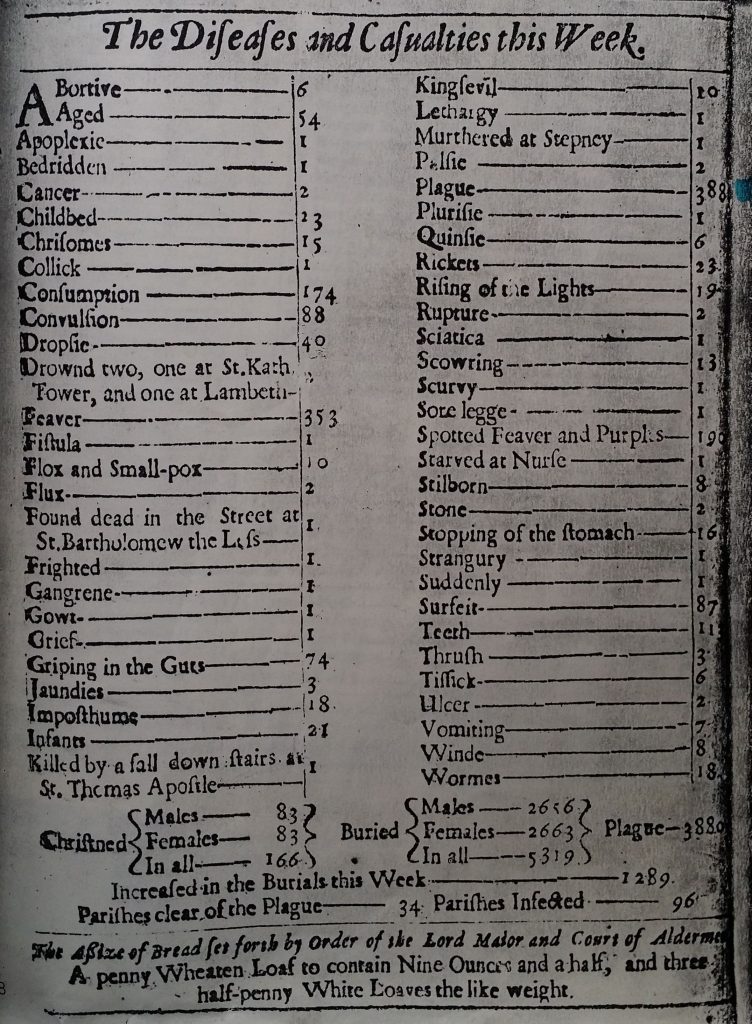
To get a tooth drawn you could go to a Barber Surgeon, a Blacksmiths or specialist Tooth Drawer. It would be terrifyingly painful. Probably only done when the pain was unbearable. Just think what a premium you would pay for a really competent drawer? The drawers would not have any formal training, but the skills would be passed on by the drawer to his apprentice or assistant. ‘Teeth’ was a common cause of death – most likely from infection or an abscess.
List of causes of death, London during the plague of 1665. Teeth killed 11 people
Magic and Toothache
John Aubrey, an erudite and educated 17th Century writer, reports on the use of Magick for tooth care. When he relates these unlikely cures he often provides information that the person who told him the story is worthy of belief. So he seems to give some credence to the efficacy of these magical ‘cures’. But, judge for yourself; this is what he wrote:
To Cure the Tooth-ach.
Take a new Nail, and make the Gum bleed with it, and then drive it into an Oak. This did Cure William Neal, Sir William Neal’s Son, a very stout Gentleman, when he was almost Mad with the Pain, and had a mind to have Pistoll’d himself.
To Cure the Tooth-ach, out of Mr. Ashmole’s Manuscript Writ with his own Hand.
Mars, hur, abursa, aburse. Iesu Christ for Marys sake, Take away this Tooth-ach.
Write the words, Three times; and as you say the Words, let the Party burn one Paper, then another, and then the last.
He says, he saw it experimented, and the Party immediately Cured
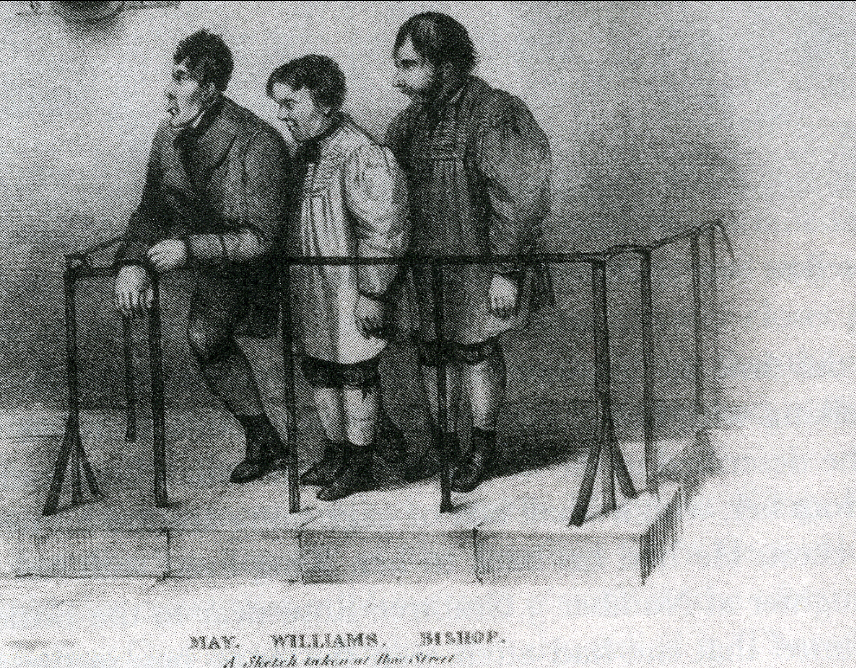
May, Williams and Bishop at the Old Bailey accused of murder in pursuit of bodysnatching
Teeth and the Body-Snatchers
In 1832, in London Bishop, Williams, and May were accused of body snatching. After killing the Italian Boy (wonderful book by Sarah Wise ‘The Italian Boy‘) they jemmied out his teeth. Then, took the teeth to a South London Dentist. with whom they bargained for a good price. (They used the term ‘cheapened’ – I cheap, you cheap, we are cheapening: meaning to barter). The dentist wanted to use the dead boy’s teeth for false teeth for his patients. If memory serves, he paid £1 for them.
The teeth were used as evidence in the trial of the murderers. When the trial was over and the accused punished, the dentist asked for the teeth back! Two of the murderers were hanged but the third freed for turning King’s Evidence. Thereafter, the teeth were released back to the Dentist. He promptly put them in the window of his surgery as an advert for his professional skills!
Earlier, one of the Borough Boys Resurrectionist gang (based in Southwark, London) toured the battlefields of the Peninsular Wars collecting teeth. He made a substantial sum selling them to dentists as false teeth. They became known as Waterloo Teeth.
When I first wrote this in I added ‘How things have changed!’ But in recent years there have been reports of people undertaking their own dental work, if they cannot get access to an NHS dentist. Effectively, it seems that the Conservative Government was allowing dentistry to slip out of the NHS just like it did with eye health. For a study in what has happened to Dentistry in the UK in recent years, please look at this report here.
On This Day
1907 – the National Union of Women’s Suffrage Societies (NUWSS or Suffragists) organised the so-called the Mud March. This was the ‘first large procession’ in support of votes for women. It was called the Mud March because of the downpour of rain on the day.
1916 – Conscription started in World War 1 with the call-up of unmarried men aged between 18 – 41.
1933 – The Oxford Union passed the resolution ‘the House will in no circumstances fight for King and Country.’
Bird of the Month The Blackbird. The common Blackbird is a true Thrush. The male is black with a yellow beak and the female is dark brown with a yellow beak. The Blackbird begins to sing as early as January, and is one of the birds who sing first early in the morning. British Blackbirds do not migrate, but Northern European Blackbirds often migrate to the UK in the winter for warmer weather. Viruses have put the species under some threat and they need help to get through the winter. ArkWildlife suggests this is what you should feed blackbirds:
‘Mealworms A top choice, mimicking their natural insect diet.
Is an 18th Century nursery rhyme which refers to the medieval habit of baking a pie crust, and putting it over a bowlful of live birds. When it was opened all the birds, well sing the song to remind yourself what they do?
Sing a song of sixpence A pocket full of rye Four and twenty blackbirds Baked in a pie When the pie was opened The birds began to sing Wasn’t that a dainty dish To set before the king?
The king was in his counting house Counting out his money The queen was in the parlor Eating bread and honey The maid was in the garden Hanging out the clothes When down came a blackbird And pecked off her nose
Sing a song of sixpence A pocket full of rye Four and twenty blackbirds Baked in a pie When the pie was opened The birds began to sing Wasn’t that a dainty dish To set before the king?
A stinging Cure for Lust
Another story told of the Blackbird is a similar tale I have told before about holymen and temptation. So St Benedict was pecked on the cheek by a Blackbird. Next day he finds himself assailed with lust. It was the Devil disguised as the Blackbird he decides that infected the Monk. Then Benedict did what a number of saints did in similar circumstances. He threw himself, naked, in a patch of nettles and brambles and rolled around, until his body was sore afflicted. But he had overcome his lust.
Then St Kevin held out his hand and a blackbird laid her eggs in it. So he stayed still for the two weeks it took the fledglings to hatch! (for more on St Kevin see my post here)
Icy Sedgwick has an excellent website on the folklore of Birds, containing a nice podcast, which for those who love a north-east accent will enjoy.
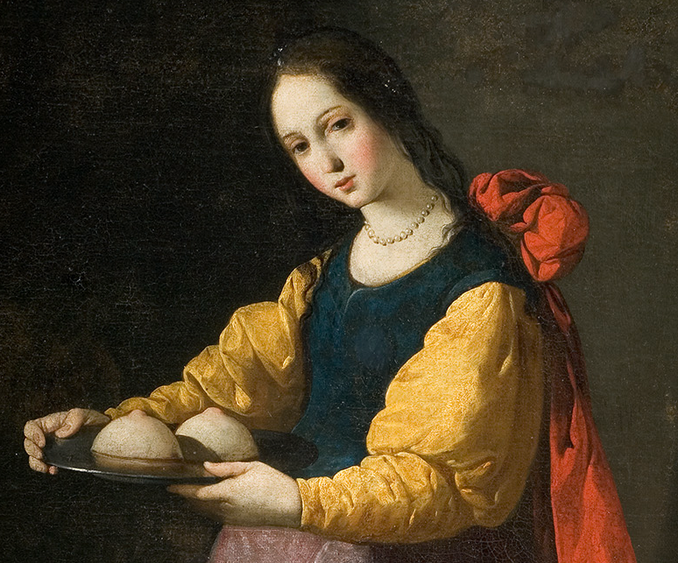
Saint Agatha, detail from a painting of Francisco de Zurbarán – she is carrying her severed breasts
She is a Sicilian Saint, who refused to sleep with a powerful Roman (Quintianus) in the third Century. St Agatha was imprisoned, tortured, had her breasts pincered off, and still refused to sleep with him and died in prison. She is remembered in Sicily by cakes shaped as breasts eaten on her feast day (I kid you not).
Minne di Sant’Agata, Sicilian (Wikipedia)
St Agatha Patronage
Her patronage springs from the usual mixture of deep and simplistic identifications. So she is ‘the patron saint of rape victims, breast cancer patients, martyrs, wet nurses, bell-founders, and bakers.’ As she is from Sicily ‘she is invoked against eruptions of Mount Etna.’ And therefore also against fire and earthquakes.’ (Wikipedia).
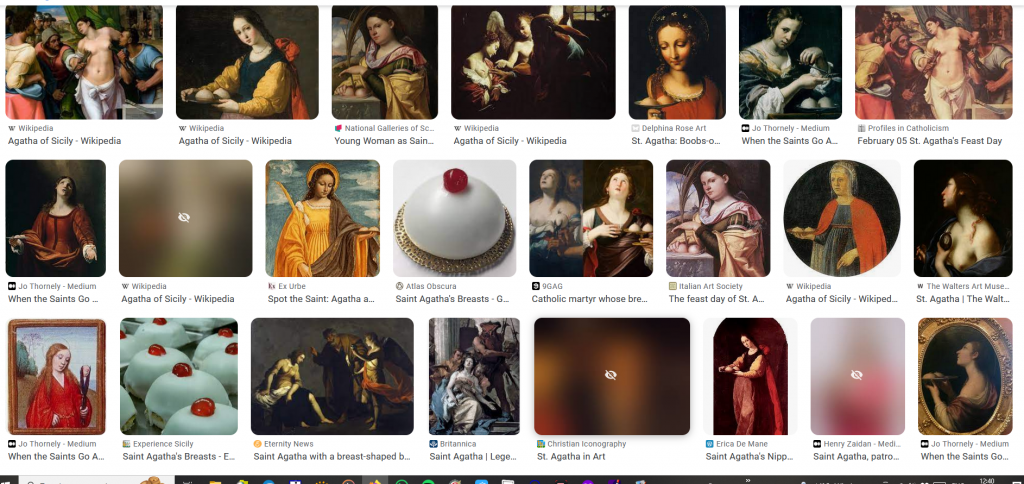
Bell Founders and Bakers? So, the bakers and bell founders, it is suggested, may have mistaken the trays of breasts as bells or loaves? Unlikely in my opinion, as Google image search shows they look clearly like breasts. They are cakes, of course, so that can help explain the Bakers, but the Bell Founders?
She was martyred, at the age of 20 (231-251AD), in the last year of the reign of Emperor Decius (Emperor 249 to June 251 AD). Thus, she is an early martyr whose cult was established in antiquity. But many of the details of her life and death are, as usual, apocryphal and from later traditions.
Results of a search for images of St Agatha in Google
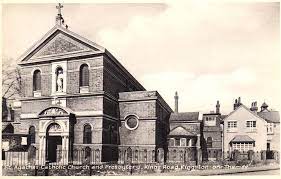
St Agatha’s Church, Kingston on Thames
St Agatha and Etna
Detail of a Portrait of St Agatha by Cariana (Paintedin 1516-17). In the backgrouns is Catania
A year after her death, Mount Etna erupted. According to the story, the Christians of her home town of Catania lifted the Martyr’s veil towards the flowing lava. And the City was saved as the lava flow stopped. Hence, she protects against eruptions and by extension, earthquakes, and fire. This part of the story I got from my friend Derek who sent me the link to a piece written by Father Patrick van der Vorst. This also has the full image of the detail of painting by Cariani I show here.
2 BC – Caesar Augustus is granted the title Father of the Country (pater patriae) by the Roman Senate. Ovid celebrated this day in his alamanac poet Fasti. He seems to be praising Augustus mentioning him with the divine Julius Caesar, and Romulus and Reamus, founders of Rome.
Book II: February 5: Nones
Now I wish for a thousand tongues, and that spirit Of yours, Homer, you who celebrated Achilles, While I sing the sacred Nones in alternating verse. This is the greatest honour granted to the calendar. My wit deserts me: the burden ís beyond my strength, This special day above all I am to sing. Why did I wish, foolishly, to lay so great a task On elegiac verse? This was a theme for the heroic stanza. Sacred Father of the Country, this title has been conferred On you, by the senate, the people, and by us, the knights. Events had already granted it. Tardily you received Your true title, you’d long been Father of the World. You have on earth the name that Jupiter owns to In high heaven: you are father of men, he of gods. Romulus, give way: Caesar by his care makes your walls Mighty: you made such as Remus could leap across. Tatius, and the little towns of Cures and Caenina, Knew you: under this Leader all the sun sees is Roman.
But suddenly the verse turns dark, and the references to Augustus are now slights and accusations. He continues:
You owned a little patch of conquered land: Caesar possesses all beneath Jupiter’s heavens. You raped married women: under Caesar they are ordered To be chaste: you permitted the guilty your grove: he forbids them. Force was acceptable to you: under Caesar the laws flourish. You had the title Master: he bears the name of Prince. Remus accused you, while he pardons his enemies. Your father deified you: he deified his father. Already Aquarius shows himself to the waist, And pours the gods flowing nectar mixed with water, And you who shrink from the north wind, be pleased, A softer breeze is blowing from the West.
Ovid only finished the first 5 chapters of his calendar poem. He was exiled from Rome by Augustus, we don’t know why. But perhaps this is why he was exiled, because he was willing to defame the Godly Tyrant, Augustus, who had destroyed the Roman Republic. Dictators demand flattery, not criticism. Ovid paid the price. For more on Ovid’s exile please read my post on his abandonment of the Fasti here.
1811 – The Prince of Wales appointed Prince Regent during his dad’s, George III, mental incapacity
1924 – The famous pips, the time signal, first broadcasted by the BBC from Greenwich
1944 – War time diarist, Joan Wyndham receives letter from Norwegian lover Hans Gundersen. It confirms he is still alive and that she loves him. Follow the link to read his drunken letter and Joan’s reaction.
1953 – Last foodstuffs taken off Rationing in the UK. From this day forward, people could eat as many sweets and as much chocolate as they wanted. In the War they were limited to 2oz per person, and post war 6oz per person per week.
1990 – the last pips broadcasted from Greenwich by the BBC, henceforth the BBC generated their own pips.
First published in 2024, and republished in 2025, Ovid section added 2026
19th Century illustration of St Blaise’s Chapel, Westminster Abbey
The Blessing of St Blaise helps protect the throat. The way it is works is that blessed candles are made into a cross. These are then touched against the throat of the afflicted one. Why? Because a story was told that Blaise, on his way to martyrdom, cured a boy who had a fish bone stuck in his throat. So, he is the patron Saint of Sores Throats.
Blaise is thought to have been an Armenian Bishop of Sebaste, martyred (316AD) in the persecution of the Emperor Licinius.
Sage Advice for Sore Throats:
Salvia officinalis. Lamiaceae By Kurt Stüber [1] – caliban.mpiz-koeln.mpg.de/mavica/index.html part of www.biolib.de, CC BY-SA 3.0, https://commons.wikimedia.org/w/index.php?curid=8109
In the spirit of St Blaise, here is advice for care of your throats.
Sage Tea is said to be excellent for many things, including dental hygiene and alleviating sore throats. The Kalendar of Shepherds tells us how to treat our throats:
Good for the throat honey, sugar, butter with a little salt, liquorice, to sup soft eggs, hyssop, a mean manner of eating and drinking and sugar candy. Evil for the throat: mustard, much lying on the breast, pepper, anger, things roasted, lechery, much working, too much rest, much drink, smoke of incense, old cheese and all sour things are naughty for the throat.
The Kalendar of Shepherds 1604
The Martyrdom of St Blaise
Internet Archive book illustrations collection on Flickr. (from wovember see below)
So far, an uplifting, healing story. However, the Medieval Church’s propensity for the gruesome and its peculiar need to allocate a unique method of martyrdom to each early saint leads us to Blaise being pulled apart by wool-combers irons. Then he was beheaded.
Hence, he is also the patron saint of wool-combers, and by extension, sheep. Wikipedia tells me that ‘Combing: was a regular form of torture.
Combing, sometimes known as carding (despite carding being a completely different process) is a sometimes-fatal form of torture in which iron combs designed to prepare wool and other fibres for woollen spinning are used to scrape, tear, and flay the victim’s flesh.
https://en.wikipedia.org/wiki/Combing_(torture)
Gory Martyrdoms Explained?
I am horrified by the goriness of these martyrdoms, and it needs some explanation. If we believe in Richard Dawkins idea of the meme we can find an explanation. Allocating a different and gory death to each and every saint has advantages for the survival of the cult. It brings a uniqueness to the story of the Saint. Particular details of death suggests authenticity. The extreme death creates an example of stoicism in the face of challenge to faith, and provokes empathy and piety. There is, also, we have to accept, a very human attraction in the bloodthirstiness of stories.
But, there is, I suspect, a financial interest too. In order for these cults to survive, they need adherents, acolytes, worshippers, donors, patrons. They require income streams that can help support the expensive clergy and the fabric of the Church or chapel. One source of income is from the wealthy, but in the medieval town, urban wealth was held within the booming guild structure. If the martyred Saint, could attract a particular Guild then (the sponsoring Priests, or Church) were quids in.
Wool was the mainstay of the economy in the medieval period. A martyr like St Blaise would prosper wherever there were people working with wool, cloth or sheep. So, is it too cynical to suggest someone with an eye for the main chance added the detail of the wool combing death to attract donations from rich wool merchants? As a successful meme, it spread throughout Europe.
Also, there were any number of endemic diseases and occupational hazards for which there was no clear cure. So if the Saint can become the Saint of common, preferably chronic, illnesses, he/she can attract all those who suffer from that or similar diseases.
Of course, it may not always be a cynical drive for more income. In exchange, the Church offered the sufferer comfort in the face of suffering. This quality is not only of great use on its own, but it would have maximised the placebo effect. The effect has been scientifically measured. And would often be more effective a cure as than the available, often bizarre, medieval remedies.
Blaise’s hagiography suggests he was a physician. The cult was able to grow into being not only the Saint for Sore Throats and Sheep but one of the go-to saints for diseases in both humans and animals.
His cult came to Britain when King Richard I was ship wrecked on Crusade. Richard was helped by Bishop Bernard of Ragusa where Richard was washed up. When the Bishop was deposed he sought sanctuary in Britain and was made Bishop of Carlisle where he promoted the cult of Blaise. Several churches in the UK founded churches named for him.
St Blazey in Cornwall is named after his Church and celebrates him by a procession of a ram and a wicker effigy of the Saint. Milton, in Berkshire, dedicated its Church to St Blaise, probably because the village’s wealth depended on sheep. The village held a feast on the third Sunday after Trinity, and the day after held the Tadpole Revels at Milton Hall. Tadpole is thought to be a corruption from the word ‘Tod’ which means cleaned wool.
Blaise in London
Westminster Abbey has a chapel dedicated to Blaise (see image at top of page). In the Bishop’s Palace at Bromley is St Blaise’s Well. It is thought to have begun as a spring when the Palace ‘was granted to Bishop Eardwulf by King Ethelbert II of Kent around 750 AD.’ A well near the spring became a place of pilgrimage and an Oratory to St Blaise was set up. In the 18th Century, the chalybeate waters of the well were considered to be useful for health. It still exists today.
On February 3rd, St Etheldreda’s Church in London holds the Blessing of the Throats ceremony. It was a Catholic Church in the medieval period, then, in Reformation was used for various purposes until returned to the Catholic Church in 1876. It has memorials for Catholic Martyrs killed in the reign of Queen Elizabeth I
One of London’s oldest guilds is the Worshipful Company of Woolmen, first mentioned in 1180, when fined, for operating without a license, by Richard 1’s dad, Henry II.
1870 – The 15th Amendment to the US Constitution was ratified. It prohibits the federal government or any state from denying or abridging a citizen’s right to vote “on account of race, colour, or previous condition of servitude”. What I don’t understand is how this is compatible with all the many ‘abridgements’ of a citizen’s right to vote which seem to flourish. In particular, Gerrymandering. Isn’t it effectively an abridgement of the right to vote, if the electoral districts are so artificially engineered as to make that vote meaningless? Maybe it’s ok if the abridgement is not about race, colour etc.? (OK as in ‘get away with subverting democracy’.
1917 – World War I: The USA enters the War (unrestricted submarine warfare being one of the causes)
1933 – The policy of Lebensraum announced by Adolf Hitler. This might be explained as one powerful country saying it is entitled to take over less powerful countries because they can?
Many plants can be used for hedges, but hawthorn is the most common. It can be planted as bare-root from Autumn to Spring, so January is as good a time as any. It can also be grown from the seeds from its red berries. But this takes 18 months to achieve. Interspersed along the hedge line are often other trees—either trees for timber, or fruit trees perhaps crab-apples or pear-stocks. Trees were also useful as markers. Before modern surveys, property would be delineated by ancient trees. Hedges could be removed. Trees were more difficult to eradicate.
Hawthorn hedges are an oasis for insects, mammals and migrating birds (who eat the berries). It is a lovely plant for May. In fact, it is also called May, or the May Flower or May Tree and also whitethorn. The berries are called ‘haws’ hence hawthorn. For more on this, look at https://whisperingearth.co.uk.
Hawthorns & Folklore
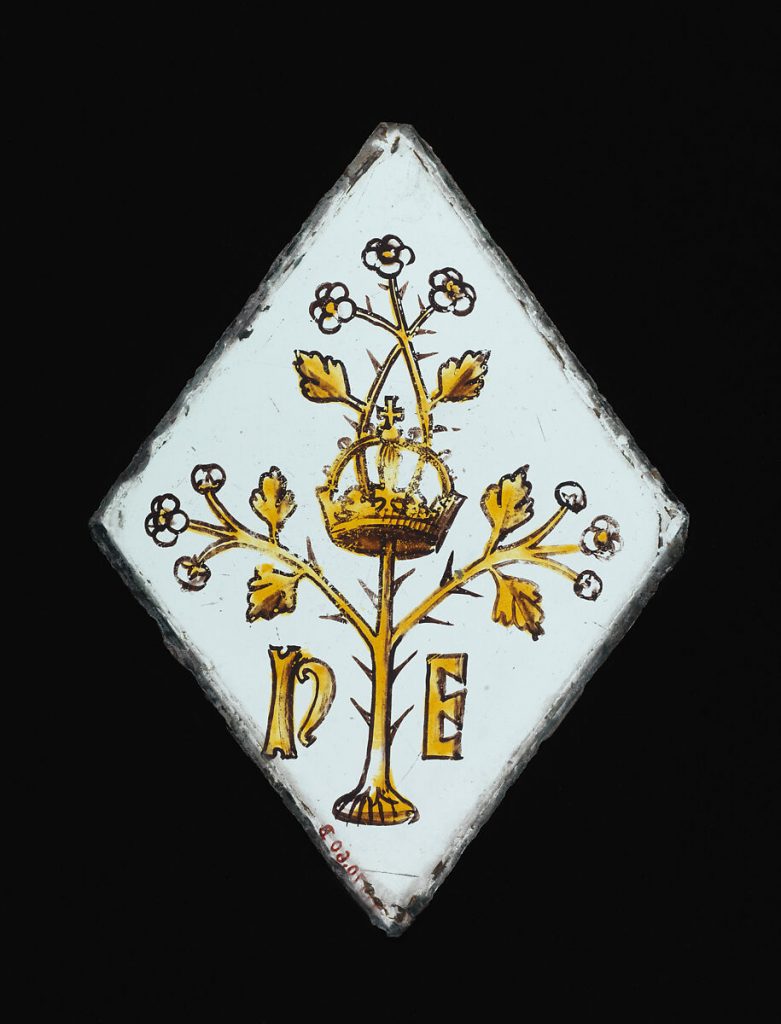
A ‘Quarry’ of Stained Glass showing the Crown, a hawthorn Bush and initials representing Henry VII and his, Queen, Elizabeth of York. Possibly from Surrey. Early 16th Century and from the Metropolitan Museum of Art (Public Domain).
Hawthorn produces white flowers in Spring. So, it is one of the great pagan fertility plants, its flowers forming the garlands on May Eve. One of the chemicals in the plant is the same as one given out in decay of flesh. It is, therefore, associated with death in folklore, and not to be brought into the house.
It was also said to be the thorn in the Crown of Thorns, so sacred. A crown from the helmet of the dead King Richard III was found on a hawthorn bush at the Battle of Bosworth Field. The victorious Henry VII adopted it for a symbol. . For more on the plant, https://www.woodlandtrust.org.uk
The virtues of Hawthorn
John Worlidge, wrote in 1697
‘And first, the White-thorn is esteemed the best for fencing; it is raised either of Seeds or Plants; by Plants is the speediest way, but by Seeds where the place will admit of delay, is less charge, and as successful, though it require longer time, they being till the Spring come twelvemonth ere they spring out of the Earth; but when they have past two or three years, they flourish to admiration.’
Hawthorn is an excellent wood for burning, better than oak. It has the hottest fire so that its charcoal could melt pig-iron without the need of a blast. It is also good for making small objects such as boxes, combs, and tool-handles. The wood takes a fine polish, so also used for veneers and cabinets. For advice on the best wood to burn read my post here.
Hawthorn has many medicinal benefits according to herbalists. Mrs Grieve’s Herbal suggests it was used as a cardiac tonic, to cure sore throats and as a diuretic. (But don’t try any of these ancient remedies without medical advice!)
What to plant in late January
This is the time, according to Moon Gardeners, to plant and sow plants that develop below ground. So rhubarb and garlic, fruit trees, bushes, bare-root plants and hedging plants.
On This Day
1571 – The Royal Exchange opens in London. London first Business centre since the Roman Forum, creating the first Bourse in the UK
1785 – ‘Boys play on the Plestor at marbles & peg-top. Thrushes sing in the Coppices. Thrushes & blackbirds are much reduced.’ From the Garden Calendar in Gilbert White’s Year. the Plestor is the village green; peg-top is a spinning top game. For more on Gilbert White,the inspirer of Darwin, see my post.