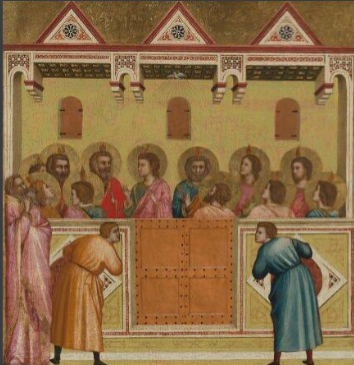
Pentecost by Giotto and Workshop, probably about 1310-18, National Gallery
Today, is Whitsun or Pentecost. (Sun, May 24th 2026). It is celebrated on the 7th Sunday after Easter, 50 days after the Crucifixion. The Day the Holy Ghost descends on the disciples. According to one of my teachers, it gave the disciples the power of expression and turned them from grieving Disciples to self-confident Apostles. They could now begin to spread the Christian message.
The week following is called Whitsuntide. It was one of three holiday weeks enjoyed by the medieval peasants. The villein had to work on the Lord’s land (desmesne) in exchange for the use of farm land. But this week he was free of that obligation.
Whit Monday was a Bank Holiday until 1972. But was then replaced by the Spring Bank Holiday. This was on the last Monday in May and so does not vary unknowably like Whitsun. ( 16 May 2027, 4 June 2028).
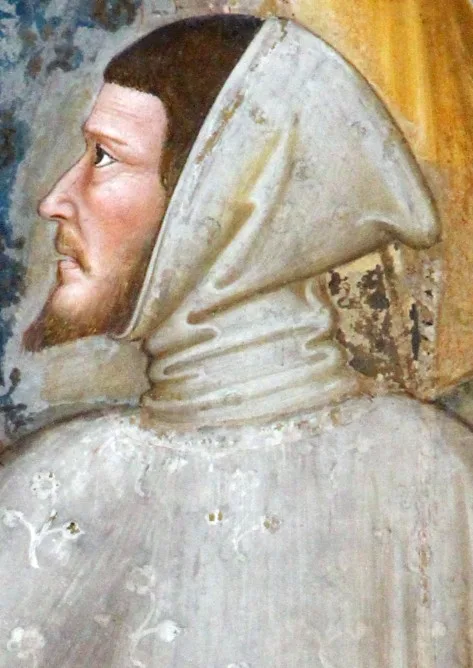
Giotto di Bondone
Giotto in Santa Maria Novella, Florence By Sailko – https://commons.wikimedia.org/wiki/ File:Andrea_di_bonaiuto,_via_veritas,_chiesa_trionfante_17.JPG, CC BY 3.0, https://commons.wikimedia.org/w/index.php?curid=189631337
Giotto’s painting shows the Apostles with their halos in the chamber. There are 12 of them, St Matthias having replaced the dead, Judas. The Holy Spirit is represented by the little dove in the centre of the Ceiling. The narrative is carried by the two men in the foreground leaning towards each other. We imagine them saying something like ‘What’s all this about! Galilean nonentities, lost their guru and yet, confident, speaking authoritatively to all and sundry? ‘
Giotto was a forerunner of the Renaissance. According to the great Giorgio Vasari (30 July 1511 – 27 June 1574) who wrote about the advances in painting achieved by Italian artists:
‘that very obligation which the craftsmen of painting owe to nature, who serves continually as model to those who are ever wresting the good from her best and most beautiful features and striving to counterfeit and to imitate her, should be owed, in my belief, to Giotto, painter of Florence, for the reason that, after the methods of good paintings and their outlines had lain buried for so many years under the ruins of the wars, he alone, although born among inept craftsmen, by the gift of God revived that art, which had come to a grievous pass, and brought it to such a form as could be called good.‘
The miracle was that this boy, a poor shepherd with no training in art, was able to show nature its true face.
‘One day [the artist] Cimabue, going on business from Florence to Vespignano, found Giotto, while his sheep were feeding, drawing a sheep from nature upon a smooth and solid rock with a pointed stone, having never learnt from anyone but nature.’
Moving towards Perspective
One of the points Vasari is making is that Byzantine Art had lost the use of perspective, something the Romans knew. Paintings had become cartoon-like spaces with no real three-dimensionality. Groups of people seemed to be standing on each other’s shoulders. If you look at the painting above you will the room the Apostles are in has the beginnings of a realistic space, the rafters slope down to a vanishing point. The Apostles are ranged convincingly around the space. Their faces are rounded and realistic. They are separated from the outside world by a dividing wall. And two dudes at the front are convincingly on the ground, rather than hovering in midair (though I might have cropped the photo too closely!)
It would be over one hundred years before photo realistic portraits and realistic perspective paintings were rediscovered, but Giotto showed the way.
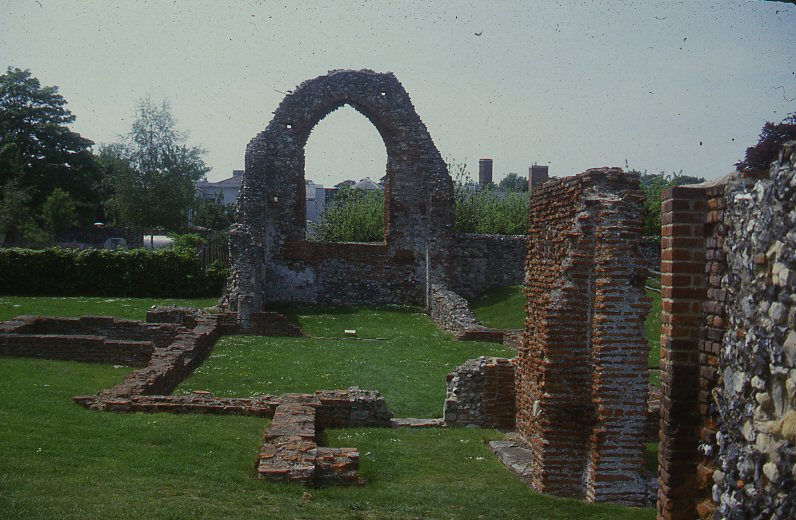
Ruins of St Pancras, Canterbury Photo: K Flude (note the reused Roman Bricks.)
St Pancras and the Ice Saints
It has been unusual cold in the last few days. You can blame this on the St Pancras and the Ice Saints. These are saints with feast days from May 11th to May 14th. They are: St. Mamertus, St. Pancras, and St. Servatius (and in some countries, Saint Boniface of Tarsus – Wikipedia). They represent a medieval belief that there was often a cold snap in early May. So the idea of the Ice Saints was probably to help persuade farmers to delay sowing until later in May. But modern statistics disprove this, but it is true that a late frost can cause havoc with crops.
St Pancras in Rome
He was a 14 year old who refused to give up his Christian Faith during the persecution of Christians by the Emperor Diocletian. He was beheaded on the Via Aurelia, in Rome, traditionally, on 12 May 303 AD. His body was buried in the Catacombs, but his head is kept in a reliquary in the Church of Saint Pancras in Rome.
Pancras means ‘all-powerful’ in Greek. His youth makes him the Patron Saint of children, but he is also the patron saint of jobs and health. He is ‘invoked’ against cramps, false witnesses, headaches, and perjury.
St Pancras in Canterbury
Pope Gregory is said to have given St Augustine relics from St Pancras when his mission came to Kent in 597AD. They built a church dedicated to St Pancras in Canterbury. The ruins still survive in the grounds of what is now St Augustine’s, Canterbury (see picture at top of this post).
St Pancras in London
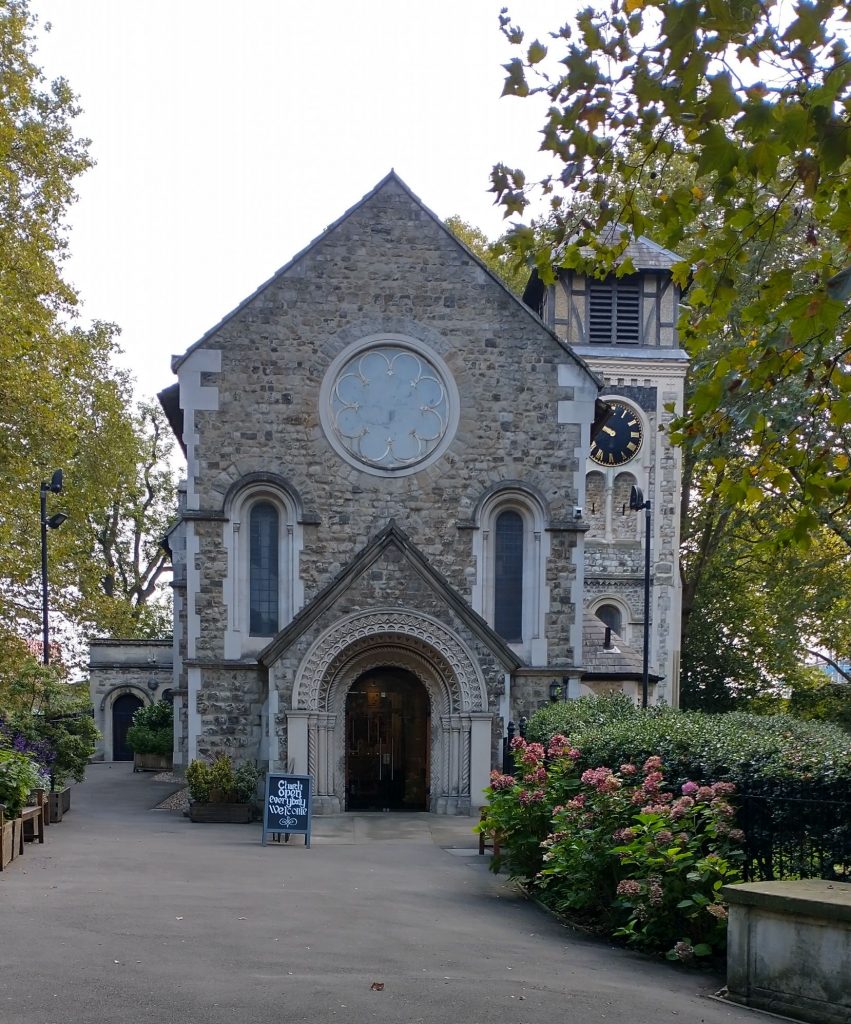
St Pancras, Old Church, London (Photo: Kevin Flude)
This story is partly responsible for the claims that St Pancras Old Church, in Camden (pictured above) is a very old foundation. It is claimed there was a late Roman place of worship here. But there is very little solid evidence for this. It is also argued that, if it isn’t late Roman, then it dates to just after 604AD. This is when St Mellitus, sent by St Augustine, established St Pauls Cathedral. It is suggested that Mellitus also founded St Pancras Church. St Pancras’ Church was a Prebend of St Pauls Cathedral (a Prebend provides the stipend (pay) to support a Canon of a Cathedral). But this is not evidence it was established as early as the Cathedral was, and there really isn’t any other credible evidence for a 604 date.
When the Church was restored, the architects said it was mostly Tudor work with traces of Norman architecture. However, it was reported that a Roman tile or two were reused in the fabric. This is about the only evidence, but it helps keep the legend going.
If you read the Wikipedia page, you will see evidence of two strands to the contributions. One is playing down the legends of its early foundation. The other trying to keep hold of its place as among the ‘earliest sites of Christian worship’. Read the wikipedia page here: https://en.wikipedia.org/wiki/St_Pancras_Old_Church to make up your own mind.
It is a lovely Church, on an impressive site, with links to Thomas Hardy, and Sir John Soane whose tomb is the design inspiration for the iconic Red Telephone Box.
As Patron Saint of Headaches, St Pancras Day is a good day to make worms come out of your head. Or so say the Fairfax Household Book of the 17th/18th Century as quoted in Charles Kightly’s ‘The Perpetual Almanac’:
‘To make a worm come out of the head. Take, in May, the marrow of a bull or cow, and put it warm into the ear, and the worm will come forth for sweetness of the marrow.’
Generally,willow bark was used for headaches. We know this would have worked as the bark contains salicin, which is converted by the body into salicylic acid. This is a precursor to aspirin (acetylsalicylic acid). But it is not as effective.
On This Day
113 – Trajan’s Column is finished in Rome. Reliefs sculptures on the Column celebrate his victory over the Dacians. There is a copy made of plaster on display at the V&A. The sculptures provide a prime document on the Roman army.
1593 – London playwright Thomas Kyd is arrested and tortured. He lived with Christopher Marlowe. In the search of their rooms, it was claimed they found evidence of atheism and blasphemous documents, including the claim that Jesus was homosexual. Kyd claimed the documents were Marlowe’s. Marlowe was awaiting news of whether he was going to prosecuted, when he was murdered in a tavern in Deptford, possibly by Government agents.
First Published in 2024, revised 2025 OnThis day added in 2026
Rodmas – Rood screen in St. Helen’s church, Ranworth, Norfolk by Maria CC BY-SA 3.0
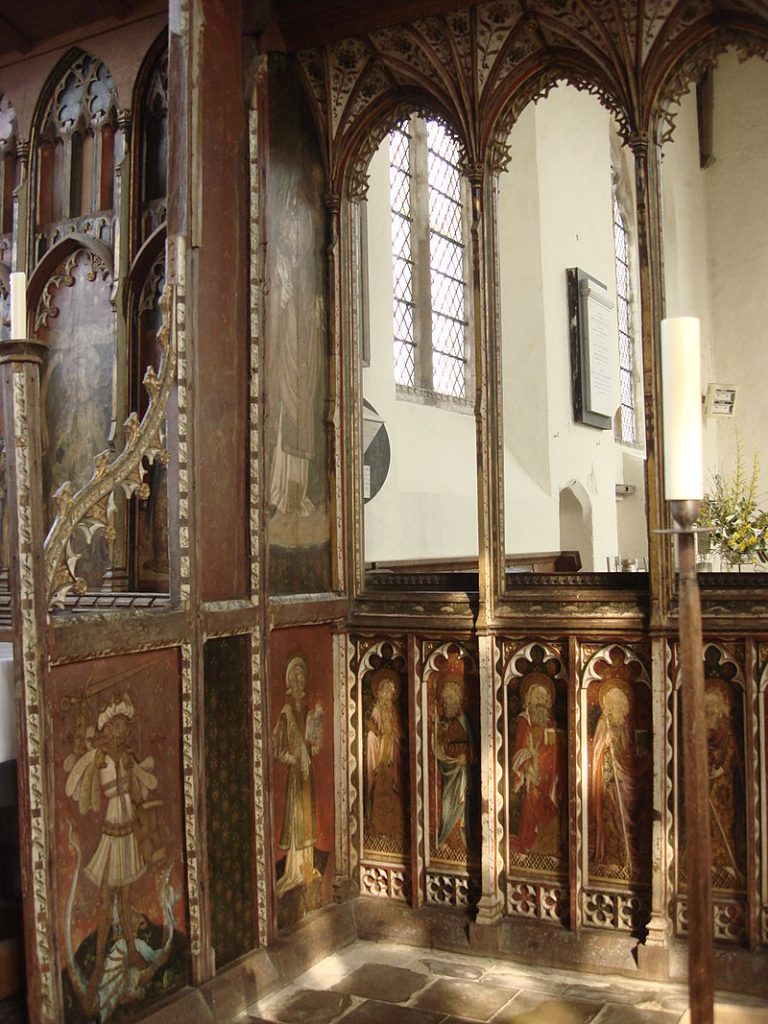
Rood is another word for the Cross. Parish Churches used to have a Rood Screen separating the holy Choir from the more secular Nave. This screen was topped with a statue of the Crucified Jesus nailed to a Rood. So, Roodmas, is the festival of the Holy Cross. Roodmas is celebrated on May 3rd and September 14th, although the Church of England aligned has itself with the Catholic Church’s main celebration on September 14th.
See my post on September 14th here for more on the True Cross.
Object of the Week
Mechanical Celestrial Globe, 1575 (Holburne Museum Bath) Photo K Flude
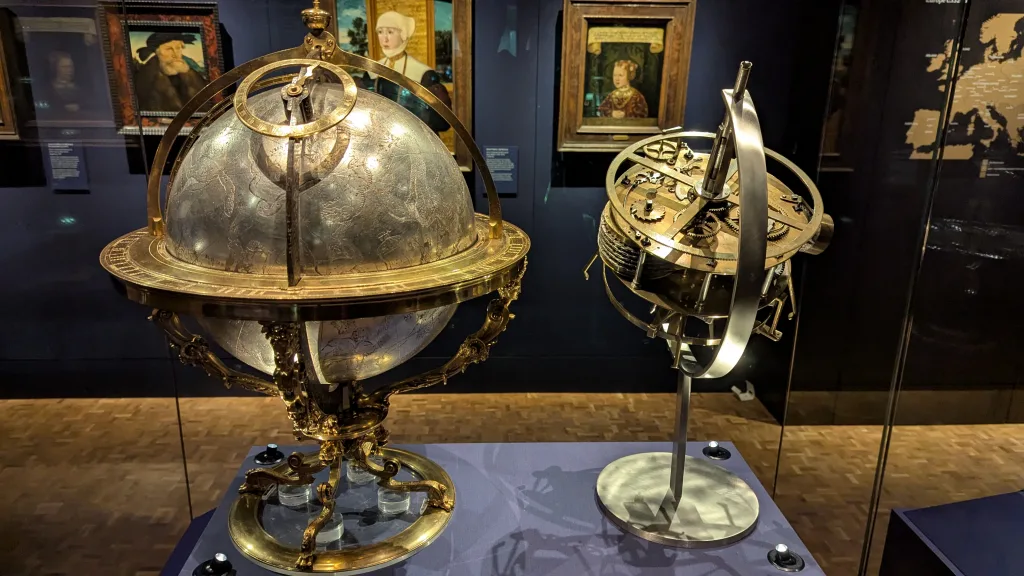
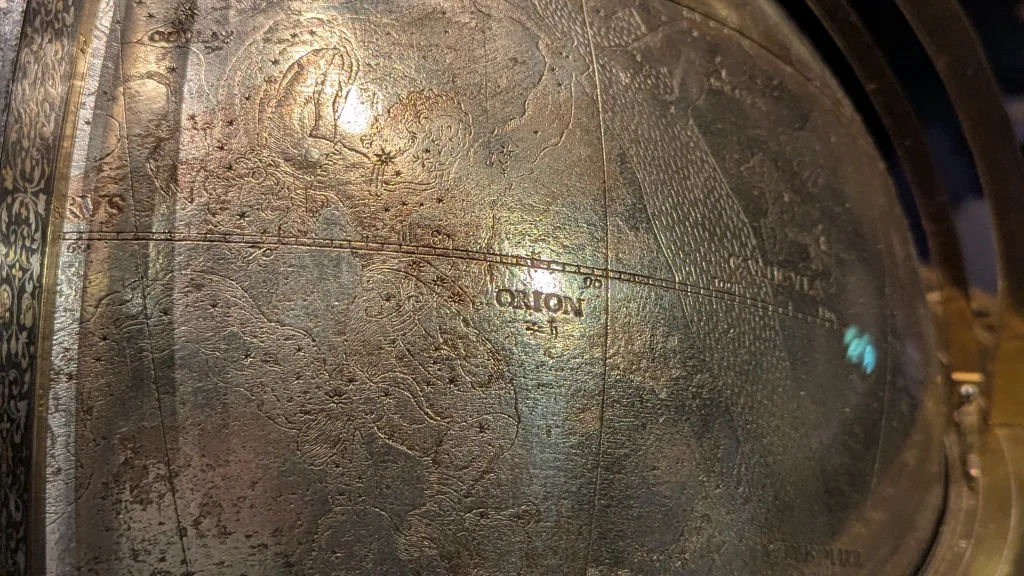
I spent a couple of days in Bath and revisited the Holburne Museum. Here I saw this amazing object from the 16th Century. The Globe is a model of the universe, and built to show the movement of the constellations, but it also tells the time and date. So the user can see when a constellation appears above the horizon and where it will be in real time. The mechanics are designed to be seen from inside the Globe, so reading it from the outside requires a mental adjustment to the mirror image of the stella sphere. It also show a pre-Copernican view as the stars were imagined as if on the inside of a huge sphere circulating around the earth. For more information please read the label below.
Museum Label for Celestial Globe.Close up of the surface of the Globe showing Orion. Photo K Flude
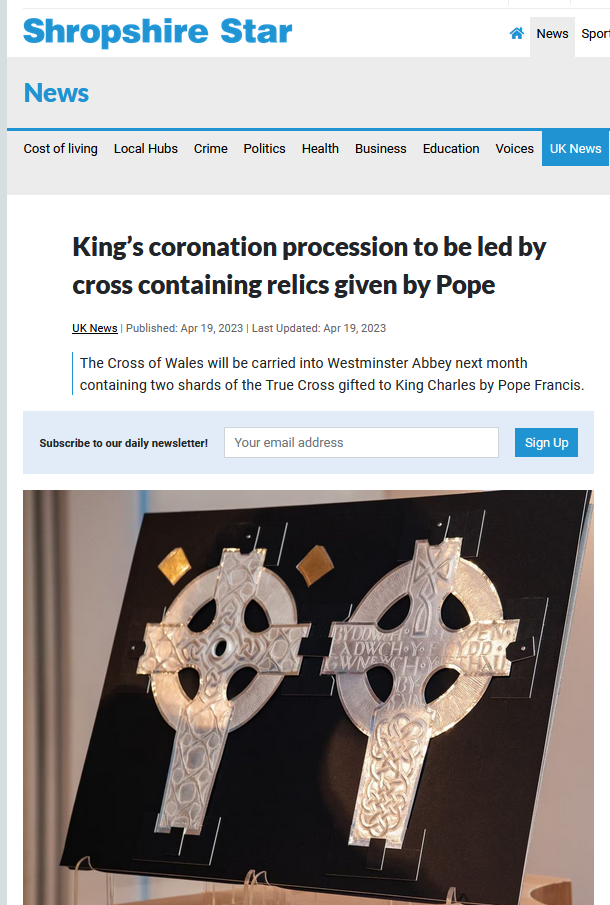
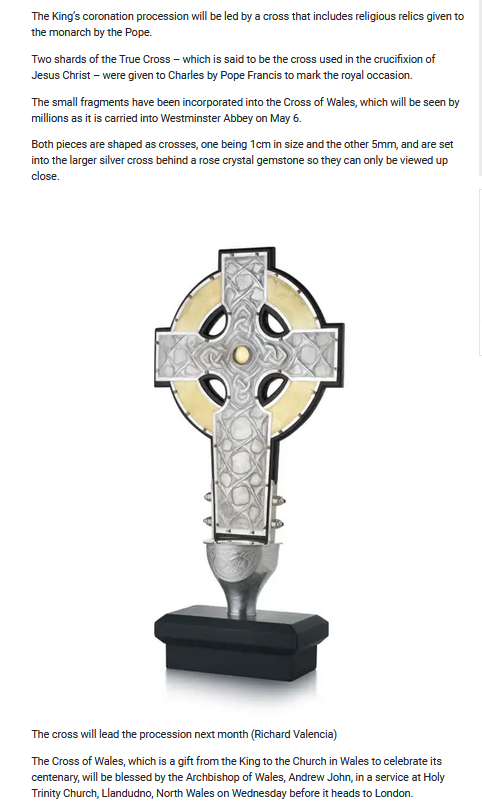
The Shropshire News reported that two pieces of the True Cross were given to Charles III by the Pope for the Coronation. They were installed into a cross called the Welsh Cross. This was part of the Coronation Procession. The King gave the Cross (I assume with the pieces of the Holy Cross) to the Church in Wales. Let the Shropshire News tell the story:
It is a clear reminder that we are subjects not citizens and news, as a nation, we still set store by superstitions.
The Duke of Buckingham and the True Cross
The Duke of Buckingham had a piece of the True Cross in his collection, which he kept at York House in the early 17th Century. How he got it, I don’t know. But I think he must have acquired it in the aftermath of the destruction of the Reformation. John Tradescant, who looked after the Duke’s collection until Buckingham was murdered, had a piece of the True Cross. Tradecant created Britain’s first Museum, Tradescant’s Ark. Again, I suspect (without any evidence) that he got the fragment from Buckingham. Was he gifted it? Did he acquire it after the murder? Or shiver off a timber fragment hoping no one would notice?
First Written on May 3rd 2023, revised 2024, 2025, Object of the Day added 2026
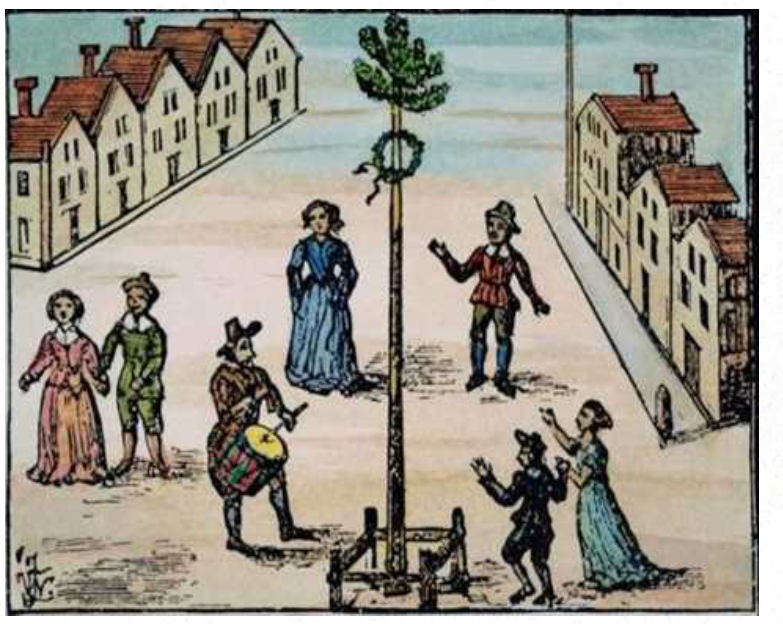
The Stinking Idol : An Imagined Scene at the Maypole at St Andrew Undershaft
This post is about the end of the Maypole in London but first:
On This Day
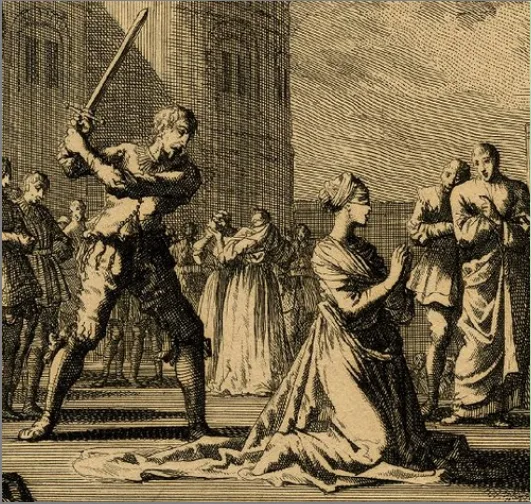
Old Print of the French Executioner dispatching Anne Boleyn with a sword rather than an axe.
1536 – Anne Boleyn arrested on ‘charges of adultery, incest, treason and witchcraft.’ But, Claire Ridgway in her post here and her book, show that she was never accused of witchcraft in court. The stories of extra fingers, and teats, are all later Catholic propaganda aimed at weakening Elizabeth’s claims to the throne. She was accused of adultery. Five men were executed for sleeping with her: her brother George Boleyn, (Lord Rochford); Sir Henry Norris, groom of the stool; courtier Sir Francis Weston; courtier William Brereton, and musician Mark Smeaton. Incest with her brother (one possible explanation of the incest is the idea that she desperately needed a baby and if she needed a surrogate then her brother was safest as the child would have a family resemblance to her and not rouse any suspicions from Henry of adultery. The other explanation is that Anne never commited incest!). Treason, well sleeping with someone other than the King risked imperilling the blood line of the Royal Family. It also gave a motive for killing the king.
A new portrait has been claimed to be of Anne Boleyn, the only one to have been done in her lifetime. But it has been revealed by AI, and some art historians are not convinced. Follow this link to see for your self.
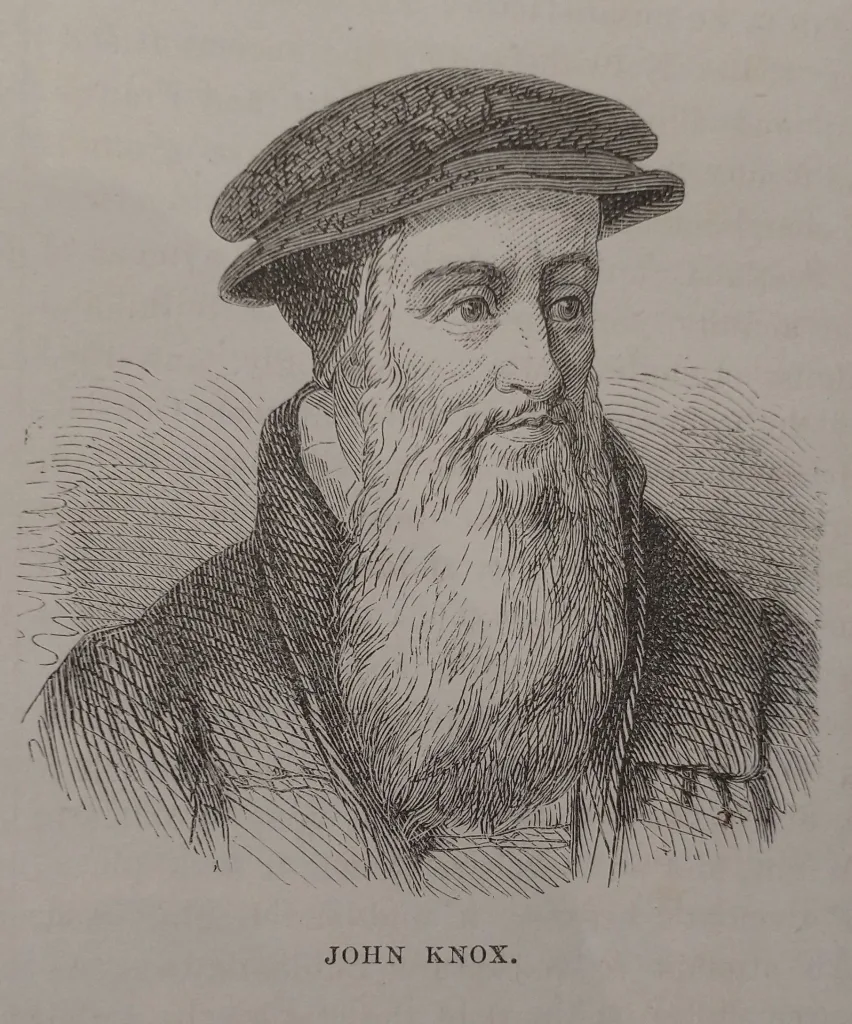
1559 – John Knox returns from exile to Scotland to lead the Scottish Reformation.
1568 – Mary, Queen of Scots, escapes from Lochleven Castle. You could blame John Knox for the hostility Mary faced as a Catholic governing a country rapidly turning Presbyterian.
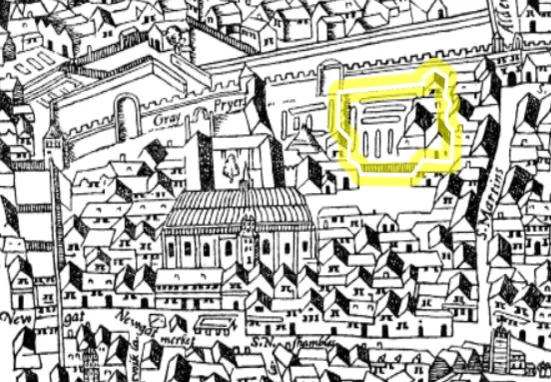
1611 – The King James Version of the Bible is published by printer Robert Barker. His printshop was at Northumberland House, Aldersgate Street, in the City of London. (as far as I can see no one else seems to know where the printing was done.)
Northumberland House marked in yellow nearAldersgate. The Map of Early Modern London, Edition 7.0, edited by Janelle Jenstad, U of Victoria, 05 May 2022, mapoflondon.uvic.ca/edition/7.0/NORT2.htm. INP.
The Printer then went on to create the worst possible error in publishing history by omitting the word NOT in the 6th or 7th Commandment, ‘Thou Shalt Commit Adultery’. This edition became known as the Wicked Bible. Barker & Howard are still in the publishing industry and have offices in the East End of London.
The King James Bible introduced many phrases into the English language, including:
The apple of his eye The four horsemen of the apocalypse Baptism of fire Chariots of Fire O death, where is thy sting? Like a thief in the night Weighed in the balance and found wanting
1670 – King Charles II of England granted a charter to the Hudson’s Bay Company. In 1917 my 17 year old Grandfather sailed to the Hudson bay as an able seaman for the Hudson’s Bay Company.
1982 – The British nuclear submarine HMS Conqueror sunk the Argentine cruiser ARA General Belgrano. It was controversial as the Belgrano was outside the Exclusion zone, and said to be sailing away from the conflict. 323 Argentine sailors were killed. The event, arguably, changed Mrs Thatcher political fortunes.
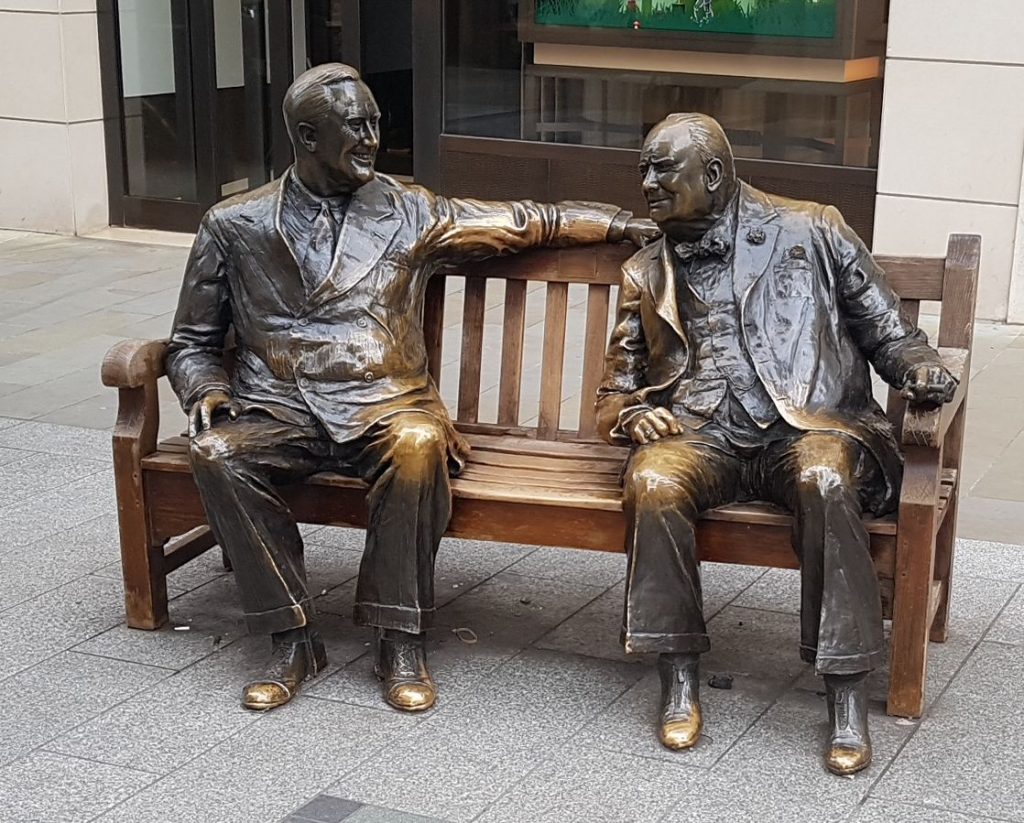
1995 – Allies Statue unveiled. The Statue of Churchill and Roosevelt set up to commemorate 50 years of peace. 30 years later, how we wonder what Churchill and Roosevelt would say about the current state of NATO? https://www.iwm.org.uk/memorials/item/memorial/11351
‘Allies’ Roosevelt and Churchill by by Lawrence Holofcener, unveiled on May 2nd 1995 by Princess Margaret and Lord Snowdon
The Maypole or rather ‘This Stinking Idoll’
Philip Stubbes, wrote a vitriolic attack on pagan practices in his ‘Anatomy of Abuses in 1583’. He fired a broadside at the tradition of dancing around the Maypole. He said they had: ‘as Superintendent and Lord ouer their pastimes and sportes: namely, Sathan Prince of Hell‘ as they erected ‘this stinking Idoll’. By which he meant the Maypole. Stubbes suggested that of the maids who went out to the woods on May Eve, less than one-third returned ‘undefiled‘.
Evil May Day Riots
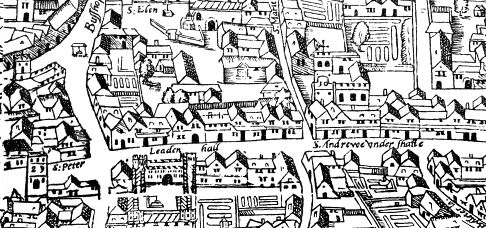
The Maypole was stored at St Andrew Cornhill, which became known as St Andrew Undershaft. In 1517, it was attacked during the ‘Evil May Day riots’. The main focus of the riot was foreign workers. The Under Sheriff of the time, Thomas More, tried to quell it, meeting the rioters at the corner of Cheapside and St Martin’s Legrande. But 5,000 troops commanded by the Duke of Northfolk was necessary to regain control of the City. 300 rioters were arrested. One hanged, drawn and quartered, 13 hanged and nearly 300 pardoned after the intercession of Woseley and/or Katherine of Aragon (depending on which historian you read). The shaft was returned to its place under the eves of the houses in Shaft Alley. But apparently banned from being raised again.
1549 May Day Riots
However in 1549, the curate of nearby St Katharine Cree Church made an inflammatory speech. This incited a Puritan mob, who cut the shaft into pieces and burnt it. I always imagine the Curate’s sermons to be along the same lines as Phillip Stubbes attack on the Maypole.
Maypole: this Stinking Idol, Rather
Here is a longer description of the May Day Celebrations by Stubbes.
‘But their chiefest iewel they bring from thence is the Maie-poale, which they bring home with great veneration, as thus: They haue twentie, or fourtie yoake of Oxen, euery Oxe hauing a sweete Nosegaie of flowers tyed on the tip of his homes, and these Oxen drawe home this Maie-poale (this stinking ldoll rather) which is couered all ouer with Flowers and Hearbes, bound round about with strings from the top to the bottome, and sometimes painted with variable collours, with two or three hundred men, women and children following it, with great deuotion.
And thus being rearedvp, with handkerchiefes and flagges streaming on the top, they strawe the ground round about, bind green boughes about it, set vp Summer Haules, Bowers, and Arbours hard by it. And then fa! they to banquet and feast, to leape and daunce about it, as the a Heathen people did, at the dedication of their ldolles, whereof this is a perfect patteme, or rather the thing it selfe. I haue heard it crediblie reported (and that viua voce) by men of great grauity, credite, and reputation, that of fourtie, threescore, or a hundred Maides, going to the wood ouemight, there haue scarcely the third part of them returned home againe vndefiled.‘
The unraised pole seems to have survived until the beginning of the Civil War, (1644) when it was destroyed. But at the Restoration of Charles II a new and huge Maypole was ordered. It was joyously erected 134 ft high (41 metres) in the Strand. This one was danced around till 1713 when it was replaced. The original was sold to one Isaac Newton. He used it to support the biggest telescope in Europe, which was erected in Wanstead by a friend.
And that, my friends, is how you get from Superstition to Science in one easy story.
Old Print of Isaac Newton
Postscript.
I have always told people that the sermon leading to the destruction of the Shaft in 1549 was made at St Paul. I cannot remember where I read this. The suggestion that the Maypole in Cornhill was not used after 1517 seems strange. Why then would an unused maypole rouse a crowd to riot in 1549? Of the sources I have at hand, the London Encyclopedia mentions the riot of 1517 in its entry on St Andrew Undershaft but doesn’t elaborate more. ‘Layers of London‘ says ‘It was last raised in 1517 when ensuing riots led to the celebration being banned.’ which is definitive sounding. But is it? I wonder if it was banned for a year or two, then allowed again, and finally stopped in 1549?
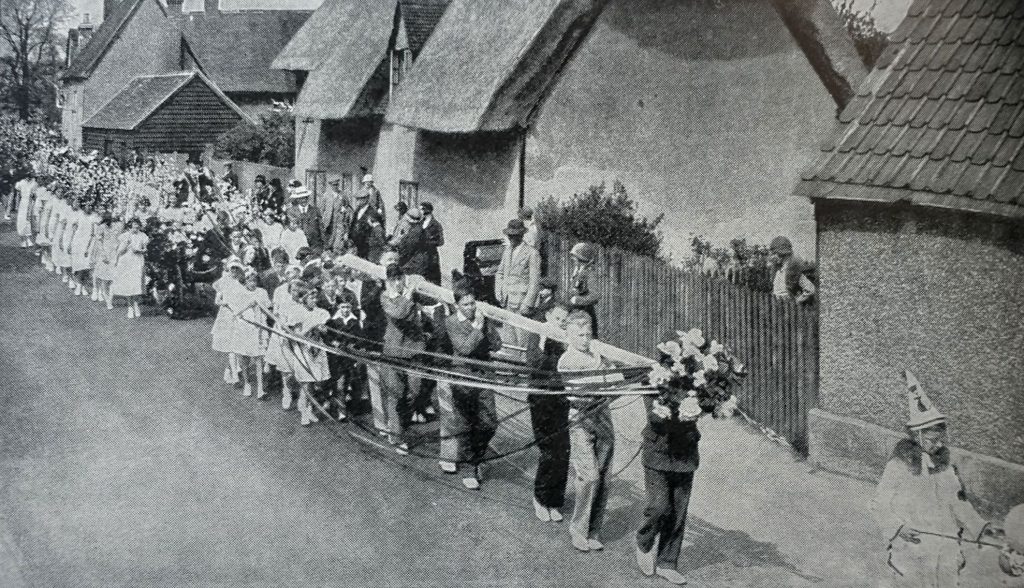
May Day – Bringing the Maypole, Bedfordshire. Image from ‘Romantic Britain’
May morning would commence with dancing around the Maypole, followed by feasting, and summer games. Maypoles were often stored during the year. A few days before May Day they were repainted, and bedecked with May Garlands – mostly made from Hawthorn. The Maypole used in London in 1660 was 134 feet high. Tall straight trees were used, sometimes of Larch, and they might be spliced together to get the requisite height. John Stow says that each parish in London had their own Maypole, or combined with a neighbouring Parish. The main Maypole was on the top of Cornhill, in Leadenhall Street. It was stored under the eves of St Andrew’s Church, which became known as St Andrew’s Undershaft as a result. For more about Maypoles and May Day see my post may-2nd-this-stinking-idol-the-end-of-may-day/.
Padstow May Day Festival
Padstow holds, perhaps, the most famous May Day festival on May 1st. It feels very ‘pagan’ or do I mean it is fuelled by an enormous amount of drink? Here is a video, watch until you see the ‘obby ‘orse and the teaser dancing.
Why May Eve?
The celebrations begin on May Eve because the Celtic calendar starts the day at Dusk. This seems strange to us who, perversely, ‘start’ our day at Midnight just after everyone has gone to bed! The other choice, and maybe the most logical is Dawn? But Dawn and Dusk are difficult to fix. Midnight was chosen by Julius Caesar when he created the Julian Calendar. Midnight has the virtue of being a fixed metric, being half way between Dawn and Dusk. From the Celtic point of view, the day ends when the Sun goes down over the western horizon. So the end of the old day, is the beginning of the new day. Makes sense?
Celebrations centred around the Bonfire. The day was sacred to the fire God Belenus (Gaulish: Belenos, Belinos, British Belinus, Bel, or Beli), and May Day was called Beltane. Bonfires continued to be a part of the celebration into the 16th Century, and in places until the 2st Century. According to folklore tradition, the bonfire should be made of nine types of wood. They must be collected by nine teams of married men (or first born men). They must not carry any metal with them. The fire has to be lit by rubbing oak sticks together or a wooden awl twisted in a wooden log.
Participants, have to run sunwise around the fire. Oatcakes are distributed, with one being marked with a black spot. The one who collects it has to jump through the fire three times. Bonfires would have been, by choice on the top of hills. But then they were also held in the streets in London. May celebrations have a similarity to Halloween. This was also a fire festival and both are uncanny times when sprites and spirits abound.
Hawthorn
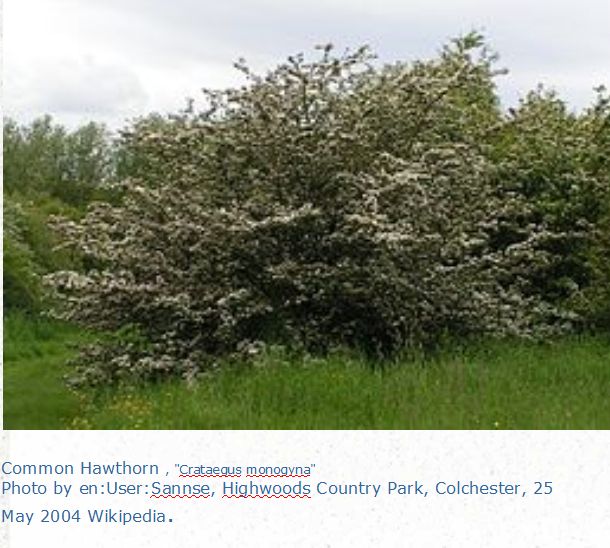
Hawthorn was a favoured wood not only because of its beautiful may flower. It was also said to be the wood the crown of thorns was made from. Hawthorn had the power of resisting supernatural forces. Therefore, it was used to protect doors, cribs, cow sheds and other places from witches.
Protecting Babies from Witches
Witches, it was said, got their power to fly from potions made from chopped up infants. The best protection was Christening. The custom was to have the christening as early as possible. Normally three days after birth. Shakespeare was baptised on 26th April 1564, so we celebrate his birthday on 23rd April. See my post for more on this subject. Cribs would be bedecked with Hawthorn and protection might be augmented by a bible, rowan, and garlic.
Special May Babies
Babies born between May 1 and 8 were thought to be special. They were destined to have power over man and beast. Weddings were frowned upon in Lent and in May, so April became a popular choice for marriage.
May Dew
After celebrations on May Eve (April 30th), women would go out in the woods to collect May, and other flowering plants. They would wash their faces in May Dew, preferably from the leaves of Hawthorn. If not from beneath an oak tree, or from a new-made grave. The dew was said to improve their complexion. It was also used for medical conditions such as gout and weak eyes.
Thinking Can Make it Happen?
Thinking of one’s lover on May Day might bring marriage within the year., it was thought This is a little like the modern woo-woo technique of ‘Manifesting’. Woo-woo or just woo is slang for something to do with crystals or other new age nonsense. Manifesting can either be a visualisation technique, whereby visualising the thing you want happening helps you concentrate on making it happen. The woo-woo part of it is that if you think it hard enough, you will get the universe to help make it happen. An analysis I heard on BBC Radio 4 showed that people who believe in the power of manifesting to alter the universe were more reckless in their endeavours and had a higher rate of bankruptcy and investment losses. It seemed they were more willing to take the risk. On the other hand, those who thought through the process of achieving their goals and the obstacles in the way of success were more successful.
Belenus
is a Celtic God of whom very little is clear and unambiguous. He was linked in Gaul with Apollo. The name, some people think, comes from ‘Shining’ but others disagree and think it means ‘Master of Power.’ His association with Irish mythology and the festival of Beltane suggests he was a powerful god in Celtic Europe. Geoffrey of Monmouth has a King called Belinus, and spins a yarn about Belinus and Billingsgate. Linguists prefer the idea that Billingsgate is named after some unknown Saxon called Billings. This may be a little more likely but far less interesting.
305 – Diocletian and Maximian retire from the office of Roman emperor. Diocletian was a systems man. and changed the Empire so there were 2 Emperors, 4 Caesars, a lot of Prefects, and a shed load of Governors. It was supposed to make the Empire more efficient and less liable to Civil War. He also introduced a Wages and Prices freeze. For more about this see my post on Diocletian’s reforms here.
1328 – Wars of Scottish Independence end: By the Treaty of Edinburgh–Northampton, England recognises Scotland as an independent state. (Wikipedia)
1707 – The Union of Scotland and England Proclaimed. In which Scotland voluntarily (aided by bribery and corruption) gave up its independence.
1851 – Opening of the Great Exhibition of All Nations in Hyde Park, inspired by Prince Albert and put into place by Henry Cole. See the V&A on the building of the V&A.
1945 – German Fascist Goebbels kills himself and his entire family
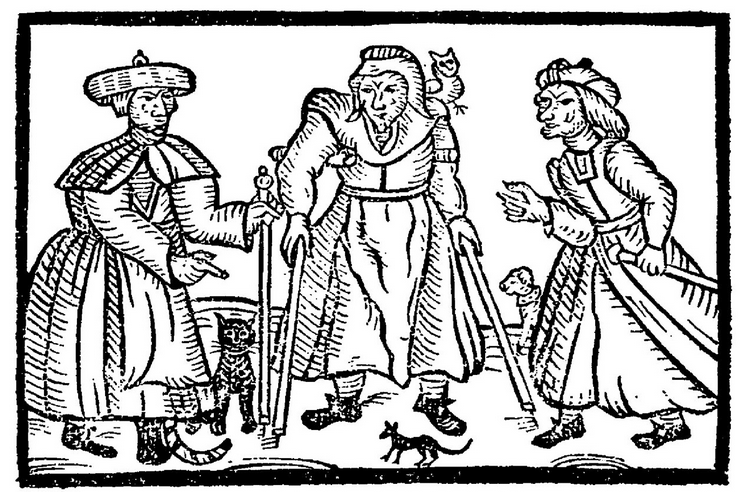
Witches From ‘The Wonderful Discoveries of the Witchcrafts of Margaret and Phillip Flower’, London, 1618
As May Eve approached, which like Halloween, was considered a particularly uncanny time, people were warned to guard against witches stealing their babies:
He (the Devil) teacheth the witches to make ointments of the bowels and members of children, whereby they ride in the air and accomplish all their desires. So as, if they be any children unbaptized, or not guarded with the sign of the cross or orisons: then the witches may and do catch them from their mother’s side at night, or out of their cradles. …. and after burial steal them out of the graves, then seethe them in a cauldron until their flesh been made possible.
Reginald Scott ‘The Discovery of Witchcraft’ 1594 (from ‘The perpetual Almanack of Folklore’ by Charles Kightley). Please note that Reginald Scott’s book was actually against the idea of witchcraft, i.e. he was debunking it. (for more on Reginald Scott read my post here)
Keeping Witches away
Ways to keep witches away were various, but baptising your children early was the best method. As you will have seen in previous posts, children were normally baptised as soon as possible. Normally, three days after birth in the early modern period.) There were various ways of protecting against witches including saying prayers (orisons), hanging garlic, bread, rowan-leaves, around the cradle.
Witch marks
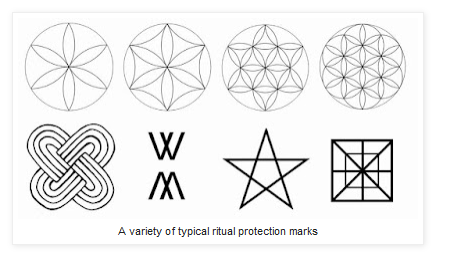
In archaeological surveys of timber framed buildings increasing numbers of reports of ‘witches’ marks have been discovered. They are now so ubiquitous that it seems most people felt the need to deploy them to secure their houses. Or was it the Carpenters and Builders who felt the need to protect their work? It was believed that witches gained entry where there was an inlet of wind. So doors, windows, chimneys, and anywhere there was a draft. These would be marked by pentagons, which represent the five wounds of Christ. Also used were a variety of other marks ‘chequerboards, mesh patterns, peltas (a type of knot work design) and circle’. https://theartssociety.org/arts-news-features/ancient-symbols-once-used-ward-away-witches is an excellent read and gives more detail.
Robert Burns poem ‘Tam O’Shanter’ gives a graphic, fictional, account of a witches’ coven presided over by the Devil (auld Nick) himself which features ‘wee, unchristen’d bairns‘. Tam, drunk, has come upon a witches coven, presided over by the devil himself.
And, vow! Tam saw an unco sight! Warlocks and witches in a dance; Nae cotillion brent new frae France, But hornpipes, jigs, strathspeys, and reels, Put life and mettle in their heels. A winnock-bunker in the east, There sat auld Nick, in shape o’ beast; A towzie tyke, black, grim, and large, To gie them music was his charge: He screw’d the pipes and gart them skirl, Till roof and rafters a’ did dirl.— Coffins stood round, like open presses, That shaw’d the dead in their last dresses; And by some devilish cantraip slight Each in its cauld hand held a light.— By which heroic Tam was able To note upon the haly table, A murderer’s banes in gibbet airns; Twa span-lang, wee, unchristen’d bairns; A thief, new-cutted frae a rape, Wi’ his last gasp his gab did gape; Five tomahawks, wi’ blude red-rusted; Five scymitars, wi’ murder crusted; A garter, which a babe had strangled; A knife, a father’s throat had mangled, Whom his ain son o’ life bereft, The grey hairs yet stack to the heft; Wi’ mair o’ horrible and awefu’, Which even to name wad be unlawfu’.
I talked more about Tam O’Shanter and the Cutty Sark here and to read the whole poem see below. Please do have a look and when you read it read it quick. Loud and don’t worry about how to pronounce it or understand it, just enjoy the ride!
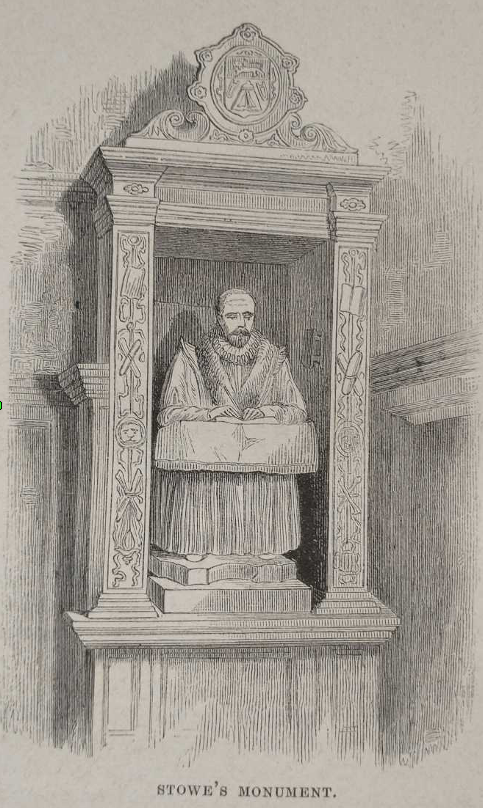
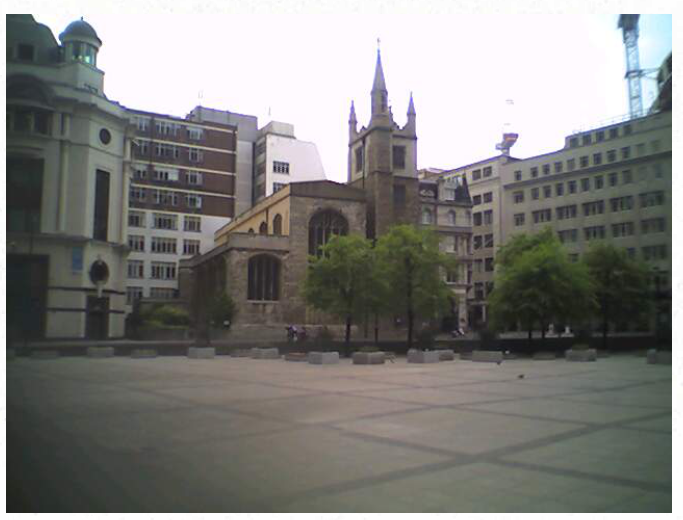
On the corner of Leadenhall Street and St Mary Axe in the City of London is one of the very few medieval Churches that survived the Great Fire of London is 1666. It was sheltered by the firebreak that was the Leadenhall, a big market building made of stone. This is where the great London historian John Stow is buried. His Survey of London is one of the best sources for Medieval and Tudor London. Every three years, there is a commemorative service and his quill is changed. Last year it was on the 22nd April. The next is due in 2027, date yet to be announced. The Lord Mayor attends, and it is organised by Stow’s Guild – the Merchant Taylors.
John Stow records that his father returned to his home at Austin Friars one day to find his house had been moved. He had no warning, nor payment for the loss of land. He had the misfortune to live adjourning the property of Thomas Cromwell. This is what Stow wrote:
‘My father had a garden there, and a house standing close to his south pale; this house they loosed from the ground, and bare upon rollers into my father’s garden twenty-two feet, ere my father heard thereof; no warning was given him, nor other answer, when he spake to the surveyors of that work, but that their master Sir Thomas commanded them so to do; no man durst go to argue the matter, but each man lost his land, and my father paid his whole rent, which was 6s. 6d. the year, for that half which was left. Thus much of mine own knowledge have I thought good to note, that the sudden rising of some men causeth them to forget themselves.’
St Andrew Undershaft
The Church is London’s Maypole Church as it was here the Maypole or the shaft was stored under the eves of the Church. Hence, St Andrew’s sobriquet of ‘Undershaft’. The May Day riot of 1517 put an end to the dancing around the Maypole but the pole itself survived until 1547. Then, in a Puritan riot, the ‘stynking idol’ was destroyed. (see my May Day blog post here for more more details.)
There is also a plaque to Hans Holbein, but no one knows for sure where he is buried. He died in London in 1543, possibly of plague. The present church was built in 1532, but it is first recorded in the 12th Century.
Today is Earth Day. It was set up in 1970. For more information click here.
2016 – On Earth Day the landmark Paris Agreement was signed by 123 countries including the United States, the United Kingdom, and China. The USA is the World’s the second largest emitter. They withdrew from the agreement in 2020, rejoined in 2021, and withdrew again in 2026. Iran has signed it but not ratified it.
First Published on 30th November 2022, Revised 2023, moved to April in 2024, and revised 2025, On This Day added 2026
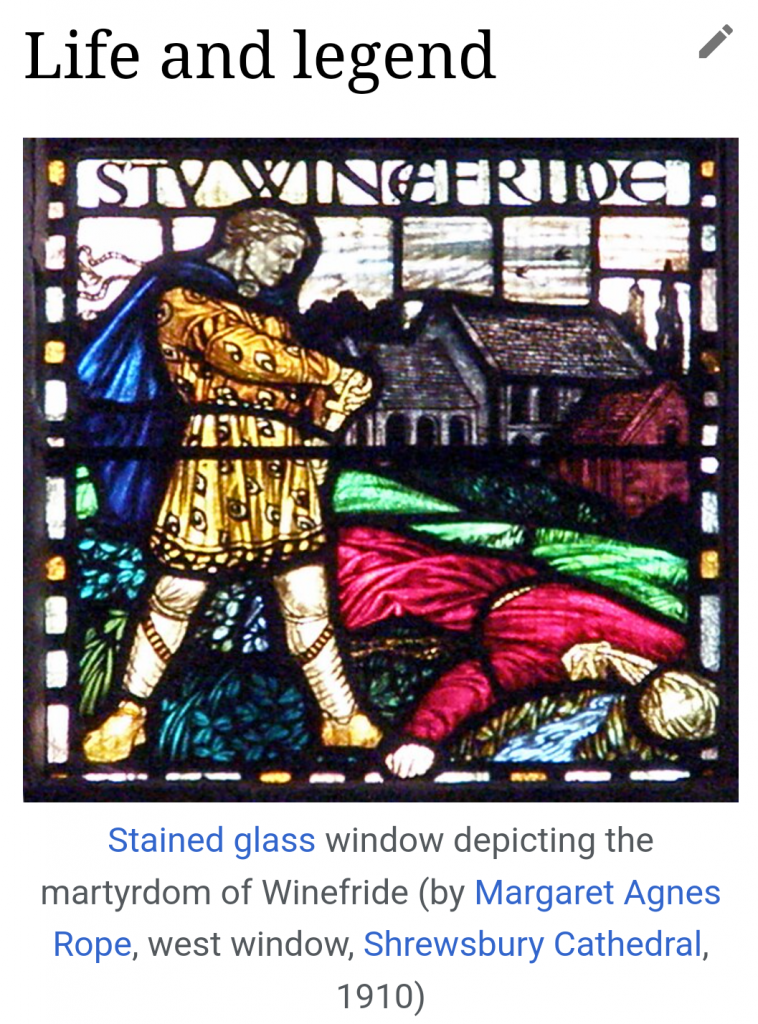
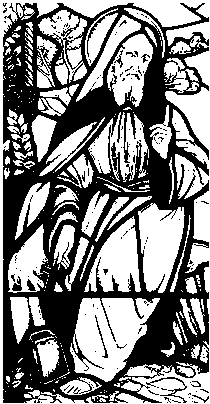
Drawing of a Stained glass window depicting Saint Beuno. D A R C 12345 – Own work
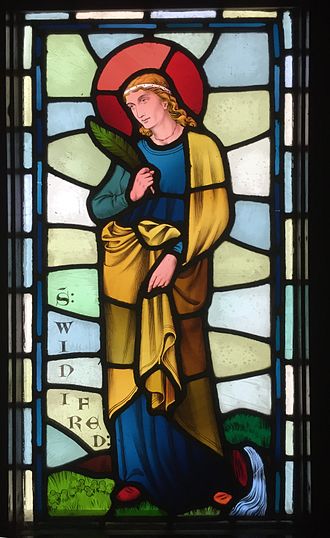
Today is St Beuno’s Day. St Beuno is also known as St Bono. He was an 8th Century Welsh Abbot of some power. The grandson of a prince of Powys in Wales who was descended from Vortigern. (see my post on Vortigern here.) Vortigern was a predecessor to King Arthur. Beuno was educated in Bangor Monastery, one of the foremost Celtic monasteries in Wales. During his ministry he restored 7 dead people to life including St Winifred (or Winefred).
Winifred & St Beuno
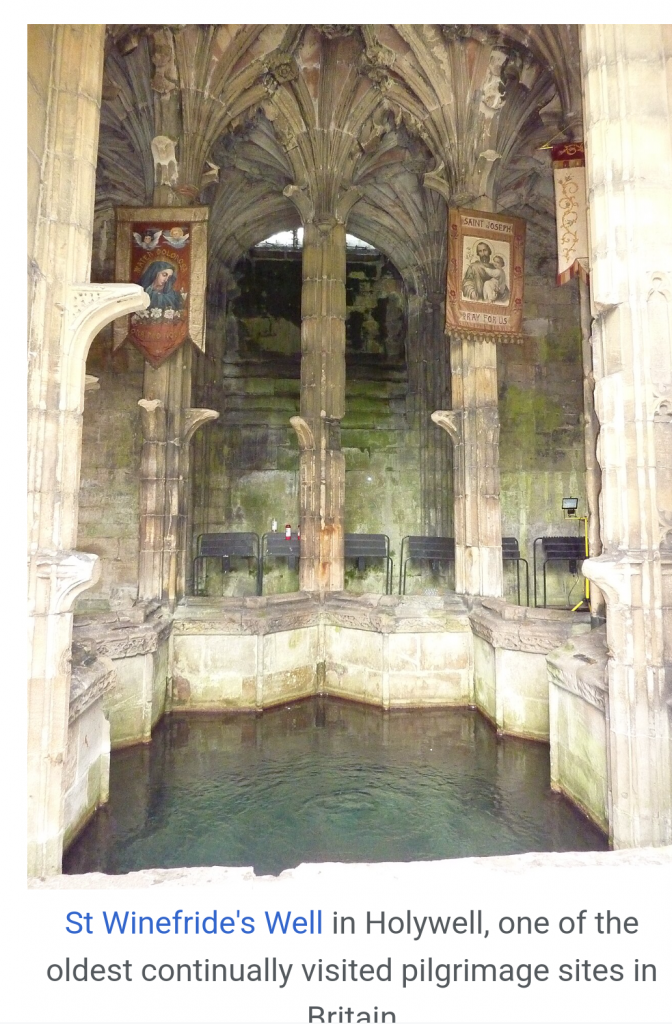
St Winifred’s Holywell, from Facebook.
She was Beuno’s niece, a virgin who refused the advances of a certain Caradog. Furious at her taking vows, Caradog tried to seduce her, but she refused. So, he chopped her head off.
Where her head landed a spring sprung amd became a holy spring. The spot, in Flintshire is still called Holywell. It has been described as the Lourdes of Wales and one of my tours go past it . This is how I heard about St Beuno.
Anyway, the story goes that Beuno put his niece’s head back on her shoulders and restored her to life. How he did that, is a mystery.
From Facebook
She lived a full life with a brilliant Church career. Of course, she is the patron of those who have suffered unwanted advances (but believe me there are many other candidates for that particular honour amongst the female Saints! Have a look at my post on St Agatha for another example of male sexual abuse).
Medieval Powys, & Neglected Parts of the Female Anatomy
I drafted this in January 2025, when I came across a reference to St Beuno in a fabulous exhibition at the British Library. The show was called ‘Medieval Women – In their own Words’.
On display amongst the many wonderful manuscripts and books of the 11th – 15th Century was a Welsh poem. The author was Gwerful Mechain (1460–1502), the only female medieval Welsh poet with a surviving and a substantial body of work. She is known for her erotic poetry, in which she praised the vulva among other things.
What is extraordinary is that I should, by complete chance, be publishing this the day after posting about the statue of the erect Minotaur! So, you can see how even-handed I am? Erect penises one day, love poem to the Vagina the next!
Here it is in full, in a modern translation:
To the Vagina by Gwerful Mechain
Every poet, drunken fool Thinks he’s just the king of cool, (Every one is such a boor, He makes me sick, I’m so demure), He always declaims fruitless praise Of all the girls in his male gaze. He’s at it all day long, by God, Omitting the best bit, silly sod: He praises the hair, gown of fine love, And all the girl’s bits up above, Even lower down he praises merrily The eyes which glance so sexily; Daring more, he extols the lovely shape Of the soft breasts which leave him all agape, And the beauty’s arms, bright drape, Even her perfect hands do not escape. Then with his finest magic Before night falls, it’s tragic, He pays homage to God’s might, An empty eulogy: it’s not quite right: For he’s left the girl’s middle unpraised, That place where children are upraised, The warm bright quim he does not sing, That tender, plump, pulsating broken ring, That’s the place I love, the place I bless, The hidden quim below the dress. You female body, you’re strong and fair, A faultless, fleshy court plumed with hair. I proclaim that the quim is fine, Circle of broad-edged lips divine, It’s a valley, longer than a spoon or hand, A cwm to hold a penis strong and grand; A vagina there by the swelling bum, Two lines of red to song must come. And the churchmen all, the radiant saints, When they get the chance, have no restraints, They never fail their chance to steal, By Saint Beuno, to give it a good feel. So I hope you feel well and truly told off, All you proud male poets, you dare not scoff, Let songs to the quim grow and thrive Find their due reward and survive. For it is silky soft, the sultan of an ode, A little seam, a curtain on a hole bestowed, Neat flaps in a place of meeting, The sour grove, circle of greeting, Superb forest, faultless gift to squeeze, Fur for a fine pair of balls, tender frieze, A girl’s thick glade, it is full of love, Lovely bush, blessed be it by God above.
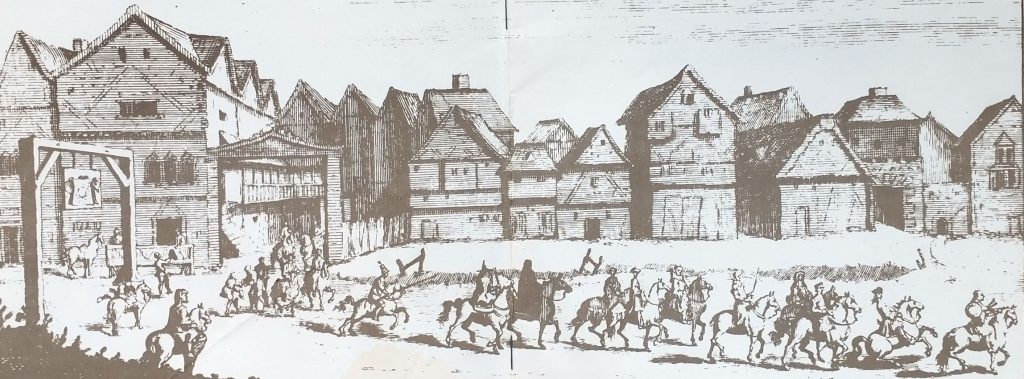
Pilgrims leaving the Tabard for the Canterbury Pilgrimage
Canterbury Pilgrimage
Tonight (April 18th 2026 7.45pm) , I am leading my annual Canterbury Tales Virtual Pilgrimage. This is the day Chaucer’s pilgrims leave London to ride to Canterbury. (For more details or to book look here.) Also, at 11am today i do my Chaucer’s London walk – for details click here.
And I have just realised the above paragraph is wrong! Chaucer mentions it is April 18th in the Man of Law’s Tale which is told on the day they leave Dartford, the second day of the pilgrimage! According to an academic 1387 was the year and the timetable is:
Tuesday 16 April Gather at the Tabard Wednesday 17th April Leave the Tabard early in the Morning. Ride to Dartford Thursday 18th April leave Dartford after 10am which annoys Harry Bailly. Overnight in Rochester Friday 19th April Probably overnight at Ospringe Saturday 20th April travel to Canterbury, Probably overnight in Chequer of Hope, Mercery Lane but this comes from medieval fan fiction as Chaucer doesn’t say much about what happened in Canterbury, But tells of their riotous time in Canterbury.
Dating the Pilgrimage
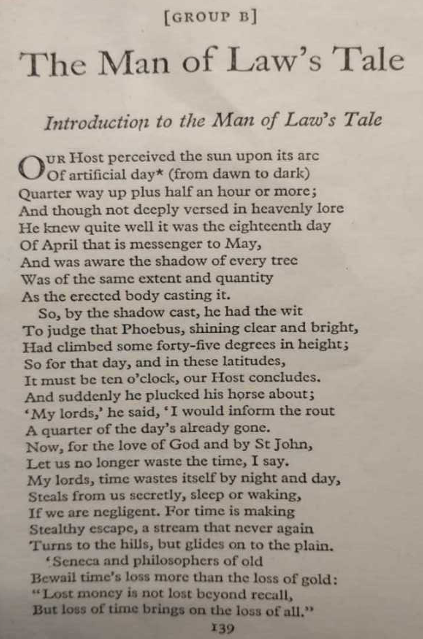
At the beginning of the prologue, Chaucer gives clues as to the date. They go when April showers and Zephyrus’s wind is causing sap to rise in plants, engendering flowers. It is also when Aries course across the sky is half run. The pilgrims are accompanied by Harry Bailly who is the landlord of the Tabard Inn in Southwark. He was a real person and a fellow Member of Parliament of Chaucer. He is jolly and quite knowledgeable. In the Man of Law’s prologue we get a glimpse of Harry time telling in the days before clocks.
Telling the Time
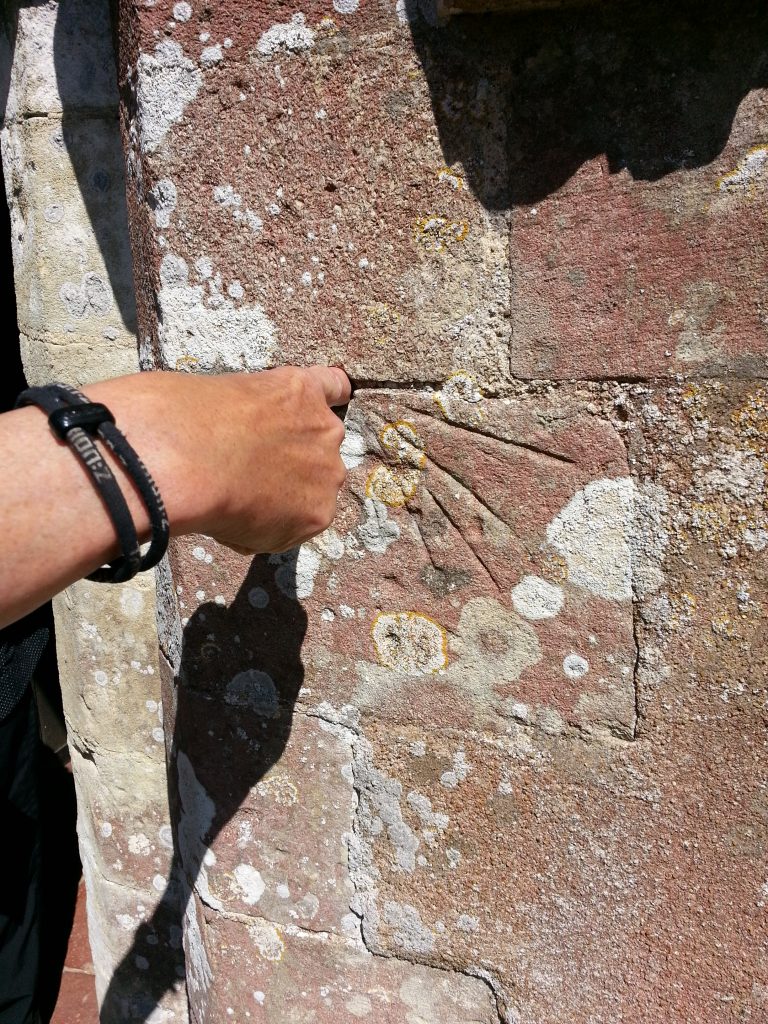
A mass clock (scratch dial) at Steventon Church. Hampshire, Photo K Flude
Chaucer mentions ‘artificial day’ and this is a reference to the way days were divided into hours. There were twelve hours in the daylight part of the day, and twelve hours in the dark night. So in the winter daylight hours were short, and in the summer long.
Romans used water clocks. King Alfred used candles marked into hours. Harry Bailly knows how to tell the time by the height of the Sun. Harry tells the pilgrims it’s about time they got underway. Here is an extract:
Essentially, he is telling the time by the length of the shadows. On April 18th the shadows of trees are equal in length to the tree. Showing that the Sun has climbed 45 degrees and in this latitude it must be 10 o’clock. Time to get going on the Pilgrimage!
Mass Clocks & Time Divisions
The illustration of the mass clock at Jane Austen’s Church at Steventon shows how easy it was to tell the time by the sun. The first mass clock I noticed was at St James’ Cooling in Kent. Dickens used this in Great Expectations, where Pip’s brothers and sisters were buried. Once you find one mass clock, you suddenly discover them everywhere!
Telling the time, before mechanical clocks, was not complicated. The basic unit is the day and the night, and we can all tell when the dawn has broken. The Moon provides another simple unit of time. The month’s orbit around the Earth is roughly every 29 days. The new, the crescents and full moons provide a quartering of the month. For longer units, the Earth orbits around the Sun on a yearly basic. But it is easily divided into four, the winter solstice; the spring equinox, the summer solstice and the autumn equinox.
Nature’s Way of Time Telling
But there were other ways of marking days in the calendar, with natural time markers marked by, for example, migrating birds, lambing, and any number of budding and flowering plants such as snowdrops, daffodils and elm leaves:
When the Elmen leaf is as big as a mouse’s ear, Then to sow barley never fear; When the Elmen leaf is as big as an ox’s eye, Then says I, ‘Hie, boys” Hie!’ When elm leaves are as big as a shilling, Plant, kidney beans, if to plant ’em you’re willing; When elm leaves are as big as a penny, You must plant kidney beans if you mean to have any.’
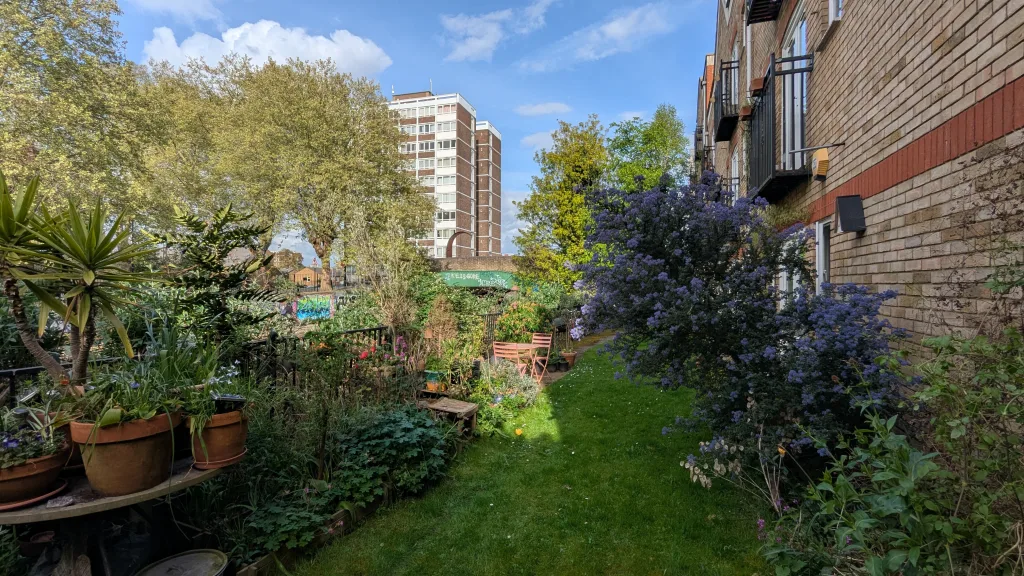
In my north-facing garden, I have my very own solar time marker. All through the winter, the sun never shines directly on my garden. Spring comes appreciably later than the front, which is a sun trap facing south. But on 17th April, just after 12 o’clock the sun peeks over the block of flats to the south of me. It finds a gap between my building and the converted warehouse next door. For a short window of time, a shaft of a sunbeam brings a belated and welcome spring. This for my garden is the real beginning of spring. I took a photo of it this year.
The First Chink of Sun in the year in my Garden. Photo K Flude
New Light on Thomas Becket’s Window at Canterbury
Recent research has revealed the true story behind stained glass windows at Canterbury which had been reassembled wrongly. The story is told here:
On This Day
2026 The Tweed Run is a mass cycle ride around London with everyone dressed in Tweeds. It’s a twelve-mile ride around London (not a run). This year it is starting near Spa Fields, which is near Exmouth Market in Islington. The route is only published on the day of the race. See here for some photos of last year’s run. https://www.tweedrun.com
Magnolia and Cherry blossom in Weymouth Terrace Haggerston London. Photo K Flude
It might already have peaked in London, but there are lots of lovely magnolias still flowering. This year, last week was very hot and plant experts feared it would lead to a brief spring. However, the shirt-sleeve warmth was soon followed by a cold spell, dropping in some places to 0 degrees C. This may have saved the situation and prolonged the spring flowering.
Magnolias, Earnest ‘Chinese’ Wilson, said were the most esteemed of all flowers. He introduced new species from the Himalayas. Magnolias are among the oldest flowers and have their origins in the Cretaceous period. They evolved 100 million years ago before the evolution of bees. So they are pollinated by beetles, which is one reason for the size of the flowers.
The first magnolias to come to Britain were from America. John Banister sent Magnolia Virginiana to Henry Compton Bishop of London, who was also highly involved in the colony in Virginia. Compton sent Banister out as a missionary, but both loved flowers. Banister wrote the first flora of N. America which was included in John Ray‘s Historia Plantarum. Sadly, he was accidently shot while exploring.
Magnolias were named after the French botanist Pierre Magnol (1638-1715) ‘Professor of Botany and Director of the Royal Botanic Garden of Montpellier’. Magnol invented the idea of plant families, which Linnaeus developed.
Herbal uses
Mrs Grieve’s ‘A Modern Herbal’ suggests Magnolia was used for rheumatism and malaria. A warm infusion was thought to be laxative, sudorific (induces ‘sweating so that the sweat runs down the body in rills!’), If cold. If warm was antiperiodic (useful against diseases like malaria which keep coming back) and mildly tonic.
Where to see Magnolias
In London, they can be seen everywhere but Google suggests:
Kensington (Phillimore Gardens, The Boltons), Chelsea (Carlyle Square), and Notting Hill (Lancaster Road). And of course Kensington Gardens and Kew Gardens. My favourites ones are in the roads around my house, often in the most unprepossessing of places.
Magnolias and Camelias in Albion Square, Haggerston,. London. Photo by K Flude
But it is a delight to go to Hidecote the National Trust Property in Mickleton just off the edge of the Cotswolds. In April, it has spectacular magnolias. Unfortunately, I don’t have any good photos except this one which shows all the magnolia petals on the ground!
Hdcote in Magnolia time. Photo K Flude
Ernest ‘Chinese’ Wilson 1876 – 1930
Prunus Serrula, (aka Tibetan Cherry) brought to England by Ernest Wilson. My favourite tree because of its bark which feels like copper. Photo K Flude
He was born in Chipping Camden where there is a lovely memorial garden which contains my favourite tree, and many plants he introduced. He brought back over 2000 species into the West of which 60 are named after him. One of his expeditions took place during the Boxer revolution. So he adopted a native disguise and risked execution.
At 16, he was apprenticed at the Birmingham Botanical Gardens. Then he worked at the Royal Botanic Gardens, Kew. His next adventure was to be hired as the Chinese plant collector with James Veitch & Sons (originally based in Chelsea). He eventually moved to America, where he became keeper of the Arnold Arboretum in Boston. Unfortunately, he and his wife died in a car accident in 1930.
1116 (or 1117) – St Magnus the Martyr Executed. He was executed because of dynastic disputes amongst Vikings in the Orkneys. Magnus lived a pious life refusing, for example, to fight in the Battle of Menai Straits in Wales, and various miracles took place after his death. He is remembered by the Church of St Magnus at the foot of London Bridge in London. But that was, before the 18th Century, thought to be dedicated one or other of the other many St Magnus’s (6). The Church is by Christopher Wren, and very high Church Protestant. On the occasion I visited on his feast day I felt like I was in a Roman Temple.