Of Setting Hens (and Spring Chickens)
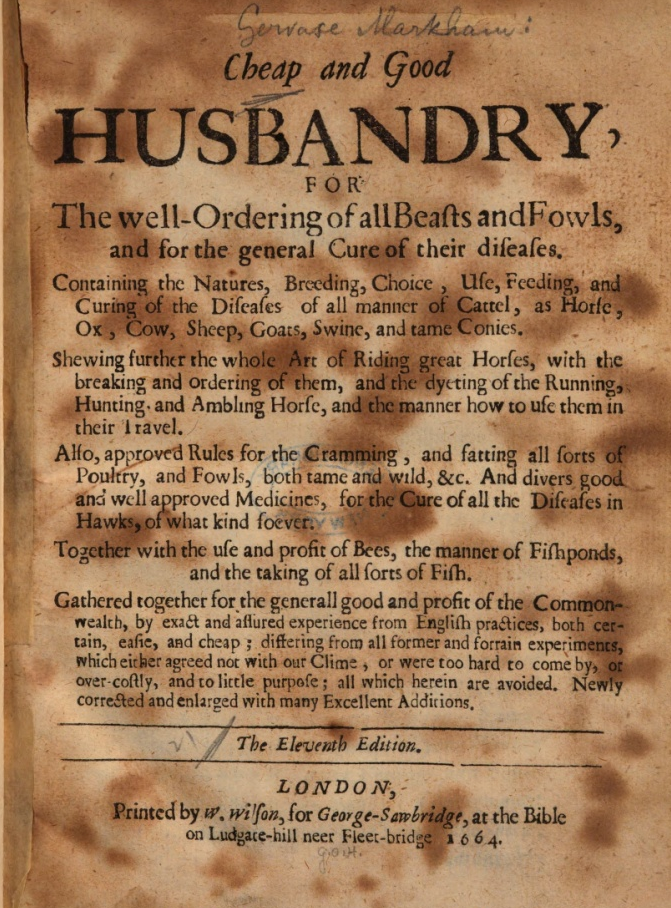
Gervase Markham wrote a heap of farming and horticulture books in the 17th Century. In ‘Cheap and Good Husbandry’ he wrote about ‘Spring Chickens’. Spring Chickens are essentially March Chickens, March Hares and even March Cats are all special. Markham starts by suggesting this is the time to impregnate them for birth in March:
The best time to set Hens to have the best, largest, and most kindly Chickens;, is in February, in the increase of the Moon, so that they may hatch or disclose her Chickens; in the increase of the next new Moon, being in March; for one brood of March Chickens; is worth three broods of any other: You may set Hens from March; till October, and have good Chickens;, but not after by any means, for the Winter is a great enemy to their breeding….
To see more of ‘Cheap and Good Husbandry follow this link.
To read about March Hares, and more on March Chickens, look at my post: https://www.chr.org.uk/anddidthosefeet/march-28th-as-mad-as-a-march-hare/
The expression comes from the 17th Century when Spring/March Chickens were more profitable than old chickens that had gone through the winter. Commonly, it is used in the negative, as in ‘Kevin ain’t no spring chicken.’
Egyptian Book of the Dead goes on display at the Brooklyn Museum
After three years of conservation, the world’s most complete gilded Book of the Dead goes on display at the Brooklyn Museum. Have a look at their post here. The Book of the Dead was prepared to accompany the deceased on their journey in the afterlife. It is full of spells, prayers and incantations. There was no one fixed format, but some are incredibly complex and beautiful. My own feeling is that they confirm my opinion that the Egyptian way of death is totally OCD. There is so much an Egyptian has to do to get a good afterlife. Not only embalming but having models of food, slaves, boats, mummies of dead cats, anything you want to have. It feels like they must have been terrified of death.
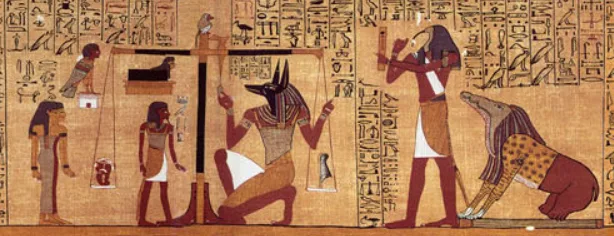
One of the issues is that the deceased had to have their heart weighed against the feather of Truth (belonging to the Goddess of Truth, balance, law, morality, and justice, Maat) . If it was found deficient, the deceased would be eaten by Ammit who has the head of a crocodile, the shoulders of a lion, and the legs of a hippo.
Wikipedia has a tremendous scan of the facsimile of the Papyrus of Ani, it is a 78ft long scroll and wonderful to look at To see it click on the first picture and zoom in and look left and right! https://en.wikipedia.org/wiki/Papyrus_of_Ani.
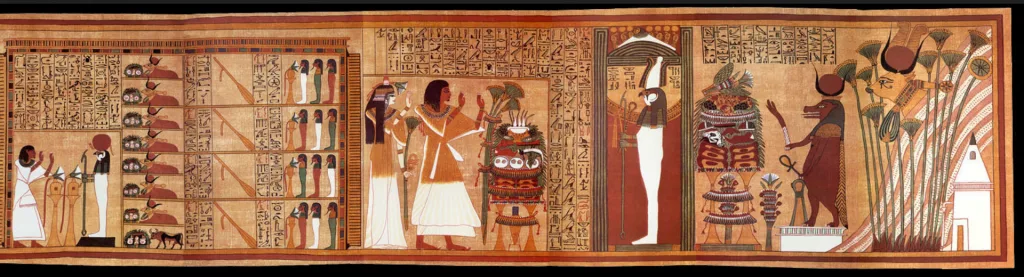
The story of its acquisition is also gob-smacking. Budge acquired in it Luxor in 1888. The Egyptian Police came to investigate the house of the illegal dealers. Budge distracted the police while his people tunnelled into the house from the rear, and retrieved ‘his’purchases. He took them to the British Museum and was paid a gratuity of £150 for them!
On this day
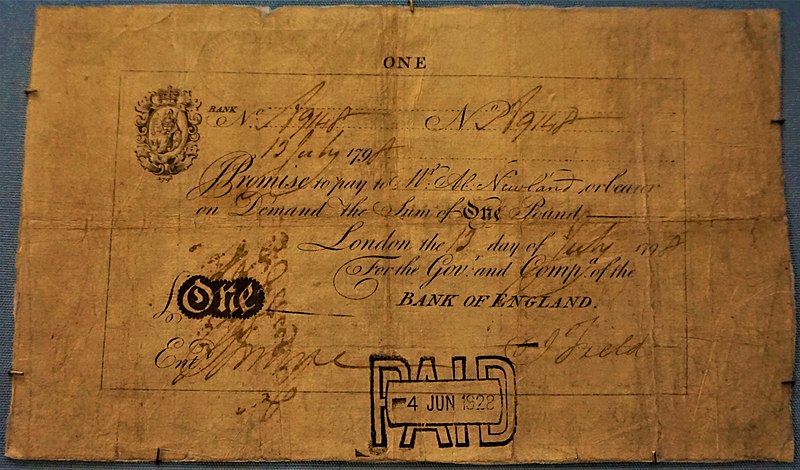
Source Joy_of_Museums Public Domain (CC by sa 4.0)
February 26th 1797 First Pound Note:
The Bank of England issued it’s first ever one pound note (although some sources say March 1797). The Bank had been issuing paper notes since the late 17th Century, but this was the first £1 note. They still had to be signed by hand and allocated to a specific person. The hand signed white paper notes were withdrawn in 1820, and the pound note was, finally, withdrawn in 1988. The £1 in 1797 was worth the equivalent of £157.46 today, so quite a big note! (see here for the calculator.)
1815 – Bonaparte escapes from exile on the island of Elba. War begins all over again.
1995 – Barings Bank collapses after a rogue securities broker Nick Leeson loses $1.4 billion by speculating on futures contracts. Barings is the UK’s oldest investment banking institute,
Pound note first published 2024, Spring Chicken added February 26th 2025 Egyptian book of the Dead added February 26th 2026